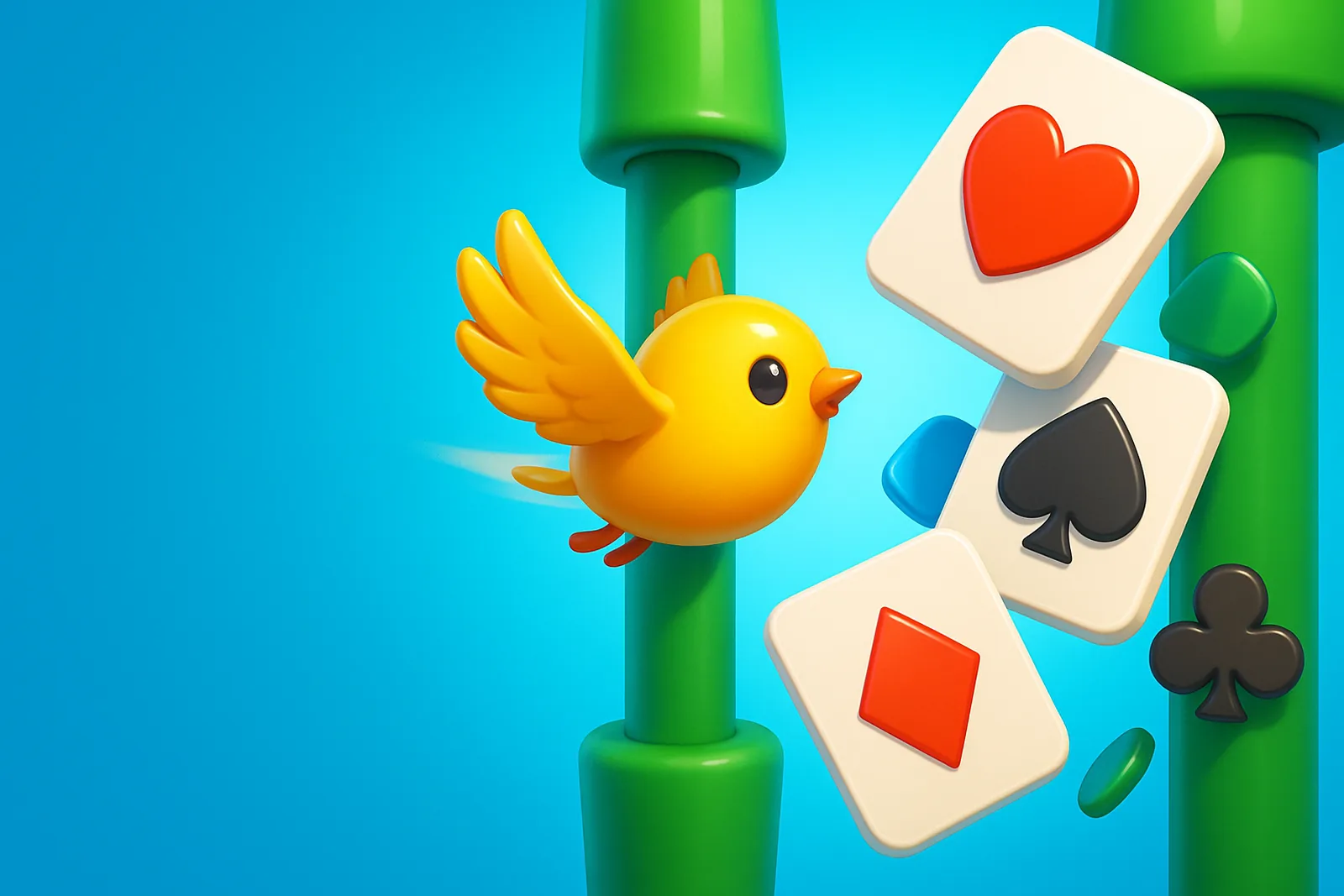
Flight is a free, single-player, one-button game: press to lift, release to fall, pass through each gap, and survive as the space tightens across 5 worlds. One touch with an obstacle ends the run. Your score is the number of gaps you clear.
That is the whole contract, and it is why the game is easy to understand before it becomes hard to play. There are no cards, no board squares, no second player, and no inventory of moves to study. The entire game sits in the distance between your eye and your finger. You see the next opening, judge the bird’s height, then decide whether to tap now, wait half a beat, or do nothing.
Flight sits in the same broad family as a flappy bird game, but the useful thing to know is not the label. It is the rhythm. Every input is small, but every input changes the line you are flying. A good run feels calm for a few seconds, then suddenly too quick, then briefly calm again when you find the timing.
What is Flight, and why does one button matter?
Flight is a one-button game about keeping a bird in the air long enough to pass through narrowing gaps. The single button matters because it removes every excuse except timing. There is no choice of card, no route on a board, no hand management, and no hidden set of commands. You press, or you do not.
The game is single-player. A run is measured by distance through openings, not by beating an opponent. It has no deck and no fixed board size in the card-game sense; the challenge is the moving screen, the bird’s height, and the gap ahead. That makes it closer in feel to a flappy bird game than to Klondike Solitaire (Turn 1) or FreeCell, where the difficulty comes from visible positions and future planning.
One button also makes mistakes very clear. If you hit too early, the bird climbs into danger. Wait too long, and gravity drags the line down. Most games give you several tools to repair a bad choice. Flight does not. A poor tap creates a poor angle, and the next gap asks whether you can recover before the space runs out.
That directness is the appeal. The rule set is tiny; the judgement is not.
How do you start a run and keep the bird in the air?
- Start the run. A run begins with the bird on screen and the first gap ahead. You do not choose a player count, a deck, or a board. It is a single-player flight game, so the first decision is immediate: press the button and set the bird moving on a safe line.
- Use the button as lift. Pressing or tapping makes the bird rise. Releasing lets it fall. The control is deliberately binary, but the result is not. A short tap changes the line a little. A longer press pushes it higher. Doing nothing is also a move, because gravity keeps acting while you wait.
- Read the next gap early. The bird is always moving towards the next opening. You are not aiming at where the bird is now; you are aiming at where it will be when it reaches the gap. That small delay is the main skill in any tap to fly game. New players usually react to the bird. Better runs come from reacting to the gap.
- Keep the line boring. Big climbs and deep drops feel dramatic, but they leave less room for correction. The safer rhythm is made of small taps, short waits, and tiny height changes. The screen may feel fast. Your finger should not panic.
- Accept that each gap is a fresh test. Clearing one opening does not bank safety for the next one. It adds to your score, then the next gap asks the same question with less comfort.
What changes from the meadow to the hollow?
Flight moves through 5 worlds: the meadow, the deep, orbit, the hive, and the hollow. The named worlds give a run a sense of distance. You are not staring at one repeated screen forever; you move from a natural opening, into stranger spaces, and then into the hollow at the far end.
The important mechanical change is the narrowing gap. The game’s pressure does not need a long list of extra rules. Early on, you have more room to be a little high or a little low. Later, the same mistake hits something. That is a clean way to make the game harder, because the button has not changed. Your margin has.
The evidence for hidden rule changes between worlds is thin, so the safest explanation is the practical one: treat each world as the same one-button flight problem with a stricter opening in front of you. If a world feels harder, it is because your correction window is smaller and your timing has to be neater.
That matters for learning. You do not need a new strategy for the deep, orbit, the hive, or the hollow. You need the early rhythm to survive later conditions. The meadow teaches the movement; the hollow tests whether it has become steady.
What ends a game, and how is a score decided?
A game of Flight ends on the first collision. Touch an obstacle and the run is over. There are no turns in the board-game sense, because nothing passes to another player; the turn is the whole run, from the first lift to the first crash.
Scoring is just as plain. Your score is the number of gaps cleared in that run. A clean pass adds to the count. A crash stops the count where it is. There is no separate bonus for style, no card value to total, and no endgame calculation after the fact.
| Moment | What happens | Why it matters |
|---|---|---|
| Press | The bird lifts | You change its height before the next gap |
| Release | The bird falls | You let gravity bring the line down |
| Clear a gap | The run continues | Your score increases by 1 |
| Touch an obstacle | The run ends | The score is fixed at the gaps already cleared |
This is why the first few seconds matter. A messy opening does not lose points by itself, but it puts the bird on a worse line for the next gap. Flight rarely feels unfair when explained this way. The game is severe, not complicated: one touch ends it, and the number on the screen belongs to the gaps you actually passed.
Why do people keep coming back after a quick crash?
People come back because the failure is legible. In a longer game, losing can be muddy. You may wonder whether the bad decision happened 10 moves ago, whether the draw was awkward, or whether you missed a better line. In Flight, the mistake is usually visible. Too high. Too low. Too late. Too much.
That clarity makes a short run feel useful rather than wasted. A crash gives you one precise thing to fix on the next attempt. Tap less sharply before the second gap. Wait longer after a climb. Stop chasing the bird after it has already drifted off line. The lesson is small enough to test immediately.
The other pull is duration. A poor run is over quickly, so starting again does not feel like a commitment. A better run lasts long enough to create tension but not long enough to turn heavy. That makes Flight different from a solitaire game such as Spider Solitaire (4 Suits), where a single decision can sit inside a much larger plan.
There is also the private chase. You are not trying to prove you understand a rulebook. You are trying to make your hand match what your eyes already know. For a simple game, that gap is surprisingly stubborn.
Frequently asked questions
Yes. Flight runs free in the browser on Veena Games, with no account, download, or payment. Open the game page and play. That matters because a crash is not a commitment; it is just the end of a run. You can try again without signing in, saving progress, or managing anything outside the game.
5 worlds carry the run: the meadow, the deep, orbit, the hive, and the hollow. They are not separate games. They are stages in the same one-button test, with the same basic demand each time: keep the bird moving through the gap as the space becomes less forgiving.
The common misconception is that holding the button is safer. The correction is that Flight is about controlled touches, not blind pressure. If you keep forcing the bird one way, you stop reacting to the actual gap in front of you. Good runs come from small corrections made early, before the opening has already slipped past.
In a real Golf Solitaire hand, a waste seven gives you sixes and eights to consider, and a short break can still turn into a chain of card choices. Flight is cleaner for one-minute play: press, dodge, crash, restart. Solitaire gives you more planning. Flight gives you one decision repeated under pressure.
It depends on your input, which means the device and the control you are most accurate with. A keyboard key can feel crisp. A mouse button can feel familiar. A phone tap can feel natural if the screen is responsive. The game does not become a different puzzle; your timing just becomes easier or harder to express.
Compared with Klondike Solitaire (Turn 3), Flight removes hidden-card planning, draw-order memory, and long recovery lines. You do not build foundations or rescue a poor early choice ten moves later. You survive one moving test until you do not. Klondike rewards patience and structure. Flight rewards timing, restraint, and accepting failure fast.
Restart if you still feel sharp. The exception is the tilted run, where you crash and immediately press again harder than before. That is usually when your timing gets worse. Take a breath, look at the first gap, and start clean. A two-second reset often saves you from five careless crashes.
Most people watch the bird too closely. That feels sensible, but it makes the next gap arrive too late. Keep the bird in your peripheral vision and look slightly ahead, where the opening is forming. Flight punishes late decisions more than imperfect ones, so earlier information is worth more than staring at the exact centre of the bird.
A one-button game is a game built around a single active control. In Flight, that means the main skill is not remembering a long list of commands. It is using one action at the right time, with the right restraint. The simplicity is the point: the control is easy, but the judgement is exposed.
Play three runs without caring about score, and spend them watching the gap rather than the crash. Then change one habit at a time: press a little earlier, release a little sooner, or stop overcorrecting after a near miss. Do not try to fix everything in one run. Flight rewards a calmer hand more than a frantic one.
Nobody knows precisely, because Veena Games does not publish an average run length for Flight. The best available figure is the fixed structure: there are five worlds, and a run ends on the first collision. For a new player, think in short attempts rather than sessions. The useful number is how quickly you can restart and learn.
Flappy Bird was released in 2013, and it made the tap-to-stay-alive format familiar to millions of players. Flight sits in that broad family of one-touch obstacle games, but you should judge it on its own details: five worlds, one control, and a narrowing gap. The article does not need to claim a direct line of descent.
The cost of getting it wrong is instant: one touch of the wrong surface ends the run. The biggest mistake is treating every scare as an emergency. Overcorrect once and the next gap becomes harder than it needed to be. Stay small with your inputs. In Flight, panic is usually more dangerous than the obstacle itself.
Final thoughts
If a friend asked whether Flight was worth their time, I would not describe it as relaxing. It is too sharp for that. I would say it is clean. You can understand the rule before the first crash, and you can usually name the reason for the crash before the restart button has finished being annoying.
Readable failure is a rare quality in a small browser game. Many quick games stretch themselves with currencies, upgrades, missions, or daily chores. Flight does not need that furniture. It asks for one action at the right time, then narrows the space until your timing is exposed.
The best way to play is to stop treating the button like an emergency handle. Do less. Tap earlier than panic tells you to. Let the bird fall on purpose when the next opening sits low. If the line becomes wild, the run is probably already borrowing time.
Short games are often dismissed as throwaway, but a good short game leaves a clean mark. Flight does that. One more run is not a grand promise. It is a small argument with your last mistake, and the game is honest enough to make that argument fair.
-
 Blackjack
 Rules, Explained Properly
Blackjack for beginners, explained in the order a first hand happens: deal, turn choices, scoring, dealer rules and what makes a hand end.
14 August 2026
Blackjack
Blackjack Rules, Explained Properly
Blackjack for beginners, explained in the order a first hand happens: deal, turn choices, scoring, dealer rules and what makes a hand end.
14 August 2026
-
 Code-Breaking Games
Bulls and Cows: The Number Game Wordle Descends From
Bulls and Cows is an older 4-digit number guessing game built on the same positional clue idea that made Wordle feel familiar.
14 August 2026
Code-Breaking Games
Bulls and Cows: The Number Game Wordle Descends From
Bulls and Cows is an older 4-digit number guessing game built on the same positional clue idea that made Wordle feel familiar.
14 August 2026
-
 CloseWord
: The Word Game About Meaning, Not Spelling
CloseWord is a semantic word game where each guess is judged by meaning, so you solve the hidden word by chasing closeness rather than spelling.
14 August 2026
CloseWord
CloseWord: The Word Game About Meaning, Not Spelling
CloseWord is a semantic word game where each guess is judged by meaning, so you solve the hidden word by chasing closeness rather than spelling.
14 August 2026