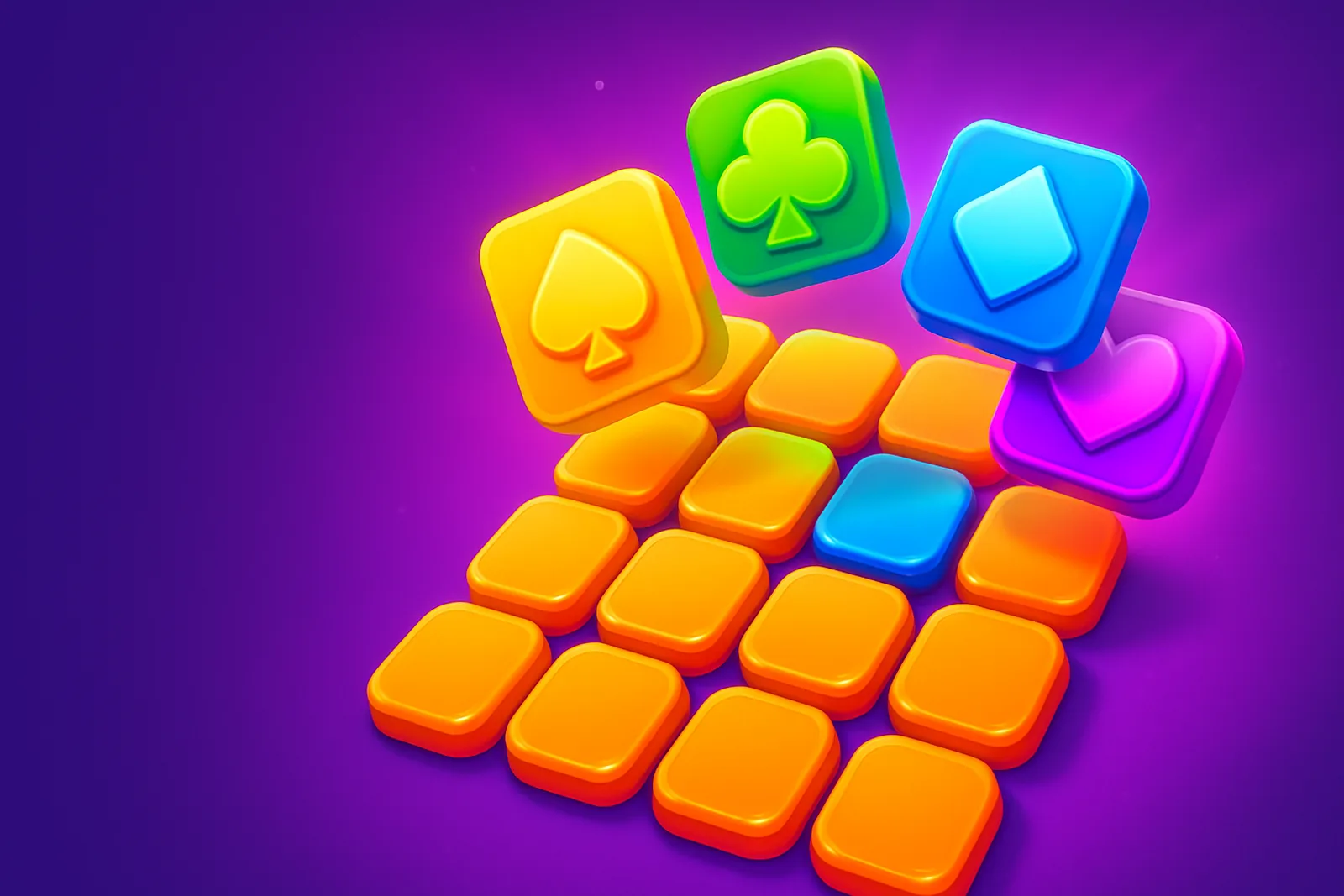
Connect is a one-player word puzzle: 16 words are shown, and your job is to sort them into four hidden groups of four. If you came for classic connect four rules with counters and a vertical grid, this is a different game with a similar promise: find four that belong together.
The board is small enough to look harmless. That is part of the trick. Every word belongs to exactly one group, but several are written to tempt you towards the wrong set. A word may be a colour, a surname, a verb, a place, a brand, or part of a phrase. The first answer you see is often too broad.
Your first game starts with the board: 16 words, four hidden groups, and one legal move at a time. You read the board, choose exactly four words, submit them as a set, then work with what remains. The game ends when all four groups are found. The scoring is not about running up points. The result that matters is whether you find all four groups without losing the thread.
What is Connect, in plain terms?
Connect is a compact sorting puzzle. You are given 16 words, and behind them are four hidden groups. Each group contains four words. Every word has one correct home, even when it appears to fit somewhere else.
That last point is the whole game. If the board showed APPLE, PEAR, PLUM, and ORANGE, the link would feel immediate. Real boards are less obedient. A word might look like fruit, then turn out to be a technology company, a shade of colour, or part of a common expression. Four in a row here means four words that share the same concealed rule, not four counters lined up on a physical board.
The game is for 1 player. There is no opponent taking discs, blocking columns, or racing you to a row. The resistance comes from the board itself: 16 short words, several plausible patterns, and only four final answers.
The clean version of how to play Connect is this: inspect the words, choose exactly four that you believe form a group, submit them, then use the remaining words to find the next group. A solved board has all four groups found. The core score is binary rather than arithmetic: the board is solved, or it is not.
How do you set up the four groups without spoiling the game?
As a player, you do not need to set up the answer. The board arrives with 16 words already chosen, and the four hidden groups are already built into it. Your only setup job is mental: read the whole board before touching anything.
That matters because the first visible connection is rarely safe on its own. If you see three words that plainly belong together, hunt for the fourth before you commit. Then ask a sharper question: could one of those words belong to another group instead? Connect boards are designed around overlap. A fair board does not require private knowledge, but it does expect you to notice double meanings.
If you are making a board for someone else, the setup is stricter. Pick four separate answers first. Each answer needs exactly four words. Then check every word against the other three answers. A weak board has accidental fifth members, near-duplicates, or a word that only fits because the setter has a very private association.
Keep the category labels hidden. Do not sort the words on the screen by group. A useful layout mixes them so the player cannot solve by position. The board size stays fixed: 16 words, four groups, four words per group. Change that ratio and you are playing a different puzzle.
What happens on your turn, and what counts as a legal move?
- Read all 16 words before choosing. A turn starts with looking, not clicking. The board is small, so take the advantage it gives you. Scan for meanings, sounds, spellings, phrases, names, and categories that might contain exactly four members.
- Form one proposed group. A legal move contains exactly four words. Three is only a suspicion. Five is proof that the idea is too broad, or that one of the words belongs somewhere else.
- Use only words still in play. Once a group has been accepted, those words are no longer candidates for later groups. The remaining board becomes simpler, but it can also become more deceptive because your earlier mistake may have removed the clue you needed.
- Submit the four together. Thinking of a group is not a move until you commit the selection. The game can then judge the set as a single answer. One wrong word makes the proposed group wrong, even if the other three are perfect.
- Carry information forward. A rejected idea is not wasted. It tells you that the connection was false, incomplete, or contaminated by a decoy. Write the idea off only after checking which word was doing too much work.
- Repeat until the board ends. Each accepted group reduces the live board by four words. With 16 words at the start, you are looking for four successful submissions in total.
How do you win, and what usually goes wrong first?
You win Connect by finding all four hidden groups of four. The game ends when the 16 words have been correctly divided into those four groups. There is no capture, no hand management, and no second player to beat. The win condition is complete classification.
The common first failure is choosing a category that is true but not exact. Four words may all be animals, for example, while the intended group is more specific: animals in idioms, animals in company names, or animals that can follow another word. Broad truth is dangerous. The answer has to explain why these four belong together and why the other 12 do not.
- The three-and-a-decoy trap: three words clearly match, and a fourth merely looks convenient.
- The famous-name trap: a surname, place, or title pulls attention away from its ordinary meaning.
- The spelling trap: words share letters or endings, but the real grouping is about meaning.
- The leftover trap: after solving two groups, you force the remaining eight into pairs of four without rechecking the original clues.
Scoring in the plain rules is not a points race. A board is solved when every word is in its correct group. If an interface also tracks mistakes or streaks, treat that as a layer on top of the core rule, not the object of the puzzle.
A good final check is simple: name the group before submitting it. If you can only say “these feel connected”, wait. The best answers usually have a crisp label, even if the board never asks you to type it.
Why play another round after you’ve solved one board?
A solved Connect board gives a neat little click in the mind, but it does not exhaust the game. The next board can use the same 16-word structure and still ask for a different kind of attention. One may turn on word meanings. Another may depend on phrases. Another may hide the easiest group in plain sight because the tempting group is louder.
That repeatability comes from constraint. Four groups of four is tight enough to be learnable, yet wide enough for misdirection. You begin to build habits: look for exactness, distrust the first broad category, keep possible meanings alive, and avoid spending all your faith on one clever theory.
It also has a different rhythm from solitaire games such as FreeCell or Klondike Solitaire (Turn 1). Those games stretch over moves, positions, and consequences. Connect compresses the pleasure into recognition. You are not managing a tableau for ten minutes; you are testing whether four words share one clean reason to sit together.
That makes another round easy to justify. Not because there is a grind to feed. Because the next set of words may catch a different blind spot, and finding that blind spot is half the pleasure.
Frequently asked questions
Yes. Connect runs in your browser on Veena Games, so you can open it, play a board, and leave without a sign-up, download or payment. That matters because the puzzle works best as a quick round: sixteen words, four groups, no ceremony around the actual thinking.
4 words make one group, and there are 4 groups on the board. The number is fixed, which is why half-right sets are so dangerous. Three obvious words do not prove the fourth. You need the exact quartet, because every word belongs somewhere and the leftover words still have to make sense.
The common misconception is that every group is a neat subject, such as fruit, colours or capitals. The correction is that a group can also depend on spelling, sound, phrases, prefixes, suffixes or another shared feature. Treat meaning as your first check, not your only check.
In a Klondike Solitaire (Turn 1) hand, a black 7 can be useful in two places: on a red 8 now, or uncovered later for a better sequence. Connect has the same kind of temptation. A word may suggest music and fish, but only one four-word set will fit the whole board.
It depends on the fourth word: if you can explain why all 4 share one exact feature, submit; if you are choosing the least bad leftover, wait. Three-word confidence is often a trap because the puzzle is built to make several partial sets look plausible.
Compared with FreeCell, Connect asks for pattern judgement rather than move ordering, but the useful habit is similar: do not spend your best option too early. In both games, a tempting move can block a better one. Good Connect play often means holding back until the whole board supports the choice.
Solve any group you can prove. The exception is when an obvious set would leave four awkward leftovers that share no reason; then pause and test the leftovers before committing. Connect does not reward solving a category first because it looks neat. It rewards keeping all sixteen words accountable.
Most people lock in the first attractive group and never check what it does to the rest of the board. The fix is simple but slightly slower: before submitting, ask whether the remaining 12 words can still split into 3 believable groups. If they cannot, your neat group is probably stealing a word.
A red herring is a word or cluster that appears to point at a group but does not complete the correct set. It is not a trick for its own sake. It exists because many words have more than one association, and the puzzle only works if you test the exact reason shared by all 4 words.
Sort the words into rough piles, then attack the piles that are too large. If 6 words look like sports terms, do not stare at the board hoping for clarity. Name the shared feature out loud, remove any word that does not fit it exactly, and see which 4 survive that test.
Nobody knows precisely, because the answer depends on the word list, the allowed clue styles and how the boards are generated. A useful fixed figure is this: for any given set of 16 distinct words, there are 2,627,625 ways to split them into four unlabelled groups of 4.
Classification puzzles long pre-date browser games: puzzle books and newspaper pages used odd-one-out, word families and shared-property clues before web play made them instant. Connect packages that old idea into a tight browser format. The modern pleasure is speed and reset, not a new human skill.
The cost of getting it wrong is that you spend your attention defending a false pattern. Even if the board is still playable, the bad guess can make the remaining words feel random because you have mentally removed a word they needed. Reset your assumptions, not just the selected tiles.
Final thoughts
The best way to get better is to slow down at the exact moment you feel certain. Certainty arrives early in Connect because the board is small and words are familiar. That feeling is useful, but it is not evidence yet.
Before you submit, make the group prove itself. Can you give it a name? Does the name fit all four words equally? Are there any other words on the board that could claim the same label? If the answer has a loose edge, leave it alone for a minute and inspect another part of the board.
Do not be embarrassed by wrong first ideas. They are often close to the intended answer. The skill is in noticing which part of the idea was sound and which part was lazy. Three correct words and one passenger is not failure; it is the board telling you where the disguise sits.
Connect rewards tidy thinking, but not rigid thinking. Hold two meanings for the same word. Let a word be ordinary before you make it clever. If you solve a group, read the leftovers as a fresh board rather than a rubbish pile. Four words are waiting to become obvious. They usually do, just after you stop trying to make the wrong four behave.
-
 Roulette
American Roulette Rules: The Double-Zero Wheel
American Roulette uses a 38-pocket double-zero wheel, making its rules familiar but its odds sharper than European roulette.
18 August 2026
Roulette
American Roulette Rules: The Double-Zero Wheel
American Roulette uses a 38-pocket double-zero wheel, making its rules familiar but its odds sharper than European roulette.
18 August 2026
-
 Blackjack
Atlantic City Blackjack Rules: The Player-Friendly Package
Atlantic City Blackjack is an eight-deck blackjack variant with dealer stand on soft 17 and late surrender on poor starting hands.
18 August 2026
Blackjack
Atlantic City Blackjack Rules: The Player-Friendly Package
Atlantic City Blackjack is an eight-deck blackjack variant with dealer stand on soft 17 and late surrender on poor starting hands.
18 August 2026
-
Blackjack
Atlantic City Blackjack: What the Extra Rules Give Back
Atlantic City Blackjack is a low-edge surrender game when played correctly, but the quoted number only works under the right rules.
18 August 2026