No. Wordle is better for a quick daily word puzzle; Mastermind is better for pure deduction you can play again straight away. They share a feedback loop, but the skills are not the same.
People compare them for a good reason. In both games you make a guess, receive partial information, then use that information to reduce the remaining possibilities. Wordle marks letters as right place, wrong place, or absent. Mastermind marks colours as right place, wrong place, or absent from the code. The shared part is the feedback loop.
The difference is what sits on top of that skeleton. Wordle asks you to think like a reader of English: common letters, word shapes, duplicate letters, spelling patterns, and the hidden answer list all matter. Mastermind removes language. Four pegs, six colours, 1,296 possible codes, ten guesses. If you enjoy the logic of Wordle but dislike arguing with vocabulary, Mastermind is the cleaner game.
Are Mastermind and Wordle really the same game in disguise?
Mastermind and Wordle are cousins, not twins. The shortest honest answer to wordle vs mastermind is this: Wordle turns deduction into a word hunt, while Mastermind keeps deduction exposed.
Both games run on the same useful rhythm. You propose a complete answer. The game does not say yes or no; it gives structured feedback. You then use that feedback to make a better proposal. A bad guess can still be useful if it tests enough possibilities. A lucky guess can be wasteful if it teaches you little.
Wordle adds language to that rhythm. You cannot play any five-letter pattern you fancy; you must play accepted words. That makes Wordle more charming and more social, because people know what a good word looks like before they know the answer. It also makes the game less pure. Your knowledge of English, common letter positions, vowel habits, and obscure allowable guesses changes the difficulty.
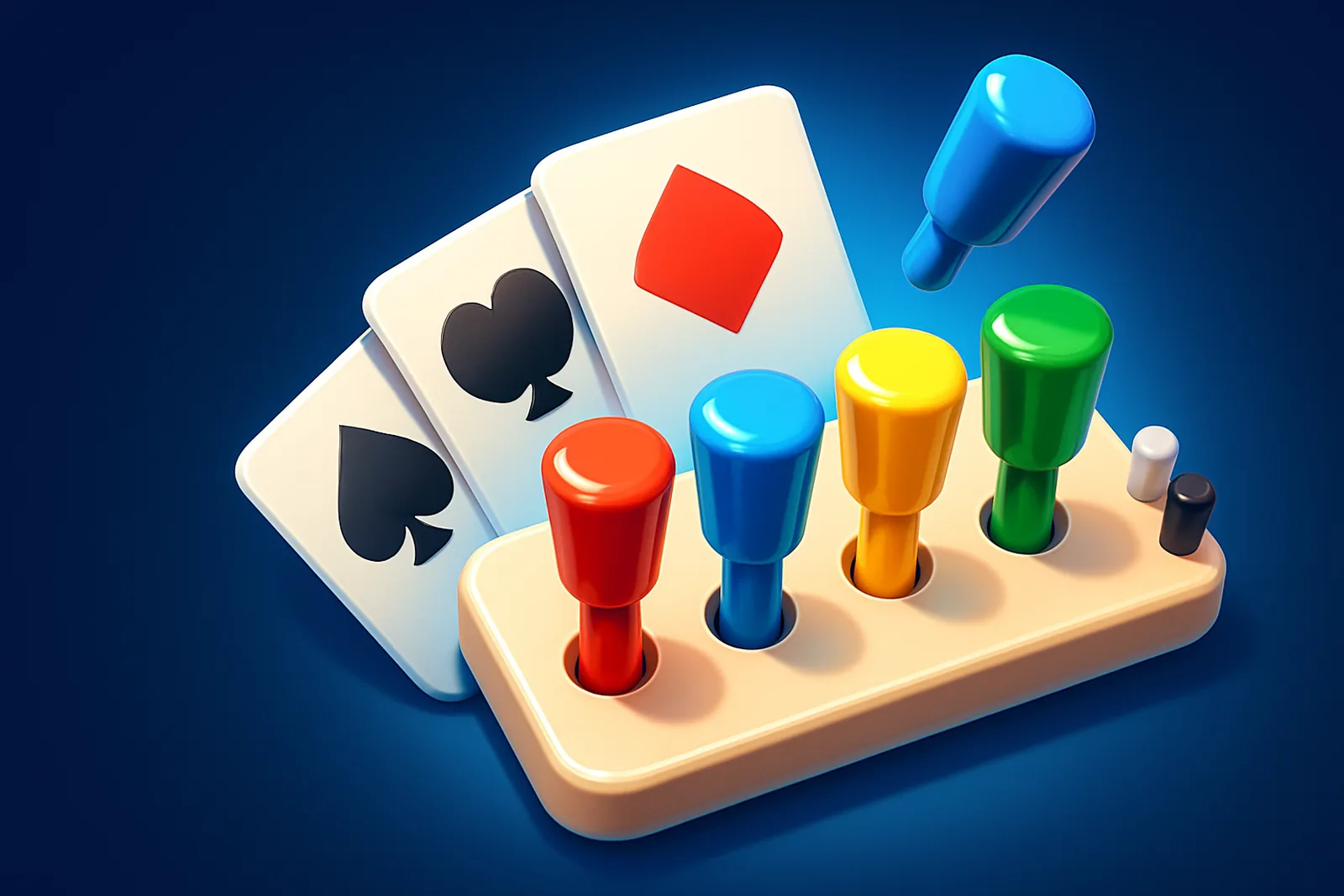
Mastermind strips those extras away. In the Veena Games version, a code is four pegs chosen from six colours, giving 1,296 possible codes. The feedback tells you how many pegs are correct in both colour and position, and how many are correct colours in the wrong positions. No dictionary intervenes. No word feels unfair because you have never seen it.
If you hit a wall in Wordle, the next useful move may be a word you would never normally use. In Mastermind, the next useful move can be any four-peg test the feedback allows.
Which one should you play if you want a quick daily puzzle?
For a quick daily puzzle, pick Wordle. It is built around one shared answer and a small daily habit. Pick Mastermind when you want the same deduction pressure without waiting for tomorrow.
| Decision point | Wordle | Mastermind |
|---|---|---|
| Best use | One short word puzzle a day, especially if you like comparing results with other people. | Several deduction puzzles in a row, with each code independent of the last. |
| Main skill | Vocabulary, letter frequency, spelling patterns, and logical elimination. | Logical elimination from exact feedback about colours and positions. |
| Guess limit | Six guesses for a five-letter word. | Ten guesses for a four-peg code in the Veena Games version. |
| Source of frustration | An answer can feel awkward if the word is rare, oddly spelt, or outside your usual vocabulary. | Mistakes usually come from misreading the feedback or failing to track possibilities. |
| Replay value in one sitting | Low if you want the standard daily format. | High, because a new hidden code can be generated immediately. |
| Play this if | You want a neat daily word ritual with a shared cultural answer. | You want deduction without word knowledge deciding the result. |
If the question is only speed, Wordle wins. If the question is control over the puzzle, Mastermind wins. One answer a day is Wordle's strength; a fresh code straight away is Mastermind's.
Why does Mastermind feel fairer when you want pure deduction?
Mastermind feels fairer because every legal code is made from the same small set of parts. Six colours. Four positions. Clear feedback after each guess. The game does not care whether you know a word, remember a spelling, or guess what a puzzle editor considers acceptable.
- The search space is explicit. There are 1,296 possible four-peg codes in this version, because each of the four positions can take one of six colours.
- The feedback is mechanical. A peg is either the right colour in the right place, the right colour in the wrong place, or not part of the code count.
- Every guess can be purposeful. You can test repeated colours, split the board, or confirm a position without needing the result to form a word.
- Accessibility is better than colour alone. Each peg is lettered, so players are not forced to rely only on colour differences.
Wordle is fair within its own rules, but it carries more hidden texture. Some guesses are legal; some are not. Some answers are common; some feel specialist. Duplicate letters can be elegant, but they also trip people who understand the feedback in principle. Mastermind has no such layer. If you lose, the board usually tells you why.
What should you play if you like Wordle but want more control?
- Play Mastermind when you want the Wordle feeling without the dictionary. You still get the pleasing loop of guess, feedback, rethink, but you decide what information to test. No guess is rejected for failing to be a word.
- Play Mastermind when you want more than one puzzle. Wordle is strongest as a daily appointment. Mastermind is stronger when you have ten minutes and want to keep going until your brain is warm.
- Play Mastermind when repeated symbols interest you. Repeated colours are part of the problem space, and they force careful counting. The best guesses often test structure rather than chase a likely answer.
- Play Mastermind when you dislike cultural knowledge in logic games. Wordle rewards familiarity with English. That can be fun. It can also make a puzzle feel less like deduction and more like having seen the right word before.
- Play Wordle when the ritual matters more than control. One answer, one day, one little result to compare. That is its great strength, and Mastermind should not pretend to replace it.
- Play Mastermind if you want improvement you can feel. Better tracking, sharper test guesses, and fewer wasted turns show up quickly because the rules stay bare.
Where do other games like Wordle fit, and which one is the real wordle predecessor?
Most games like Wordle borrow the same basic pleasure: make a guess, receive limited feedback, narrow the answer. The theme changes. The thinking pattern stays recognisable.
If you mean the closest famous wordle predecessor in spirit, Mastermind is the obvious answer. It predates Wordle by decades and uses the same core idea of hidden code plus positional feedback. Replace colours with letters, add a dictionary, and restrict the answer to one daily word; the family line is easy to see.
If you mean the older underlying idea, the answer is less tidy. Bulls and Cows is an older number-and-feedback game where a guess tells you which digits are correct and which are in the right places. The evidence for one single parent of Wordle is thin, because this style of deduction has appeared in several forms. Still, Bulls and Cows is a better answer for the deep ancestor, while Mastermind is the better answer for the widely recognised commercial predecessor.
On Veena Games, Bulls and Cows and 5-Digit Bulls and Cows sit closer to Wordle if you enjoy exact-position feedback with symbols that are not words. Super Mastermind moves the other way, making the colour-code challenge larger. Pick the branch by what you want removed: words, colours, or the daily limit.
Frequently asked questions
No. Mastermind and Wordle share the same broad idea: guess, read feedback, reduce the possibilities. The difference is the material. Wordle tests vocabulary, spelling patterns, and letter frequency. Mastermind strips that away and gives you colours, positions, and exact feedback. If you want the clean deduction underneath Wordle, Mastermind is closer to the bare machine.
1,296 possible codes exist in the standard Veena Games version: four pegs, six possible colours, and repeats allowed. That is small enough to reason about, but large enough that guessing blindly is hopeless. Ten guesses gives you room to test ideas, correct them, and still finish without needing a perfect opening every time.
The common misconception is that green, yellow, and grey are just Wordle names for Mastermind feedback. The correction is that Wordle ties those clues to letters and valid words. Mastermind feedback is about position and colour only. There is no dictionary, no awkward plural, no rare vowel pattern, and no argument about whether a word should count.
If the hidden code is ABCA and your guess is AABC, the first A is in the right place. The other A, B, and C are all in the code but in the wrong places, so the feedback is 1 exact match and 3 colour-only matches. That single result tells you a lot, but it does not tell you which peg caused which part of the clue.
It depends on what you find hard: words or logic. A strong Wordle player may dislike Mastermind at first because there are no familiar word shapes to lean on. A strong logic player may find Wordle messier because English spelling keeps intruding. Mastermind is usually easier to analyse after a mistake, because the clue system is smaller and more consistent.
Compared with Bulls and Cows, Mastermind is the more visual cousin. Bulls and Cows uses digits and gives feedback for exact and misplaced matches, which makes it structurally very close to Mastermind. Wordle adds the word layer on top of that pattern. If you like Wordle’s feedback but not its vocabulary traps, Bulls and Cows is worth trying too.
Use a first guess that gives information; the exception is when you are playing casually and want variety. A repeated opener can help you learn what different feedback patterns mean, especially while you are new. Once you understand the clue system, changing the opener is fine. The important part is not the first guess alone, but how sharply you use the reply.
Most people chase the right colours too early. They get a clue showing that some colours are present, then start moving them around without first checking which colours are absent or duplicated. Mastermind rewards controlled tests. A dull-looking guess that proves two colours impossible can be stronger than a dramatic guess that happens to share three colours with the answer.
A black peg is feedback for one peg that has the right colour in the right position. A white peg, in the usual board-game language, means the right colour is present but in the wrong position. Veena Games also letters every peg, so colour is never the only clue. That helps when colours look similar on your screen.
Start with one guess that uses a small set of colours, then treat the reply as a fact, not a hint. Write down what must be true: which colours are present, which might be repeated, and which positions are blocked. Do not guess for luck on move two. Use it to test the most useful uncertainty left by move one.
Nobody knows precisely for the current live Wordle list, because it has been maintained and adjusted since the original version. The best available figure for the original public Wordle answer list is 2,315 solution words. Mastermind’s standard four-from-six code space is fixed at 1,296. The useful difference is that Mastermind’s set is completely visible from the rules.
Mastermind was sold as a commercial board game in the 1970s, decades before Wordle appeared in 2021. The older paper-and-pencil game Bulls and Cows predates Mastermind and uses a similar exact-versus-misplaced clue idea with digits. Wordle did not invent that feedback pattern; it made it daily, social, and word-shaped.
Final thoughts
If a friend asked after all this, I would tell them to keep Wordle for the cup-of-tea moment and play Mastermind when they actually want to think. Wordle is excellent because it is small, finite, and shared. You get one puzzle, then you leave. That restraint is part of the charm.
Mastermind scratches a different itch. It lets you make ugly, useful guesses. It lets you test a theory without caring whether the guess looks elegant. You can sacrifice a turn to learn something precise. That is satisfying in a way Wordle cannot always be, because Wordle has to remain a word game first.
The strongest reason to choose Mastermind is not that it is older or purer, though both points matter. It is that your mistakes are usually legible. You can look back at the board and see the moment you ignored a clue, overtrusted a colour, or failed to test a repeat. That makes improvement feel concrete.
Give Wordle the morning slot. Open Mastermind when one puzzle is not enough and you want the board to show exactly what your last guess proved.
-
 Code-Breaking Games
Five-Digit Bulls and Cows: How Much Harder Is One More Digit?
5-Digit Bulls and Cows is hard because the fifth distinct digit multiplies the possible secret codes by 6 before the first guess.
18 August 2026
Code-Breaking Games
Five-Digit Bulls and Cows: How Much Harder Is One More Digit?
5-Digit Bulls and Cows is hard because the fifth distinct digit multiplies the possible secret codes by 6 before the first guess.
18 August 2026
-
 Code-Breaking Games
Bulls and Cows: The Number Game Wordle Descends From
Bulls and Cows is an older 4-digit number guessing game built on the same positional clue idea that made Wordle feel familiar.
14 August 2026
Code-Breaking Games
Bulls and Cows: The Number Game Wordle Descends From
Bulls and Cows is an older 4-digit number guessing game built on the same positional clue idea that made Wordle feel familiar.
14 August 2026
-
Code-Breaking Games
Mastermind Rules: Crack the Code in Ten Guesses
Mastermind is a code breaking game where a hidden four-peg pattern is solved by reading clues after each guess.
14 August 2026