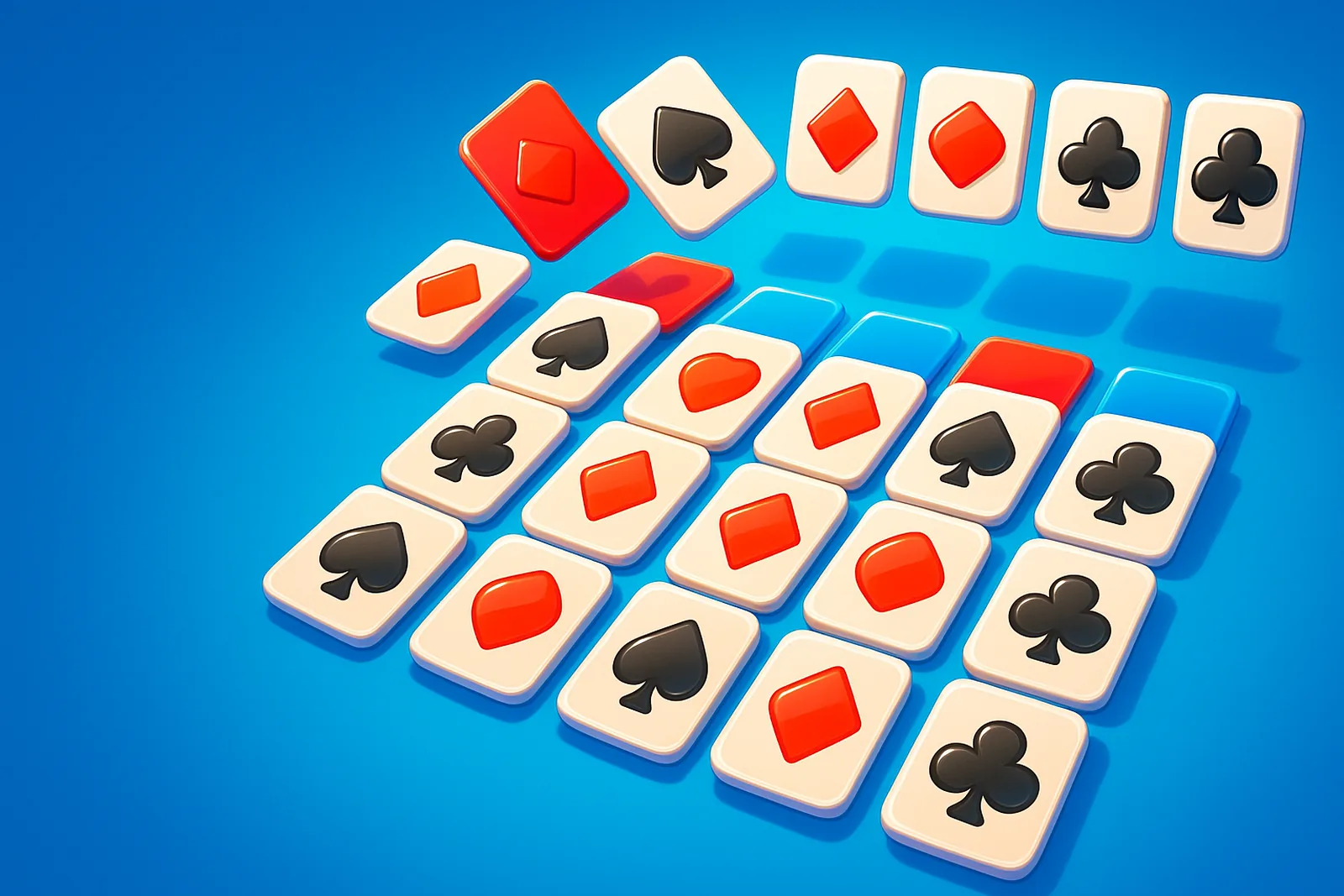
FreeCell 11982 is famous because it is the classic unwinnable numbered deal. Under Microsoft-style FreeCell deal numbering, exhaustive solver work has treated 11982 as impossible, not merely awkward, unlucky, or a puzzle that needs one clever waiting move.
That matters because FreeCell normally rewards patience. Every card is visible. There is no draw pile hiding a rescuer. If you lose, you can usually point to the move where you spent a free cell too early, buried a low card, or built a tidy-looking column that later blocked a suit. Deal 11982 breaks that comforting rule.
It also attracts the phrase hardest FreeCell deal, though that is slightly misleading. A hardest deal can still have a solution. An unsolvable FreeCell deal does not. The interest of 11982 is colder than difficulty: the position has been searched so thoroughly that the question changes from “what did I miss?” to “why can no legal sequence get out?”
Why is FreeCell deal 11982 called impossible?
FreeCell deal 11982 is called impossible because it belongs to the Microsoft deal-numbering tradition and has been tested by exhaustive FreeCell solvers, not because players gave up after a few ugly starts. In that numbering system, 11982 is the famous exception: the deal that refuses to yield even though almost every ordinary FreeCell deal can be won.
The word impossible needs care. It does not mean “I could not solve it before tea.” It means that, given the normal FreeCell rules, every legal branch from the starting position eventually dies. Four free cells are available. Empty columns can be used. Cards may move to foundations in suit from ace to king. Cards build down in alternating colours on the tableau. Within those rules, the search does not find a route through.
This is why FreeCell 11982 still gets discussed. Its reputation rests on solver evidence and on its place in early FreeCell culture, where the first 32,000 Microsoft deals became a shared reference set. Hard deals usually produce two camps: people who solved them and people who think they are broken. Deal 11982 is different.
Calling it the hardest FreeCell deal is understandable, but not exact. “Hardest” suggests a finish line exists and is merely far away. 11982 is better described as an unsolvable FreeCell deal. If the position is generated correctly, the point is not to find the hidden trick. The point is that the normal tricks all run out of space.
What does the opening position actually look like?
The concrete position is the Microsoft-compatible deal numbered 11982. The Microsoft-compatible qualification matters. FreeCell numbers are not universal across every website, app, and solver. If a program uses a different shuffling algorithm, typing “11982” may give you a completely different board, and any claim about impossibility no longer applies.
In the recognised version, the opening has the normal FreeCell shape: 8 tableau columns, 4 free cells, 4 foundations, 52 visible cards, no stock, no waste, and no hidden information. The first 4 columns contain 7 cards each. The last 4 columns contain 6 cards each. All free cells and foundations start empty.
| Part of the position | What you should see | Why it matters |
|---|---|---|
| Free cells | 4 empty spaces | They are the only temporary parking spaces at the start. |
| Foundations | 4 empty piles | No suit has begun; every ace must be released from the tableau. |
| Tableau width | 8 columns | The deal is judged under standard FreeCell, not Eight Off or Baker's Game. |
| Column lengths | 7, 7, 7, 7, 6, 6, 6, 6 | This is the standard deal pattern used by Microsoft-style FreeCell. |
| Information | All 52 cards visible from move 1 | There is no hidden draw that can change the result later. |
The awkwardness is not one dramatic buried king. It is a shortage pattern. Low cards needed for foundations cannot be freed in an order that also keeps enough manoeuvring room, and the apparently useful moves consume the same few spaces needed for the next release. That is the recurring 11982 pattern: every sensible start asks for one more empty cell than the rules give you.
Is 11982 truly unsolvable, or just brutally hard?
For the Microsoft-numbered deal, 11982 is treated as truly unsolvable. The evidence is computational rather than romantic: solvers can enumerate legal move sequences, prune repeated positions, and prove that the search tree contains no winning line. That is stronger than a long list of human failures.
The distinction is whether a winning line exists. A brutally hard deal has a solution path that is narrow, unattractive, and easy to miss. It may require delaying foundations, refusing obvious builds, or using an empty column for a single tempo move. A solver eventually finds the path, and a patient player can study it afterwards.
An unsolvable FreeCell deal has no such path. You can play beautifully and still reach a dead end because the dead end is baked into the starting arrangement. Deal 11982 is famous for sitting on that side of the line.
The evidence is strong for the named Microsoft deal. The evidence is thin for screenshots, copied grids, and random “11982” boards on sites that do not state their deal generator. If your board differs from the Microsoft-compatible deal, you are no longer testing the same claim. You may be playing a hard deal, an easy deal, or another unsolved-looking mess. The number alone is only meaningful when the numbering system is the same.
What should you try if you want to beat this deal anyway?
- First, verify the deal source. Make sure you are using Microsoft-compatible FreeCell deal 11982. If the generator is different, your result proves nothing about the famous position. This is the most common way people “solve” it by accident.
- Play as if space is the whole puzzle. Do not spend free cells just to make tidy alternating runs. In hard FreeCell, a pretty column can be a trap. In 11982, the shortage of temporary space is the central problem.
- Track the aces and twos. A foundation cannot begin until its ace is free, and it cannot grow unless the matching two and three can follow. If freeing one low card buries another, write that down. The failure pattern becomes clearer.
- Refuse automatic foundation moves for a while. Most FreeCell players learn to send safe cards up quickly. On extreme deals, a card on the foundation can no longer serve as a tableau stepping stone. This probably will not save 11982, but it is the right discipline to test.
- Use empty columns as precision tools. An empty column is more valuable than a free cell because it can hold a whole descending run, depending on available space. Spending one too early usually shortens the game.
- Keep a dead-end log. If every line collapses after the same blocker, you are seeing why the deal has its reputation. That is more useful than restarting 20 times and hoping for a different board.
Which nearby FreeCell games scratch the same itch?
If 11982 interests you, you probably like open-information card puzzles where the loss feels earned. These games sit close to FreeCell, but each changes the pressure in a different way.
| Game | Main rule pressure | Best reason to play it after 11982 | What feels different |
|---|---|---|---|
| FreeCell | 4 open cells and 8 tableau columns | The clean standard for testing planning and space management | Nearly every normal deal is winnable with sound play |
| Baker's Game | Builds by suit rather than alternating colour | It makes familiar FreeCell habits fail quickly | Sequences are harder to assemble and harder to repair |
| Eight Off | More reserve cells, but suit-building pressure | It gives more parking space while still punishing poor order | The extra cells change the rhythm without making it casual |
| Relaxed FreeCell | A softer version of the FreeCell idea | Useful when you want the shape of FreeCell without the same bite | The puzzle pressure is lower, especially around foundations |
| FreeCell Kings Only | Empty columns accept only kings | It makes empty-column timing matter from the first few moves | You cannot use a vacant column as a general dumping ground |
Baker's Game is the sharpest choice if you want pain. Eight Off is better if you want to study movement with more room. FreeCell Kings Only is the one to choose when you want one small rule change to spoil lazy habits.
Frequently asked questions
Yes. A serious FreeCell solver does not just play a few promising lines and quit. It searches the reachable positions, removes duplicates, and checks whether any route reaches the foundations. For deal 11982, that kind of exhaustive search is why the claim is stronger than “nobody has found the trick yet.”
5 cards is the normal limit when all four free cells are empty and there are no empty tableau columns. The usual rule is one more than the number of empty cells. Empty columns multiply your reach, because they let you park and rebuild parts of a sequence. Spend them carefully; they are not spare shelves.
The common misconception is that deal 11982 must be a shuffling error or a broken card layout. The correction is simpler: it is a legal FreeCell deal that happens to have no winning path under the standard rules. The deal number became famous because the rest of the familiar Microsoft set was so cooperative by comparison.
Deal 11982 itself is the example: all 52 cards are visible, no luck remains after the deal, and yet perfect information does not produce a win. That makes it useful. It separates tactics that usually work from tactics that must work. You can learn a lot from a locked door if the lock is real.
It depends on what the empty cell is buying you. If it lets you open a column, uncover an ace, or move a long sequence, spending it can be correct. If it only parks a high card with no clear return path, it is probably trouble. In FreeCell, an empty cell is a move, not storage.
Baker's Game is harsher in a different way: tableau builds by suit instead of alternating colour, so fewer moves are legal. That makes it good practice for planning, but it does not recreate 11982. FreeCell deal 11982 is famous because the standard rules still fail. Baker's Game teaches discipline; it does not make the impossible deal possible.
The short rule is: yes, if the empty cells and empty columns could support the same move one card at a time. The exception is not really an exception; some browsers or programs animate the whole run for convenience. The legality still comes from the available temporary spaces, not from the neat look of the stack.
Most people do wrong by tidying too early. They build attractive red-black runs, fill all four cells, and only then notice that no column can be opened. A clean-looking tableau can be dead if the low cards cannot reach the foundations. The better habit is to ask what each tidy move releases.
A deal number is a repeatable instruction for arranging the deck. Give the same FreeCell program the same numbered deal, under the same dealing system, and you get the same starting position. That is why players can talk about “11982” as a shared problem rather than a vague memory of a nasty layout.
Play ten ordinary FreeCell deals and forbid yourself from filling the fourth free cell unless it opens a column or releases an ace. Then try Relaxed FreeCell to see how much one rule change matters. After that, return to standard FreeCell. The aim is not to defeat 11982; it is to sharpen the habits it punishes.
Nobody knows precisely for every possible FreeCell arrangement in ordinary player terms; the number of possible deals is far beyond what anyone casually samples. The best-known figure is from the classic 32,000-deal Microsoft set: 31,999 are treated as winnable, and 11982 is the lone famous exception.
Microsoft FreeCell used a set of 32,000 numbered deals, and 11982 came from that list. The numbering mattered because it let players compare exact boards before screenshots and easy sharing were normal. A hard deal could become a public challenge because everyone could load the same one.
The cost of getting it wrong is wasted effort. “Unbeaten” means a solution may still be waiting; “unwinnable” means the rules and position leave no route. For most casual deals the difference is harmless. For 11982, the wording is the point: the fascination is that better play is not enough.
Final thoughts
If a friend had just spent an evening on 11982, I would tell them to stop treating it like a personal failure. FreeCell trains you to believe every mess has a disciplined escape, and that belief is usually correct. That is why this deal feels rude.
The useful lesson is not “never trust FreeCell”. It is that proof beats feeling. A human player can stare at a position and sense that it is dead, but feeling is cheap. Deal 11982 became famous because solver evidence gave that feeling a spine. Every branch was checked. The doors closed.
There is still value in playing it for a while. You learn how quickly 4 free cells disappear. You learn why releasing an ace is not enough if the next card in that suit is trapped. You learn that an empty column is not spare room; it is a tool, and a single careless use can end a deal that looked healthy 3 moves earlier.
Then leave it. Take the discipline back to ordinary FreeCell, where the board is harsh but fair. The next difficult deal will probably be winnable, and you will be less likely to waste space just because a move is legal.
-
FreeCell
Is Every FreeCell Deal Winnable?
FreeCell is not always winnable, but the original 32,000-deal Microsoft set produced 31,999 wins and one famous exception.
12 August 2026
-
 Spider Solitaire
How Do You Actually Win at 2-Suit Spider?
A practical guide to 2-suit Spider decisions: what to move first, when to wait, and how to recover ugly positions.
12 August 2026
Spider Solitaire
How Do You Actually Win at 2-Suit Spider?
A practical guide to 2-suit Spider decisions: what to move first, when to wait, and how to recover ugly positions.
12 August 2026
-
Spider Solitaire
What Percentage of Spider Solitaire Games Are Winnable?
Most two-suit Spider Solitaire deals are winnable with perfect play, but the stock deal can still turn a sound position into a dead one.
12 August 2026