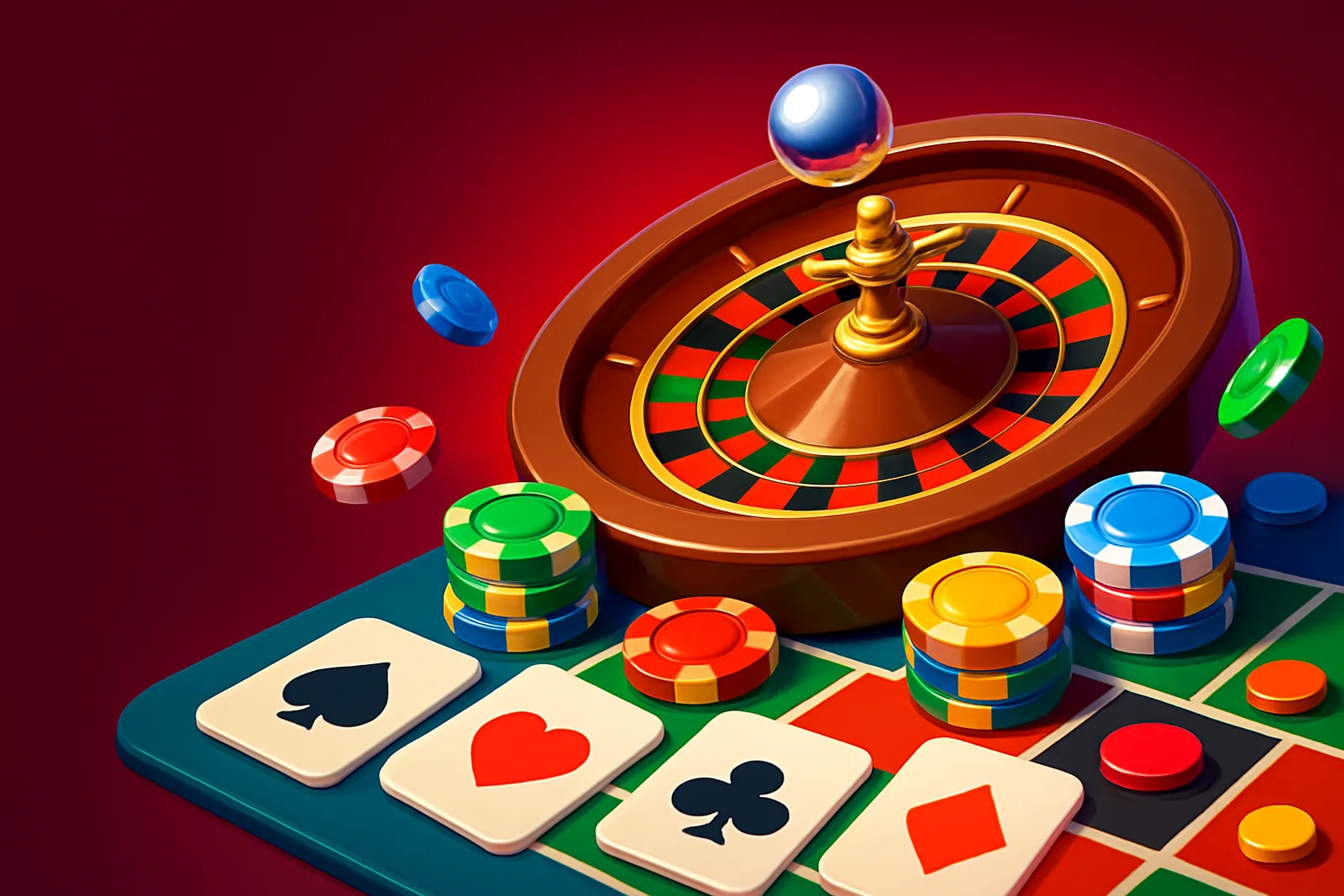
Roulette is a wheel-and-table game: place chips on outcomes from one spin, the ball lands in a pocket, and each bet wins if that pocket matches it. The wheel supplies the result. The layout is where you describe what you think will happen.
The standard European game uses a single zero and the numbers 1 to 36. You can play alone; at a casino table, several players may bet on the same spin, but they are not playing against each other. Each person is playing against the wheel and the payout schedule. That is the first useful point in roulette rules: other players do not block you, take your number, or change your odds.
If you want to know how to play roulette, learn it in the order the table shows you. First, recognise the wheel and layout. Then choose chips and place bets. Then watch one spin resolve. The win condition is exact: a bet pays only when the landed pocket belongs to the outcome you backed.
What are the wheel and the layout, and how do they fit together?
The wheel is the randomiser. In European roulette it has 37 pockets: one green 0 and the numbers 1 to 36 split between red and black. The ball can finish in only one pocket. That pocket creates the result for the whole round.
The layout is the betting map printed beside the wheel. It does not copy the physical order of the wheel. Instead, it arranges 1 to 36 in three columns and twelve rows, with 0 set apart at one end. That grid lets you put a chip on one number, between two numbers, across a row, on a block, or on a wider category such as red, odd, or the first dozen.
The fit between them is direct but not visual. If the ball lands on 17, every bet that includes 17 wins and every bet that excludes 17 loses. A straight-up chip on 17 wins. A red bet wins if 17 is red. A column bet wins only if 17 sits in that column on the layout. The number 0 is special because it has its own green pocket and is outside the ordinary even-money groups: it is not red or black, odd or even, high or low.
French called bets add one more connection. They refer to neighbourhoods on the wheel, not rectangles on the printed number grid. They are still roulette bets; they are just a faster way to cover named wheel sectors.
How do you set up a round before the ball is spun?
- Choose the wheel type. European roulette has a single zero. That matters because every spin has 37 possible results, and the zero is the pocket that stops outside even-money bets from covering the whole wheel.
- Look at the layout before you place anything. The inside area is the number grid, including 0. The outside area is for larger groups: dozens, columns, red or black, odd or even, and low or high.
- Decide your chip amount. Chips are the scoring unit for the round. A winning bet returns its original chip and adds the profit shown by the payout. A losing bet is removed.
- Place one or more bets before the spin. You may back a single number, several small groups, a broad outside outcome, or a mixture. Each chip is judged on its own. One spin can pay one of your bets and lose another.
- Stop betting when the spin begins. Once the ball is in motion, the round is locked. No later choice can improve a position, cancel a poor one, or follow the ball into a section of the wheel.
Which roulette bets are on the table?
Roulette bets make most sense when grouped by coverage. More covered numbers mean more frequent wins and smaller payouts. Fewer covered numbers mean rarer wins and larger payouts.
| Bet type | What it covers | Profit paid in standard European roulette | What to notice |
|---|---|---|---|
| Straight-up | One number, including 0 | 35 to 1 | The narrowest standard bet; it wins only when that exact pocket lands. |
| Split, street, corner, six-line | Adjacent grid groups of 2, 3, 4, or 6 numbers | 17, 11, 8, or 5 to 1 | These are inside bets for players who want number-level play without choosing only one number. |
| Dozen or column | Twelve numbers | 2 to 1 | They cover a third of the 1 to 36 grid, but they do not include 0. |
| Even-money bets | Red or black, odd or even, low or high | 1 to 1 | They cover 18 numbers. The green 0 sits outside these groups. |
| French called bets | Named wheel sectors such as Voisins du Zéro, Tiers du Cylindre, Orphelins, and Jeu Zéro | Depends on the component chips | They are useful when you want wheel-neighbour coverage without placing every chip separately. |
The payout is profit, not the whole returned amount. A winning chip also comes back to you. That small wording point prevents many early misunderstandings.
What happens during a turn, from spin to result?
A turn is one complete spin and settlement. It begins while betting is open and ends after all winning and losing chips have been dealt with.
- Bets are placed on the layout.
- The betting window closes and the wheel is spun.
- The ball slows and drops into one pocket.
- The landed pocket supplies a number, and usually a colour and category.
- Each chip is checked against that result.
If the result is 8, a straight-up bet on 8 wins, any split containing 8 wins, the correct dozen or column may win, and the correct outside categories may win. A chip on 9 does not nearly win. Roulette has no near-miss rule.
- Winning inside bets are paid at their listed odds.
- Winning outside bets are paid according to their group.
- Losing bets are removed from the layout.
- Several of your own bets can be resolved differently on the same spin.
The score is your chip balance after settlement. In real-money roulette that balance is money. In free play it is a clean way to see whether your choices survived the wheel.
What ends the game, and why do people keep playing?
Ordinary roulette has no built-in final round. There is no deck to exhaust, no opponent to eliminate, and no target score that ends the table. A round ends when the result is paid. A session ends when you decide to stop, or when a chip bank can no longer cover the bets you want to make.
That makes roulette different from Klondike Solitaire (Turn 1) or FreeCell, where the game has a defined solved or blocked state. Roulette is open-ended. The unit of play is the spin, and each spin is settled before the next one begins.
People keep playing because the decision is small but real. You choose how concentrated your risk is. One chip on one number feels nothing like a broad outside bet, even though both are judged by the same ball. The rules are visible. The result is immediate. You can change plan after any spin.
The zero is the price of the game. European roulette has 37 possible pockets, while the standard payouts are built around the 36 numbered layout. That is why there is no hidden perfect bet. The appeal is not beating a puzzle forever; it is choosing a position, watching one clean event decide it, and knowing exactly why you won or lost.
Frequently asked questions
Yes. European Roulette is the cleaner place to learn because it has one zero, not 0 and 00. That gives the standard bets a house edge of 2.70%, compared with 5.26% on American Roulette. The layout is also less cluttered, so you can see what each chip is doing.
37 pockets sit on a European roulette wheel: the numbers 1 to 36 plus a single 0. The numbered pockets are split into 18 red and 18 black, while 0 is green. The table layout shows the same results in numerical order, but the wheel places them in a fixed mixed sequence.
The common misconception is that the wheel owes you a number after a dry spell. It does not. Each spin starts again, and a single number on a European wheel has a 1 in 37 chance every time. Past results can be interesting to watch, but they do not push the next ball into place.
A typical round: you put one chip directly on 17. If the ball lands in 17, that straight-up bet is paid at 35 to 1, so you receive 35 chips in winnings plus your original chip back. If the result is any of the other 36 pockets, the chip is lost.
It depends on your stake size and tolerance for swings: outside bets such as red, black, odd, even, high and low usually move your stack more slowly, while straight-up numbers swing harder. The house edge is still there. A calmer bet pattern changes the shape of the session, not the maths underneath it.
Compared with American Roulette, European Roulette removes the 00 pocket and keeps only the single 0. That one change matters because it lowers the house edge on ordinary bets from 5.26% to 2.70%. The main table bets look familiar, but the extra zero in American Roulette changes the odds against you.
The short rule is yes: in standard European roulette, even-money outside bets lose when the result is 0. The exception is a table using French rules such as la partage or en prison, which can soften what happens to those bets on zero. Check the rules of the exact game before assuming either applies.
Most people go wrong by treating even-money bets as insurance. Red, black, odd, even, high and low all cover 18 of the 37 pockets on a European wheel, not half the wheel. The green 0 is the gap. You will win those bets often, but the payout does not erase that missing pocket.
A neighbour bet is a wheel-based bet on one number and the pockets beside it on the physical wheel. It is different from a split or corner, which follows the printed table layout. Neighbour bets make more sense once you remember that the wheel order and the table order are deliberately not the same.
Set a fixed chip stack, choose one or two bet types, and play a short session without changing stakes after a loss. Use Veena Games Roulette for this because it is free, runs in the browser, and uses no real money. Watch how quickly different bet sizes change the feel of the same wheel.
Nobody knows precisely what your next session will throw up; the fixed calculation is clear. From a named starting spin, five reds in a row is (18/37)^5, about 2.7% in European Roulette. Five results all the same colour, red or black, in a specified five-spin block is about 5.5%.
Roulette is a French word meaning little wheel. The form familiar to modern players developed in Europe, and the single-zero wheel was promoted by François and Louis Blanc at Bad Homburg in the 1840s. American Roulette took a different path by keeping both 0 and 00.
The cost of getting it wrong is misunderstanding what your chip actually covers. A corner bet follows the table grid; a neighbour or called bet follows the wheel. If you mix those up, you may think you have covered nearby results when you have only covered nearby printed squares.
Final thoughts
My advice for a first session is to play more slowly than the wheel invites. Pick one simple bet type for a few spins and watch how it is settled. Red or black is good for learning the rhythm. A single straight-up number is good for learning why high payouts do not arrive often. Do not mix five ideas at once and then wonder which one taught you something.
Keep a small mental rule: decide before the spin what you are testing. Maybe you want to see how columns work. Maybe you want to compare a dozen with an even-money bet. Maybe you just like one number and want the sharper swing. All three are valid, but they are different games in your head.
The wheel does not remember you. It does not owe a red after black, or a low number after a run of highs. That is not a moral lesson; it is the rule that keeps the game readable. Once you accept that, roulette becomes less noisy. You stop looking for messages in the last result and start noticing the structure of the next bet.
Good roulette is calm. Place the chip. Let the spin answer. Then decide whether that answer is enough for now.
-
 Roulette
Does Any Roulette Betting System Actually Work?
Roulette systems can manage drama, not maths: American double-zero rules leave a 5.3% edge before any staking pattern begins at all.
13 August 2026
Roulette
Does Any Roulette Betting System Actually Work?
Roulette systems can manage drama, not maths: American double-zero rules leave a 5.3% edge before any staking pattern begins at all.
13 August 2026
-
 Roulette
What Is La Partage and Why Does It Halve the Edge?
La Partage halves the single-zero roulette edge on even-money bets by turning zero from a full loss into a half loss.
13 August 2026
Roulette
What Is La Partage and Why Does It Halve the Edge?
La Partage halves the single-zero roulette edge on even-money bets by turning zero from a full loss into a half loss.
13 August 2026
-
Roulette
European vs American Roulette: One Pocket, Double the Edge
European Roulette is the better default because its single-zero wheel gives the same bets a much lower house edge than American Roulette.
12 August 2026