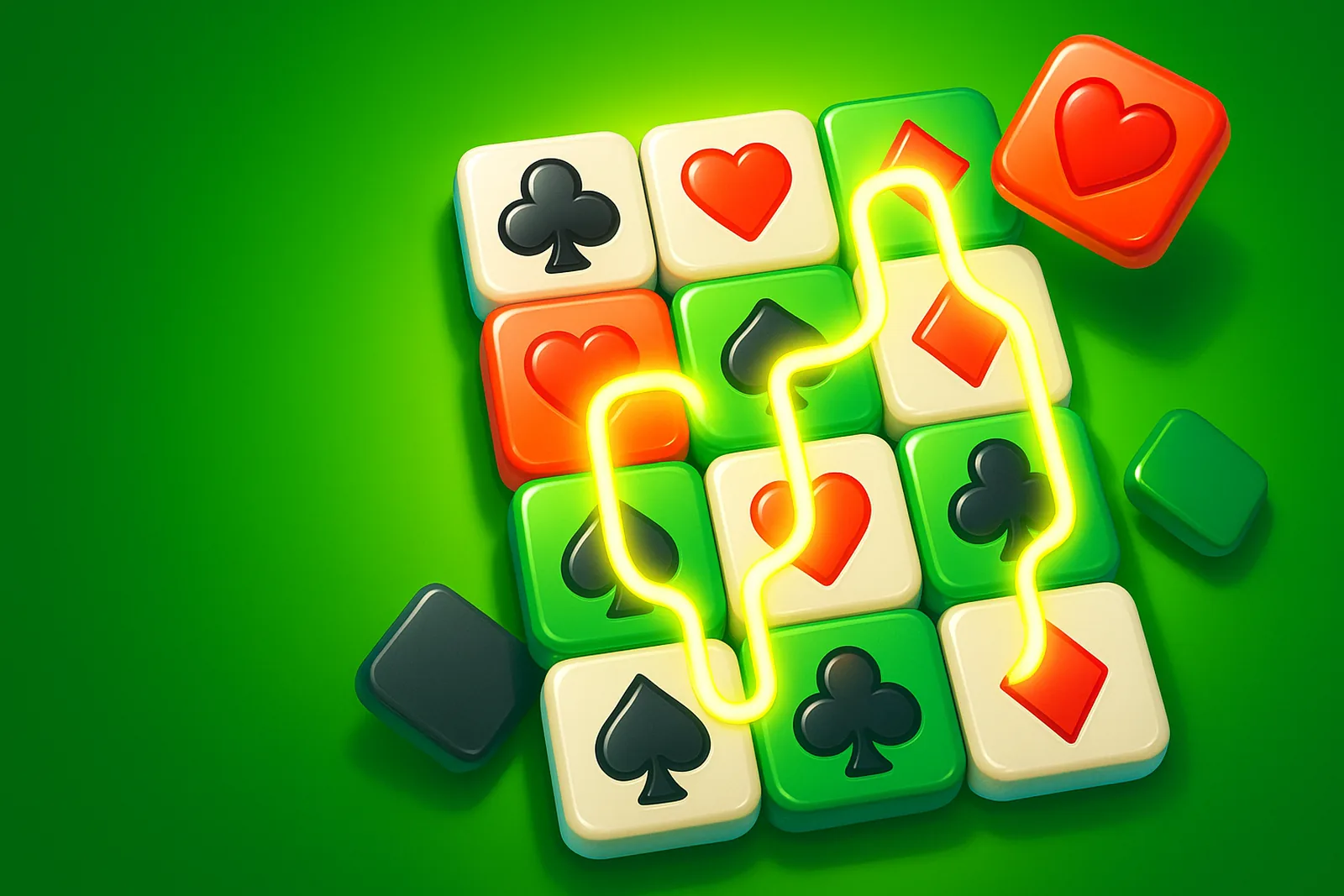
Squares is a one-player word grid game: you find words in a 4x4 board by tracing from one letter square to a touching square until the word is complete.
The pleasure is half vocabulary, half pattern-spotting. You are not drawing random lines and hoping the game agrees. Each board has been solved in advance, so the game knows the full set of words hidden in that arrangement. That matters. It means a finished board is actually finished, not merely abandoned when your patience runs out.
If you know boggle rules, the shape will feel familiar: connected letters, no jumping across the grid, and a hunt for words that are already sitting in plain sight. Squares is still its own thing on Veena Games. It is a browser puzzle, not a contest round with a table of players, a dealer, or a clock you must beat. Your job is to read the grid better than you did ten seconds ago.
What are you actually doing on the 4x4 grid?
You are looking at 16 letter squares arranged as a 4 by 4 grid, then trying to spot words that can be made by moving from one square to another touching square. Touching means the next letter must be next to the current one on the board. It may be beside it, above it, below it, or diagonal to it.
A turn is not a turn in the card-game sense. There is no deal, draw pile, discard pile, or opponent taking the next move. You choose a starting letter, trace through neighbouring letters in order, and submit the word you think you have found. If the word is part of the board’s answer set, it counts. If it is not, it does not become progress.
The board does not change when you find a word. Letters stay where they are, which is why the same small grid can hold far more possibilities than it first seems to. One path may reveal a short word; the same corner of the board may also hide a longer one that bends through five or six squares.
You are not building words from a rack. You are reading routes through fixed letters. The grid is small enough to hold in your head, yet dense enough to keep producing missed words after you thought you had exhausted it.
How do the letters get laid out before play starts?
Squares begins with a fixed 4x4 board of letters. You do not place the letters yourself, and you do not draw tiles one at a time. The puzzle is already there when play starts: 16 positions, each with one letter, waiting to be read as paths.
The important fact is that every board is solved in advance. The game already knows the complete list of words that can be found on that exact layout under its rules. That is different from a loose paper word hunt, where you might argue about a word or wonder whether anyone has really found everything.
Because the answer set is known, Squares can tell you how many words are still left. It does not need to guess. If the remaining count says there are words left, then there are words left. The evidence is on the board, even if your eyes are currently missing it.
The layout also fixes the character of the puzzle. A board with several common consonants near a useful vowel will feel generous. A board where promising letters sit one square too far apart can feel mean. Both are governed by the same movement rule: the next letter must touch the previous one.
Nothing in the setup asks you to manage resources. You are not saving letters for later. You are reading a complete position from the first second, much as you might study the tableau in FreeCell before moving a card.
What counts as a legal word in Squares?
- The word must be in the board’s answer set. Squares is not asking whether a word looks plausible to you. It checks your traced word against the valid words already identified for that board. If it is accepted, it is recorded as found.
- Each next letter must come from a touching square. You can move horizontally, vertically, or diagonally, provided the next square touches the one you are on. You cannot jump over a square, wrap around the edge of the grid, or take a letter from a distant corner because it would make a nicer word.
- The letters must be traced in order. A word hunt can be misleading because your eye sees letters as a cluster. The game only cares about the route. If the word is C-A-R-D, your path has to visit those letters in that order.
- The grid is fixed while you search. Finding a word does not remove its letters. The same letter square may be useful in several different accepted words across the puzzle, because the board is not consumed as you play.
- A rejected entry is not progress. It may be a real English word but still not count if it cannot be made by a legal path on the current grid, or if it is outside the game’s accepted answer set.
The first minute feels familiar if you know boggle rules, but the solved-board count gives Squares a cleaner target. You are not merely chasing any word you can imagine. You are trying to exhaust one known puzzle.
How does a game end, and how is it scored?
A game of Squares is complete when every valid word on the board has been found. The clearest sign is the remaining-words count reaching zero. Until then, the puzzle still contains at least one accepted word you have not traced.
Scoring is best understood as completion rather than a race for abstract points. Each accepted word increases your found total by one and reduces the number left by one. A board with 28 valid words is solved when you have found 28 accepted words. If you have found 20, you have 8 still to locate. The game’s pre-solved answer set makes that arithmetic exact.
There is no second player to beat in Squares. There are no suits, foundations, stock piles, or tableau columns as there are in Klondike Solitaire (Turn 1) or Spider Solitaire (2 Suits). Your result is between you and the board: how much of the hidden list you can uncover.
You can stop before the board is cleared, but that is quitting the search, not winning it. The proper win condition is simple and strict: find all the words the board contains. That strictness is what makes the last few words matter. If one word remains, the game is telling you something exact. The path exists. You just have not seen it yet.
Why does this word hunt stay worth another round?
Squares works because it gives you a tiny space with a large number of possible readings. Sixteen letters sounds modest. Then you notice that a single middle square touches up to 8 neighbours, and every choice changes what can come next.
The best moments are usually small. You stop looking for long impressive words and suddenly see a plain three- or four-letter word you missed five times. Or you trace a route backwards in your head and realise the ending you kept forcing was actually the beginning.
- The board is compact. You can scan the whole thing without feeling lost.
- The target is honest. Because the board is solved beforehand, the remaining count is a real measure of progress.
- The rules are quick to test. If the letters touch and the word is accepted, it counts. If not, move on.
- The difficulty shifts naturally. Early words come from recognition; late words come from patience, reversals, and awkward diagonal routes.
It also scratches a different itch from the card games around it. FreeCell asks you to plan a sequence of moves with perfect information. Pyramid Solitaire asks you to spot pairs adding to a fixed value. Squares asks you to make language spatial: to see a word as a path rather than a line of text.
The last word often matters more than the longest one. A good round does not need drama. It needs one more word hiding where you were sure there was nothing left.
Frequently asked questions
No. Reusing a square would let one good cluster do too much work, so each word has to be a clean path through different touching squares. You can use that same square again in your next word. The limit only applies inside the word you are tracing right now.
8 directions are available from a middle square: up, down, left, right and the four diagonals. Edge and corner squares have fewer neighbours because the grid stops. That is why a letter in the centre often feels more useful than a corner letter, even when the letters themselves look ordinary.
The common misconception is that long words should always come first; the correction is that spotting short, clear paths trains your eye for the board. Long finds feel good, but they can also make you stare at one corner too long. Take the obvious short words, then hunt for extensions.
On a dealt board, C-A-R-D may be visible across the grid, but it only works if C touches A, A touches R, and R touches D. If one jump skips over a square, the word is not a traceable path. The letters being present is not enough; their route has to hold together.
It depends on your mood: fast play is good when you want a quick burst, while careful play is better when you want to squeeze the board. Squares suits both because the board is small enough to read quickly, but dense enough to reward a second and third pass.
Compared with FreeCell, Squares asks for pattern recognition rather than card planning. FreeCell is about moving known cards into a workable order. Squares is about seeing paths that were already sitting in front of you. Both are open-information games, but the mental motion is different: one is sorting, the other is spotting.
Keep going while new routes are still appearing; the exception is the point where you are only staring at the same four letters. At that stage, reset your eyes. Look from the corners, read backwards, or take a short break. The remaining count tells you whether the board still has more to give.
Most people do the same thing wrong: they keep scanning the board in the same order. Your brain starts confirming what it has already seen. Change the route. Start with awkward letters, trace from endings, or look for common pairs. A board can feel empty simply because your search pattern has become too familiar.
A touching square is any square that shares an edge or a corner with the one you are on. From a central letter, that can mean eight possible next steps. From a corner, it can mean three. This rule is what turns the grid from a flat set of letters into a set of possible word paths.
Start with the most connected part of the grid, usually the four middle squares. Check the vowels, then look for common starts and endings around them. Trace short, certain words before chasing clever ones. Once you have warmed up, rotate your attention to corners and edges, where fewer routes can hide surprisingly useful letters.
Nobody knows precisely how many you will find on an average board, because that depends on the board and on your vocabulary. The best available figure is the one Squares gives you during play: the remaining-word count for this exact board, because every board has already been solved before you see it.
Boggle was published in 1972, which is a useful reminder that 4x4 letter grids are older than browser games. Squares uses the same broad pleasure of tracing adjacent letters, but it is its own browser version: no box, no account, no download, and a solved board count built in.
The cost of getting it wrong is attention, not money. Veena Games has no stakes, accounts, or paid turns. A bad trace mostly wastes a few seconds and can break your rhythm. The real risk is letting one rejected word pull you away from easier finds sitting elsewhere on the board.
Final thoughts
The trick with Squares is to stop treating the grid like a page. Words on a page run left to right. Words in this game bend. They climb, double back, slip through a diagonal, and use the same crowded patch of letters in several different ways.
If you are stuck, change the question. Do not ask, “What words can I see?” Ask, “What endings are possible from this square?” Then ask the reverse: “What could lead into this ending?” A stubborn board often opens when you search from the tail of a word instead of the head.
Short words deserve respect too. Players often waste time hunting for the longest possible route while two ordinary words sit in the middle of the grid. Clear the obvious ones, then the nearly obvious ones, then start testing strange starts. The remaining count is useful because it keeps you honest. If it says there are 3 left, your certainty that the board is empty is wrong.
Squares does not flatter you with noise. It gives you 16 letters, a known answer set, and enough resistance to make the final find feel earned. Start the next board by checking the corners, then the middle squares, then the diagonals you keep ignoring. The rules stay the same. The board does not.
-
 Blackjack
 Rules, Explained Properly
Blackjack for beginners, explained in the order a first hand happens: deal, turn choices, scoring, dealer rules and what makes a hand end.
14 August 2026
Blackjack
Blackjack Rules, Explained Properly
Blackjack for beginners, explained in the order a first hand happens: deal, turn choices, scoring, dealer rules and what makes a hand end.
14 August 2026
-
 Code-Breaking Games
Bulls and Cows: The Number Game Wordle Descends From
Bulls and Cows is an older 4-digit number guessing game built on the same positional clue idea that made Wordle feel familiar.
14 August 2026
Code-Breaking Games
Bulls and Cows: The Number Game Wordle Descends From
Bulls and Cows is an older 4-digit number guessing game built on the same positional clue idea that made Wordle feel familiar.
14 August 2026
-
 CloseWord
: The Word Game About Meaning, Not Spelling
CloseWord is a semantic word game where each guess is judged by meaning, so you solve the hidden word by chasing closeness rather than spelling.
14 August 2026
CloseWord
CloseWord: The Word Game About Meaning, Not Spelling
CloseWord is a semantic word game where each guess is judged by meaning, so you solve the hidden word by chasing closeness rather than spelling.
14 August 2026