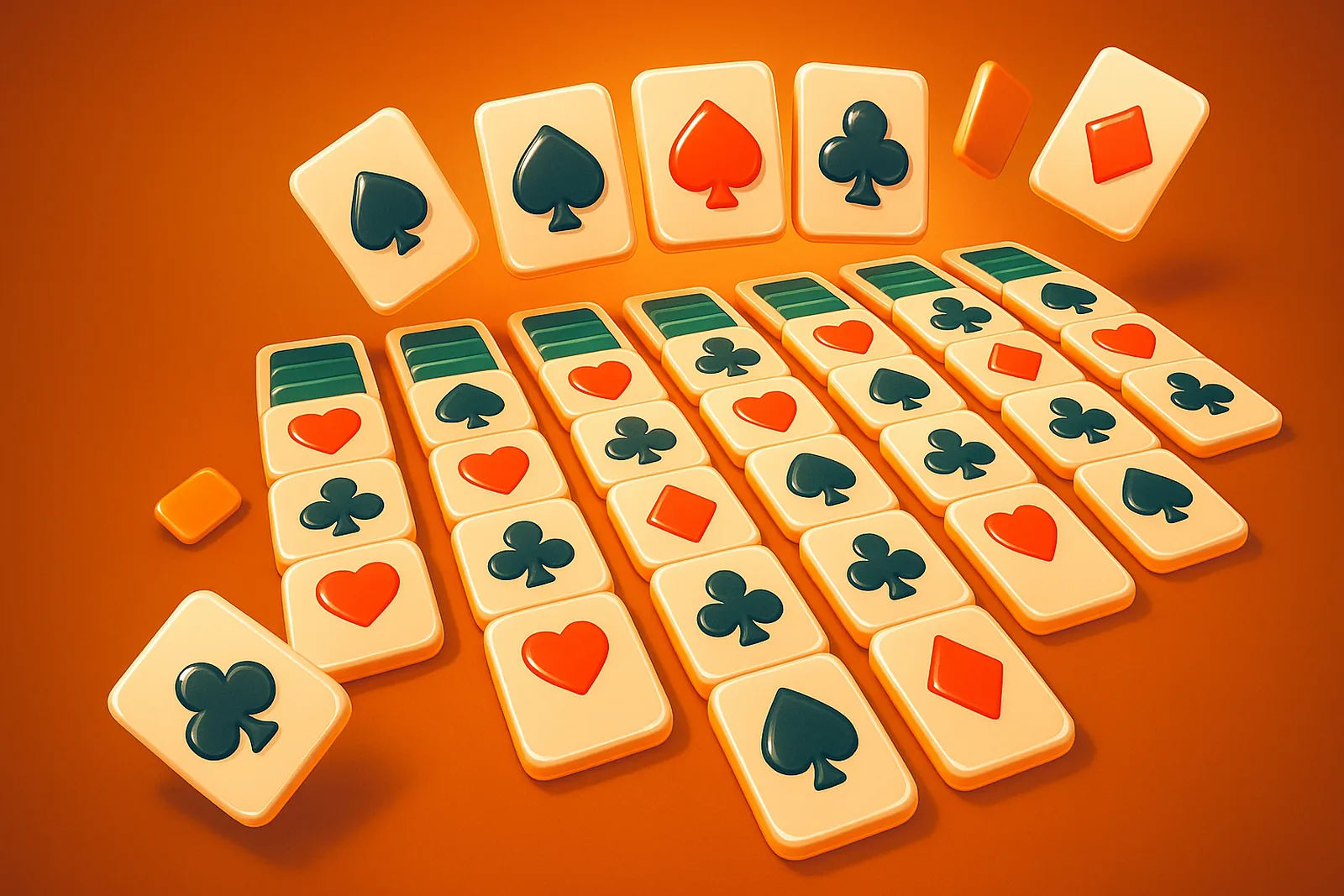
Forty Thieves Solitaire is a one-player, two deck solitaire game with 104 cards, ten tableau columns and eight foundations. You win by moving every card to the foundations by suit, from Ace to King.
The game looks generous at first. Forty cards are face up on the table. Nothing is hidden in the columns. You can see the problem. Then the rules tighten. Tableau cards build down by suit, not by alternating colour, and you normally move only one card at a time. The stock gives you a single pass. Once a card has gone past in the waste, it may sit there blocking the cards beneath it.
That is the character of Forty Thieves Solitaire: open information, strict movement, little forgiveness. Like FreeCell, it rewards planning from visible cards, but it is harsher because the stock order can refuse to co-operate. It also feels quite different from Klondike Solitaire (Turn 1) or Klondike Solitaire (Turn 3), where face-down cards create suspense. Here, the pressure comes from visible bottlenecks and the knowledge that one tidy-looking move can close a suit for the rest of the game.
What exactly is Forty Thieves Solitaire?
Forty Thieves Solitaire is a patience game for 1 player, played with two standard 52-card decks shuffled together. That gives you 104 cards: two of every rank in every suit. The aim is to build eight foundations, one for each suit sequence, from Ace up to King.
The name sounds theatrical, but the game itself is severe. You start with ten tableau columns and all tableau cards face up. There are no hidden cards waiting underneath, so the puzzle is not about discovery. It is about access. Can you free the right Ace before both 2s of that suit become buried? Can you keep a space open long enough to move a trapped card into play?
The main Forty Thieves rules are simple to say and awkward to live with. Tableau building goes down by suit: 9 of hearts on 10 of hearts, not on a black 10. Cards move singly in the usual form of the game, so even a neat run in one suit cannot be lifted as a packed sequence. The stock is dealt one card at a time to the waste, with no redeal.
Those rules make it a genuine two deck solitaire challenge. The extra deck creates eight foundations instead of four, but it also creates more duplicates to clog the tableau and waste. A second 7 of clubs can be a rescue card. It can also be another thing in the way.
How do you set up the ten columns and the two decks?
- Shuffle two full decks together. Use 104 cards in total. Both decks include the usual four suits from Ace to King, so there are two copies of every card.
- Deal the tableau first. Make ten columns. Deal four cards to each column, all face up. This uses 40 cards. Unlike Klondike Solitaire (Turn 1), there are no face-down tableau cards and no staggered pile sizes.
- Leave room for eight foundations. These start empty. Each foundation will build upward in one suit, beginning with an Ace and ending with a King. Because there are two decks, each suit needs two complete Ace-to-King foundations.
- Put the rest into the stock. The remaining 64 cards form a face-down stock. This stock is not a reserve you may search. It is dealt in order, one card at a time, to the waste.
- Start with the tableau available. The exposed card at the bottom of each column, usually called the top playable card, is available for legal moves. Since every tableau card is face up, you can inspect all ten columns before making your first move.
- Remember the empty-column rule. In the common rules used for Forty Thieves, an empty tableau column may be filled with any single card. That space is valuable because single-card movement makes it hard to rearrange blocked suits without somewhere to park a card.
The setup is quick, but it already tells you the game’s mood. You have 40 visible cards to sort, 64 unknown stock cards to survive, and no second pass to repair a careless start.
What can you do on a turn?
A turn in Forty Thieves is usually a choice between improving the tableau, building a foundation, or revealing the next stock card. The rules are narrow. Timing does most of the work.
- Move a tableau card to a foundation. An Ace may start a foundation. After that, build upward by suit: Ace, 2, 3, and so on to King.
- Move the waste card to a foundation. The top waste card is playable if it fits the next needed rank in its suit foundation.
- Move a tableau card onto another tableau column. It must go one rank lower and in the same suit. For example, the 8 of spades may go onto the 9 of spades.
- Move the waste card onto the tableau. The same down-by-suit rule applies.
- Fill an empty column. An empty tableau space may take any single available card.
- Deal one card from the stock. Turn the next stock card face up onto the waste. There is only one pass through the stock.
The restriction that matters most is single-card movement. In many familiar solitaire games, a built run can move as a group. In Forty Thieves, the usual rule is harsher: you move one card. A column reading jack, 10, 9 and 8 of diamonds may look beautifully arranged, but it is not a portable block. If the jack needs to move, the cards below it must be dealt with one by one.
This changes good play. Foundations are not automatic dumping grounds, because a low card placed too early may remove a useful support from the tableau. Empty columns are not decoration; they are working space. The stock is not something to burn through while waiting for luck, since every deal may bury a card in the waste behind later cards.
What ends the game, and how is it scored?
You win Forty Thieves Solitaire by moving all 104 cards onto the eight foundations. Each foundation builds from Ace to King in a single suit. With two decks in play, that means two complete foundation piles for each suit.
The game is lost when you can no longer make progress. In practical terms, that usually means the stock has been dealt once, the waste has no playable top card, and the tableau has no legal move that can open a new route. There is no redeal in standard Forty Thieves. Once the stock is exhausted, the remaining position has to stand on its own.
Scoring is where many rules pages pretend to know more than the game itself says. Traditional Forty Thieves rules do not have one universal points table like Blackjack. The clean score is progress: how many cards reached the foundations, out of 104. A completed game is therefore 104 foundation cards and a win. Anything short of that is an unfinished board, even if it was played well.
Some computer versions may display their own points or timing, but those are house features rather than the core rule. The rule that matters is exact and unforgiving: all cards must reach the foundations. A board with 103 cards home and one trapped card is still not won.
Why do people keep coming back to this two-deck game?
Forty Thieves keeps its appeal because it is readable without being easy. You can see all ten tableau columns, so failure rarely feels mysterious. The question is whether you used the few flexible tools well enough before the stock ran out.
| Game | What creates the pressure | Best reason to choose it |
|---|---|---|
| Forty Thieves Solitaire | Two decks, ten columns, single-card moves and one pass through the stock | You want a strict puzzle where early structure matters |
| FreeCell | Limited free cells and visible tableau cards | You want open information with more room for controlled planning |
| Klondike Solitaire (Turn 3) | Hidden tableau cards and a stock that reveals cards in threes | You want a familiar game with more chance and rhythm |
| Spider Solitaire (2 Suits) | Long in-suit sequences and new rows dealt across the tableau | You want a larger sorting puzzle with sequence building |
| Canfield Solitaire | A reserve pile that must be cleared and foundations that start from a dealt rank | You want a compact game where the opening deal sets the problem |
The evidence for its charm is practical, not grand. People return because a loss often contains one recognisable mistake: an empty column spent too soon, an Ace left blocked, a stock card wasted because the tableau was untidy. The next game offers the same rules and a different trap.
Frequently asked questions
Partly. The deal decides which cards are reachable and the stock gives you only one pass, so some games are brutal from the start. Skill still matters because every space, foundation move and waste-card decision changes what can be reached later. A careless player can lose winnable deals quickly; a patient one can squeeze life from ugly layouts.
0 cards are hidden in the tableau. All 40 tableau cards are face up from the start, which is one reason the game feels fair even when it is savage. You can see the problem. The catch is movement: only the exposed card at the end of a column can move, so visible does not mean reachable.
People often think an empty column is a spare parking space; the correction is that it is your strongest tool. Because only single cards move, an empty column lets you lift one blocking card out of the way, rebuild a suit run, or catch a useful waste card. Spend it on a random king and you may not get another clean space.
The 7 of clubs sits on the tableau, the 6 of clubs is showing in the waste, and the 5 of clubs is blocking an ace underneath it. Playing the 6 onto the 7 can uncover the 5, then the ace, and suddenly a foundation starts. The best early moves usually uncover low cards or create a controlled empty column.
It depends on what you can put there next: an empty column is valuable only if it helps you expose a buried card, save an important waste card, or build a same-suit run. Clearing a column just because you can often wastes tempo. Clear it when you already know the first card that will use the space.
FreeCell gives you four cells and all cards visible, so hard deals often feel like puzzles with a solution hiding in plain sight. Forty Thieves gives you no cells, only single-card moves, and a one-pass stock. That makes it less forgiving than FreeCell and usually more punishing than Klondike Solitaire (Turn 1).
Any single available card can fill an empty column. The exception is a card that is still buried under another tableau card or sitting deeper in the stock, because it is not available yet. You cannot move a packed sequence into the space in one go; if three cards need moving, they must move one at a time.
Most people rush through the stock as if it were a second hand of cards. It is not. With one pass, every unplayed stock card becomes waste in a fixed order, and later cards can bury earlier chances. Before drawing, check whether the current waste card can go to a foundation, a same-suit tableau card, or a space you are about to open.
The waste pile is the face-up pile made from stock cards you have turned over but not yet played. In Forty Thieves, the top waste card is the only waste card you can use. If you pass a helpful card and later cover it with another stock card, you may need several plays before it becomes available again, if it ever does.
Check the foundations first, then the exposed tableau cards, then the top waste card, then possible empty-column uses. Look especially for aces, twos and same-suit descents that uncover another card. If drawing from the stock does not improve anything, ask what the next card must do to justify covering the current waste card.
Nobody knows precisely because win rate depends on the exact rule set, the shuffle, and how strong the player is. A common published estimate for standard Forty Thieves is about 10% for competent play. Treat that as a useful scale, not a promise. The point is clear enough: you are meant to lose many deals.
The name Forty Thieves refers to the 40 cards dealt into the tableau at the start: 10 columns of 4. The game has also been known as Napoleon at St Helena, but the Napoleon connection is part of patience-game naming folklore rather than firm proof that he played this exact rule set in exile.
A bad king move can cost the whole column. High cards are useful when they anchor a same-suit descent, but they also occupy the best storage space in the game. If you park a king or queen without a plan, you may block the only column that could have freed an ace, rescued a waste card, or reorganised a suit.
Final thoughts
If you are coming from Klondike Solitaire (Turn 1), expect Forty Thieves to feel less friendly for the first few games. That is normal. Klondike often asks you to uncover the next useful card. Forty Thieves asks you to make visible cards useful before the stock buries your options.
A good first aim is not to win immediately. Aim to understand why you lost. Watch the Aces and 2s, because foundations cannot start without them. Treat empty columns as scarce tools, not as places to dump the first awkward card. Before dealing from the stock, ask what the current waste card needs and whether the tableau can be made ready for the next few ranks in a suit.
There will be deals that do not come together. The evidence is thin for any claim that every ordinary Forty Thieves deal is winnable, and the one-pass stock makes some positions brutally dependent on order. That does not make the game unfair. It makes it honest. You are managing risk with partial control, and the board is open enough that you can usually see the cost of a decision.
The best games leave you with a small irritation: one card trapped, one move late, one column you should have kept empty. That irritation is the hook.
-
 Canfield
How to Play Canfield, the Casino Solitaire
A clear guide to Canfield Solitaire rules, from the 13-card reserve and random foundation rank to legal moves, scoring, and why demon patience bites.
14 August 2026
Canfield
How to Play Canfield, the Casino Solitaire
A clear guide to Canfield Solitaire rules, from the 13-card reserve and random foundation rank to legal moves, scoring, and why demon patience bites.
14 August 2026
-
 Blackjack
 Rules, Explained Properly
Blackjack for beginners, explained in the order a first hand happens: deal, turn choices, scoring, dealer rules and what makes a hand end.
14 August 2026
Blackjack
Blackjack Rules, Explained Properly
Blackjack for beginners, explained in the order a first hand happens: deal, turn choices, scoring, dealer rules and what makes a hand end.
14 August 2026
-
 Code-Breaking Games
Bulls and Cows: The Number Game Wordle Descends From
Bulls and Cows is an older 4-digit number guessing game built on the same positional clue idea that made Wordle feel familiar.
14 August 2026
Code-Breaking Games
Bulls and Cows: The Number Game Wordle Descends From
Bulls and Cows is an older 4-digit number guessing game built on the same positional clue idea that made Wordle feel familiar.
14 August 2026