
Canfield Solitaire is a one-player, 52-card patience game where you build four foundations from a random starting rank while a 13-card reserve keeps feeding the tableau. You win by moving all 52 cards to the foundations.
The game is also called demon patience, and the name fits. The reserve is useful, because it fills empty tableau spaces, but it is also a burden because every card in it must eventually escape. Unlike Klondike Solitaire (Turn 1), the foundations do not begin with aces unless an ace happens to be the first foundation card.
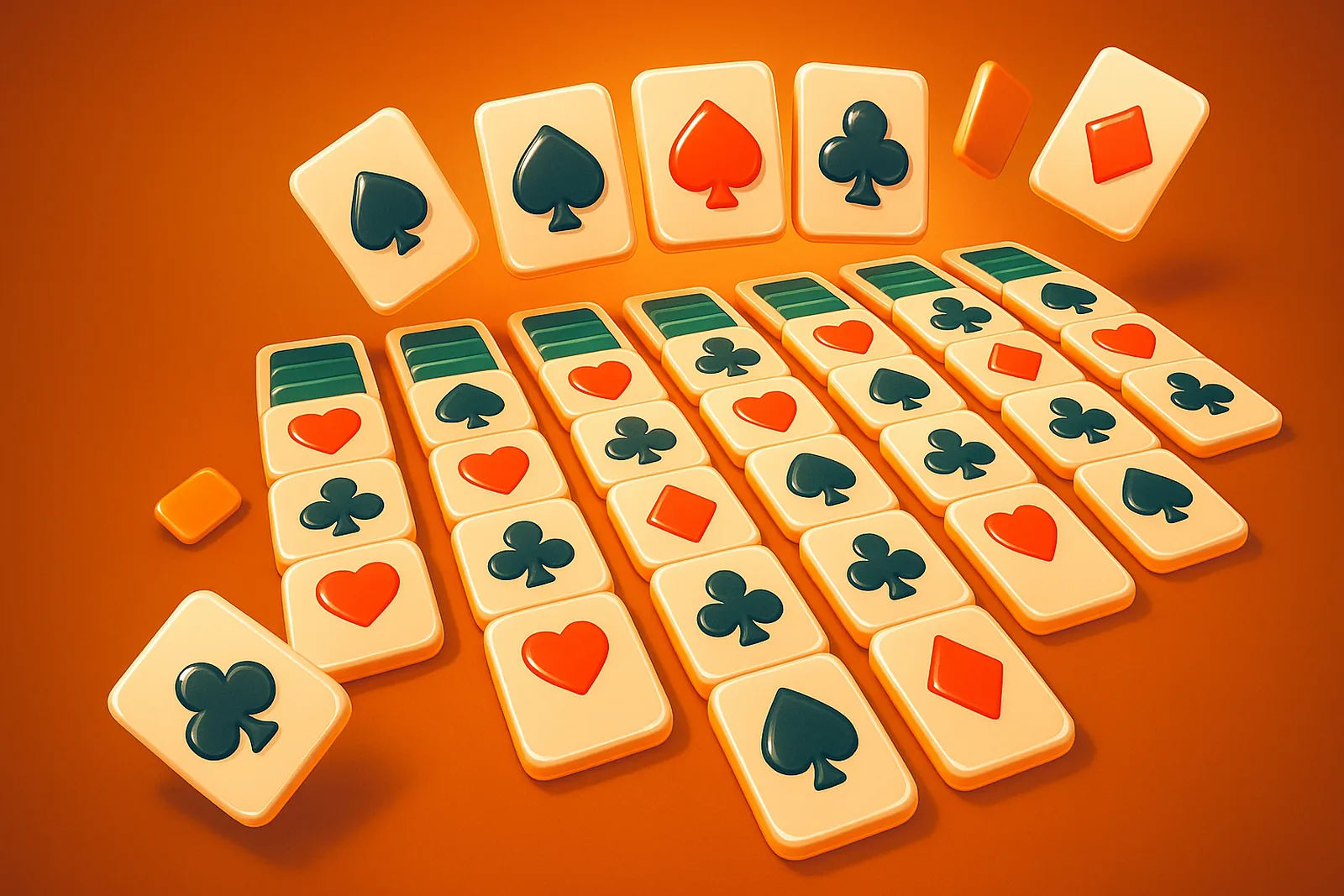
The board has five active parts: foundations, tableau, reserve, stock, and waste. The canfield solitaire rules are not complicated, but two details matter more than they first appear: foundations wrap through king to ace, and tableau building wraps through ace to king in the opposite direction.
What is Canfield Solitaire, and what are you trying to build?
Canfield Solitaire is a single-player card game played with a standard 52-card deck. It belongs to the patience family, but its shape is sharper than Klondike: a reserve pile is dealt at the start, the foundations begin on a random rank, and the game keeps asking whether you can free the buried cards before the tableau locks up.
Your main job is to build four foundations, one for each suit. The first foundation card sets the base rank for the whole game. If the base card is a 7, every foundation must start with a 7 when the right suit appears. Foundations then build upward by suit: 7, 8, 9, 10, jack, queen, king, ace, 2, 3, 4, 5, 6. The sequence wraps after king because the base rank is not fixed at ace.
The tableau is the working area. Cards there build downward in alternating colours, also wrapping when needed. So a black 6 may take a red 5, and an ace may take a king below it in the descending sequence. The reserve is the demon. Its top card is available, but the cards beneath it are trapped until the cards above move away.
The target is plain: move all 52 cards to the four foundations. In play, that means valuing access over neatness, because a tidy tableau can still leave the reserve buried.
How do you set up the reserve, tableau, stock, waste, and foundations?
Shuffle one standard deck of 52 cards. Canfield is for one player. Deal 13 cards into the reserve pile, usually with only the top card face up and available to play. This pile is the reason the game is called demon patience: it contains a quarter of the deck, and you cannot see or use most of it at once.
Next, deal one card face up to the first foundation. This card is not decoration. Its rank sets the starting rank for all four foundations. If it is the 10 of clubs, then each foundation must begin with a 10 of its own suit when that card becomes available. The three other foundation spaces stay empty until their matching base-rank cards appear.
Then deal four tableau piles, one face-up card in each. These four piles are where most of the sorting happens. Tableau cards build down by alternating colour, with the rank order wrapping from ace to king. You may move a valid face-up sequence as a group if the receiving card fits the descending alternating-colour rule.
The remaining 34 cards form the stock. The waste starts empty. During play, cards are dealt from the stock to the waste, usually three at a time, and only the top waste card is available. When the stock is exhausted, the waste can be turned over to make a new stock under the common Canfield rules. Empty tableau spaces are important: if the reserve still has cards, an empty space is filled from the reserve before you choose freely.
What does a turn look like once the cards are dealt?
- Check the foundations first. If the top card of the reserve, waste, or any tableau pile can go to a foundation, you may move it there. Foundations build upward by suit from the base rank and wrap from king to ace.
- Use the tableau to create access. Build tableau piles downward in alternating colours. A red 9 can take a black 8. Because the sequence wraps, an ace can take a king beneath it. The point is not to make tidy columns for their own sake; the point is to expose buried cards and clear spaces.
- Play the reserve whenever you can. The top reserve card is available. Moving it reveals the next reserve card, which is often the most valuable gain in Canfield. If a tableau space becomes empty while the reserve still contains cards, fill that space from the reserve.
- Move sequences when legal. A run already built in proper descending alternating-colour order may be moved together onto a suitable card. This can shift a blocked pile into a better place and free the card underneath.
- Deal from the stock to the waste. When no useful board move is available, deal cards from the stock to the waste, commonly three at a time. The top waste card may be played to a foundation or tableau if legal.
- Recycle the waste when the stock runs out. Under the usual canfield solitaire rules, you may turn the waste over to form a fresh stock and continue. A repeated cycle with no new move is the warning sign that the game is stuck.
What ends the game, and how does scoring work?
A Canfield game ends in a win when all 52 cards have been moved to the four foundations. Each foundation will then contain 13 cards of one suit, starting from the base rank and wrapping through the deck order until it reaches the card just below the base rank.
A loss is less theatrical. With unlimited redeals, the stock running out does not by itself end the game. The game is effectively lost when cycling the stock and waste produces no legal move that changes the position, and the tableau and reserve have no playable progress left.
| Situation | What it means |
|---|---|
| 52 cards on foundations | Win; every card has been built by suit in the correct order. |
| Stock exhausted | Not an ending under common rules; turn the waste over and continue. |
| No legal move after repeated cycling | Practical loss; the position no longer changes. |
| Traditional casino scoring | Pay 50 units to play, receive 5 units for each foundation card. |
| No-cash scoring | Count foundation cards, with 52 as the maximum result. |
The old casino version gives Canfield its nickname as casino solitaire. On that scale, the net result is five times the number of foundation cards, minus the 50-unit stake. A complete win scores 260 units gross, or 210 units after the stake. Free online play keeps the rules without the money.
Why do people keep coming back to demon patience?
Canfield has a mean little rhythm. The rules fit in a few minutes, but the reserve changes the weight of every move. Clearing a tableau space is usually good, except when it drags another reserve card into play before you are ready. Sending a card to a foundation is usually safe, except when that card was holding a useful tableau sequence together. The game keeps offering moves that are legal and still questionable.
That is the charm of demon patience. It gives you enough control to feel responsible and enough constraint to punish automatic play. The random foundation rank also matters. A game based on queens feels different from a game based on threes, because the useful cards and the awkward cards shift around the circle.
Claims about exact winning chances vary because Canfield rules vary: some versions differ on redeals, automatic reserve fills, and sequence movement. The evidence for one clean win rate is thin unless the rule set is specified. What is clear is the feel. Canfield is tighter than Klondike Solitaire (Turn 3), less open than FreeCell, and faster to read than Forty Thieves.
It is worth playing because it makes small decisions count. One empty space, one buried reserve card, one delayed foundation move: that can be the whole game.
Frequently asked questions
No. The casino name comes from the game’s history, not from anything you need to do now. On Veena Games, Canfield Solitaire is free in the browser: no account, no download, no stake, no payout. The old casino scoring explains why every card to the foundations feels valuable, but the game you are playing is patience, not betting.
3 cards are dealt from the stock to the waste at a time in classic Canfield, and the waste can be recycled when the stock runs out. That does not mean the stock is harmless. The order of the waste repeats, so a blocked card may stay blocked until you create exactly the right space in the tableau or foundations.
People often think the reserve is a spare hand. The correction is that the reserve is the main problem of Canfield. Only its top card is available, and empty tableau spaces are normally fed from it first. If you ignore it, you can make pleasing tableau moves while the reserve quietly locks the deal.
Say the foundation card is 9 of spades, so every foundation starts at 9 and builds 10, jack, queen, king, ace, 2 and so on by suit. If the top reserve card is 8 of hearts and a tableau pile shows 9 of clubs, move the 8 first. You reduce the reserve and keep the foundation route open.
It depends on the reserve, especially whether its top card is blocking an empty space or a useful sequence. A reserve play is often worth more than a waste play because it reduces the pile you must clear to win. But if a waste card starts a foundation run or opens a tableau transfer, take that before cycling past it.
Compared with Klondike Solitaire (Turn 3), Canfield usually feels tighter because the reserve creates a fixed bottleneck from the first move. Klondike hides cards face down in the tableau; Canfield shows you a lot, then refuses to let you reach it. If you like solving under pressure rather than slowly revealing a board, Canfield’s cruelty is the point.
Fill the space from the reserve first. The exception is when the reserve is empty; then an available card or legal sequence can usually take the space, depending on the version you are playing. This rule is why empty piles matter so much. They are not just storage. They are the main way to drain the reserve.
Most people go wrong by making every legal build as soon as they see it. Canfield punishes tidy-looking moves that reduce choice. A card moved to the tableau can block a colour, block a rank, or hide a better use for an empty pile. Before moving a card, ask what new card becomes playable and what card becomes harder to reach.
Turning the corner means the rank sequence wraps between king and ace. On foundations, a game that starts at 7 builds 7, 8, 9, 10, jack, queen, king, ace, 2 and so on by suit. On the tableau, the same idea lets sequences continue round the end of the rank order, subject to the alternating-colour rule.
Choose the move that exposes or removes a reserve card, opens a tableau space, or sends a card to the foundations without damaging a useful sequence. Do not move a card merely because it fits. If two moves look equal, prefer the one that creates more next moves from different places: reserve, waste, tableau and foundation, rather than only one pile.
Nobody knows precisely. The best available rule-of-thumb for ordinary human play is about 1 win in 30, but the evidence is thin and rule details change the answer. Redeal rules, move permissions and player skill all matter. Treat exact percentages without the exact rules as decoration. The honest point is simpler: Canfield is meant to be hard to finish.
Richard A. Canfield was a real American casino owner, and the solitaire game became associated with his gambling rooms in the late 19th century. In Britain, the same family of rules is widely known as Demon patience, a name that fits the reserve pile rather well. The exact path from table game to household patience is not perfectly documented.
The cost of treating Canfield like ordinary sorting is tempo. Each casual move can spend an empty space, bury the reserve, or push a key waste card out of reach for another cycle. One bad tableau build may not lose the game at once, but it can turn five future moves into one, and one is rarely enough.
Final thoughts
If you are learning how to play Canfield, give yourself permission to lose a few quickly. A short loss teaches more than a slow, overprotected position. Watch the reserve first. Every card removed from it is real progress, because it gives you information and reduces the pile that can force future tableau fills.
Do not rush every foundation move. Many are harmless, especially low-risk cards that will not be needed in the tableau, but Canfield sometimes needs a card to sit in place for one more move so that a sequence can move across. The useful question is simple: what card will this move reveal, and what space will it create?
Also notice the base rank. If the foundation starts on a 9, the whole game bends around that 9. Cards just below the base rank will be late foundation cards, so they may have to do more work in the tableau before they can go home.
The best Canfield games feel slightly impossible until they are not. Then one reserve card clears, a tableau space opens, the waste card suddenly fits, and three moves that were blocked become obvious. That snap is why the demon keeps getting invited back.
-
 Canfield
Forty Thieves: The Two-Deck Game That Takes No Prisoners
Forty Thieves Solitaire uses two decks, ten columns and one pass through the stock, making every blocked card matter from the first deal.
14 August 2026
Canfield
Forty Thieves: The Two-Deck Game That Takes No Prisoners
Forty Thieves Solitaire uses two decks, ten columns and one pass through the stock, making every blocked card matter from the first deal.
14 August 2026
-
 Blackjack
 Rules, Explained Properly
Blackjack for beginners, explained in the order a first hand happens: deal, turn choices, scoring, dealer rules and what makes a hand end.
14 August 2026
Blackjack
Blackjack Rules, Explained Properly
Blackjack for beginners, explained in the order a first hand happens: deal, turn choices, scoring, dealer rules and what makes a hand end.
14 August 2026
-
 Code-Breaking Games
Bulls and Cows: The Number Game Wordle Descends From
Bulls and Cows is an older 4-digit number guessing game built on the same positional clue idea that made Wordle feel familiar.
14 August 2026
Code-Breaking Games
Bulls and Cows: The Number Game Wordle Descends From
Bulls and Cows is an older 4-digit number guessing game built on the same positional clue idea that made Wordle feel familiar.
14 August 2026