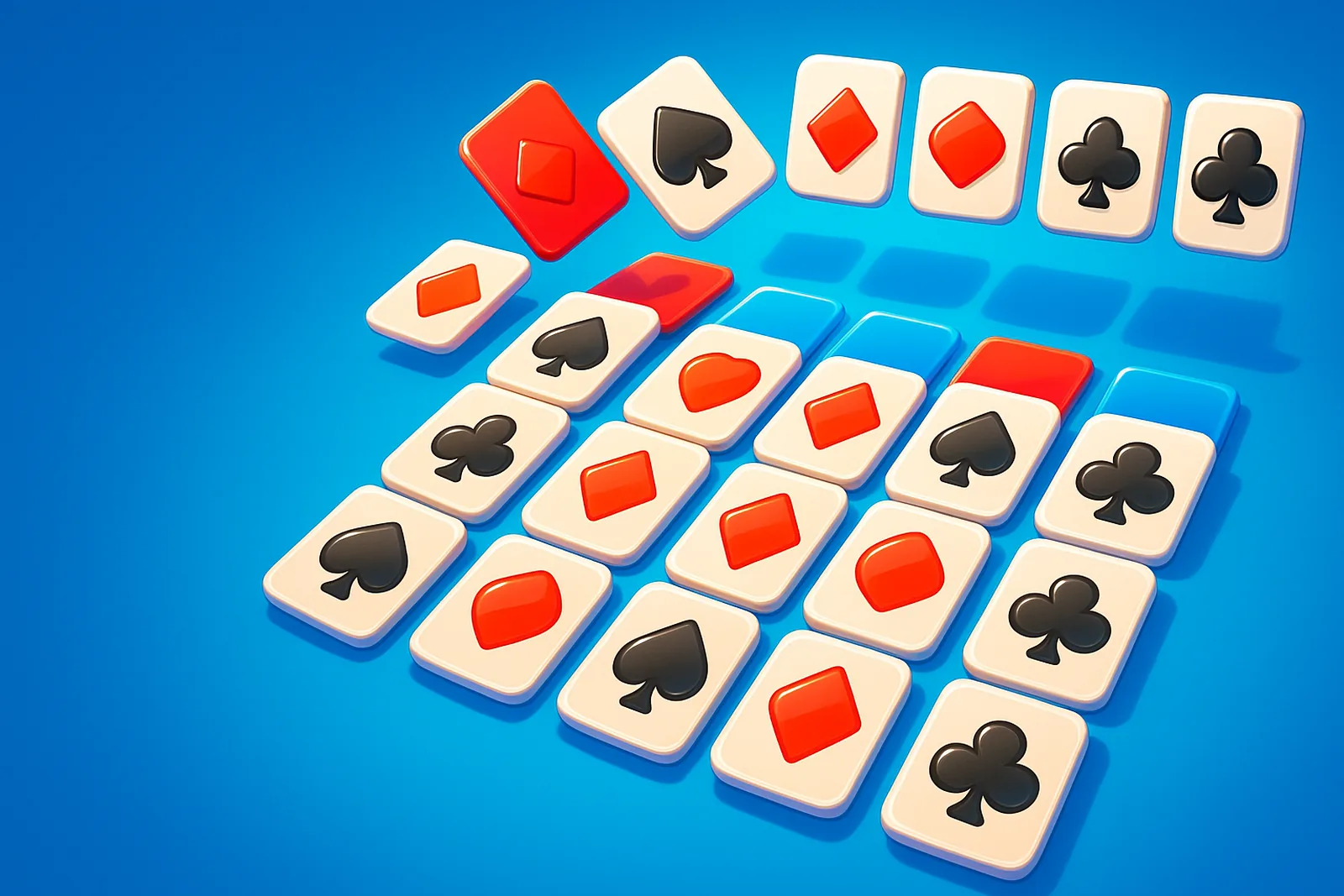
The FreeCell opening moves that matter are the ones that increase mobility without spending your four cells too early. Before the first ten moves, find the buried low cards, preserve at least one cell, and avoid foundation moves that remove useful building cards.
The rules are already on the table. A fresh FreeCell deal shows every card, yet the board can still feel crowded after only a few moves. The first phase is not about clearing foundations as fast as possible. It is about making later moves cheaper. A good opening leaves you with choices: one empty column in sight, a cell still available, and the ranks around aces and twos not buried under avoidable clutter.
These FreeCell tips are ordered because the order matters. A move that is excellent after move 12 can be poor on move 2, when you do not yet know which column will become your working space. Treat each point as a test, not a slogan. If the reason fits the deal, play it. If the exception fits better, leave the card alone.
Which first moves actually matter in FreeCell?
The first moves that matter are the ones that change how many legal moves you will have after the board tightens. Moving a card from one column to another matters when it uncovers a low buried card or turns a blocked column into a working column. FreeCell rewards access more than speed. It is the wrong move when the uncovered card has nowhere useful to go and you have merely made a longer, messier pile.
Opening a free cell matters when it buys a forced uncovering, such as parking one card to release an ace, two, or a connector you need for a run. A cell is temporary storage, not a display shelf. It is the wrong move when the card you park has no planned exit, because one trapped cell can halve what you can shift next.
Starting a same-suit foundation matters when the card is no longer needed for building below it. An ace usually leaves without cost; a two or three needs a glance at the opposite-colour ranks it might support. A foundation card cannot help you stack in the tableau. It is the wrong move when that black three was the only landing place for a red two blocking a column.
Creating an empty column matters more than almost any single exposure, but only if you can use it. An empty column can move a long sequence or hold a king safely. It is the wrong move when you empty a column and then immediately waste it on a single card that could have gone to a cell.
What should you do before you touch a foundation?
- Locate all 4 aces and the twos above them. Reason: a foundation start is only useful if the next ranks can follow or if the ace releases space. Wrong move: chasing an ace buried under 5 cards while an exposed two is blocking a cleaner column elsewhere.
- Find the shortest useful uncovering. Reason: one move that reveals a needed low card is better than three moves that only reshuffle high cards. Wrong move: taking the shortest line when it fills 2 cells and leaves no way to return those cards.
- Check whether the card you want to send up is still a builder. Reason: threes, fours, and fives often support opposite-colour lower ranks in the opening. Wrong move: holding back an ace or clearly dead two when it clogs a column and has no tableau job.
- Count your escape spaces. Reason: four cells plus any empty columns determine how much you can rearrange. Wrong move: refusing to spend a cell when that single spend uncovers a card that immediately empties a column.
- Name your first empty column before you make it. Reason: an empty column is strongest when reserved for a king, a long run, or a controlled rebuild. Wrong move: delaying a clear column because you want a perfect use; sometimes a temporary single-card use prevents a worse blockage.
Which moves look clever and are usually wrong?
- Dumping every low card to the foundations. It feels clean because the foundation never blocks a column. It is usually wrong when the card still works as a landing place in the tableau. It is right when the rank is no longer needed, especially an ace or a two with both lower foundations ready.
- Using all 4 cells to expose one attractive card. The visible reveal feels decisive. It is usually wrong because the next move has to solve 4 parked cards before it solves the deal. It is right when the exposed card immediately creates an empty column or releases several forced foundation moves.
- Clearing the shortest column first. Short columns look like free space. It is wrong when the final card in that column is a queen with no useful follow-up, while a longer column hides an ace. It is right when the short column can be emptied without spending cells and can hold a long run afterwards.
- Building a beautiful descending run too early. A neat 7-6-5-4 stack looks like control. It is wrong when it buries cards you need to move separately. It is right when the run sits on a stable base and can be shifted as a unit with your available spaces.
- Moving a king just because a column is empty. Kings are tempting anchors. It is wrong when the king traps a column before you know the colour and suit pattern needed below it. It is right when that king begins the longest movable sequence on the board.
How do you clear a column without trapping yourself?
Clear a column by working backwards from the card that will occupy the empty space. If you cannot name that card, you are probably clearing for the feeling of progress rather than for mobility. A column clear should reduce pressure on cells, not create a new debt.
- Choose the column with a useful bottom card, not merely the fewest cards. Reason: the bottom card decides what the empty column can become. Wrong move: ignoring a 6-card column that contains a buried ace because a 2-card column looks easier.
- Move blockers onto cards that already have exits. Reason: if a blocker can later go to a foundation or into a run, it will not live in a cell for long. Wrong move: stacking a blocker onto the only card needed to free another column.
- Keep one cell open until the final clearing move if you can. Reason: the last blocker often needs a temporary shelf. Wrong move: refusing to fill the last cell when doing so reveals the exact card that empties the column.
- Fill the empty column with a plan. Reason: an empty column multiplies movement, especially for longer runs. Wrong move: leaving it empty for too long while the board has no legal progress; a controlled temporary fill can be correct.
A clean clear often looks slower than a flashy one. Over the next 5 moves, it usually spends fewer cells, and those saved cells are what keep awkward deals playable.
What changes once the opening is stable?
Once the opening is stable, the question changes from how do I start? to which constraint can I remove next? A stable opening means you still have at least one free cell or an empty column, the lowest ranks are no longer badly buried, and no parked card is stranded without a route out.
At that point, foundation moves become better. The tableau has enough structure to survive losing small building cards. It is still wrong to send up a four or five automatically when it is the only support for an opposite-colour card that opens a column.
Longer runs also become more valuable. A stable board can move sequences instead of single cards, so one decision can tidy 3 or 4 cards at once. It is wrong when the run crosses the one card you needed loose for a foundation chain or a column clear.
Empty columns should now do heavier work. Use them to rebuild around kings, shift sequences, or rescue trapped low cards. The board has enough information exposed for a plan to hold. It is wrong to reserve an empty column forever while small, certain improvements disappear; unused space is not strength if it stops progress.
The middle game is less about cleverness than accounting. Count cells. Count empty columns. Count which parked cards have exits.
Frequently asked questions
Rarely. A first-move free cell is a cost, not a plan. Spend it only if it exposes a low card, creates an immediate build, or starts a clear route to an empty column. If the move merely parks a card because you can, leave the cell open and look again.
2 free cells should be your minimum after the first few moves. With two empty cells, you can still rearrange small knots and move short runs. With one, every new problem needs an empty column. With none, the deal starts choosing for you, and visible cards stop being useful information.
The common misconception is that every ace belongs on the foundation the moment it appears. The correction is that an ace is safe only when moving it does not remove a card you need for a build or expose a worse blocker. Low foundations help, but the opening is still about mobility first.
In a real hand, a move like 9♠ onto 10♥ can look harmless. If that 9♠ was covering A♦ and the 10♥ sits in a column you hoped to empty, the build has delayed both jobs. A better first ten moves would expose the ace or free the 10♥ column before making the tidy-looking stack.
It depends on the blockers between the ace and the surface. If one movable card covers it, chase the ace. If three cards cover it and two of them need free cells, work on a column first. Buried aces are useful targets, but a half-cleared column gives you more ways to reach them.
FreeCell is closer to Baker's Game than to Klondike Solitaire (Turn 1) in the opening because every card is already visible. Baker's Game is stricter because tableau builds by suit, so early mistakes bite sooner. Klondike Solitaire (Turn 1) asks more about what appears from the stock; FreeCell asks what order you choose.
The short rule: open a buried low card or reduce the tallest blocked column. The exception is a move that spends two free cells to do it. A target is not worth much if reaching it leaves you unable to move the next card. Count the spaces after the move, not before it.
Most people do one thing wrong: they treat free cells as parking spaces instead of working space. They move four awkward cards aside, enjoy the clean tableau for one move, then discover every useful card now needs storage. Keep one cell unused unless the move produces an empty column or a direct foundation run.
Tempo in a FreeCell opening means the number of useful moves you create before you run out of space. A move gains tempo when it exposes a card, joins a build, or frees a column without consuming too much storage. A move loses tempo when it parks a card and creates no next action.
Point to the card that will be uncovered, then point to where the moved card can go next. If you cannot name both, do not move yet. Check free cells, empty columns, and opposite-colour builds. A reversible move gives you a way back or a way forward; a guess gives you a smaller game.
Nobody knows precisely, because the full set of possible shuffled FreeCell deals is too large to solve exhaustively in casual play. The best hard benchmark players quote is the original Microsoft 32,000 deals: 31,999 are solvable and deal 11982 is not. That is about 99.997% for that set, not a proof for every deal.
Paul Alfille created the computer version of FreeCell for the PLATO system in 1978. The idea became widely known later through Microsoft’s version, especially after Windows 95. That history matters for openings because FreeCell was built as an open-information puzzle: the challenge is planning, not waiting for a hidden card to appear.
The cost of getting it wrong is losing your strongest tool. An empty column can move a king pile, turn one free cell into several temporary spaces, and break a jammed column apart. Fill it with the wrong card too soon and the rest of the opening becomes storage management instead of solving.
Final thoughts
If you want a practical habit, pause after the deal and make yourself say the first 3 moves before playing any of them. Not a full solution. Just 3 moves with reasons. This tiny delay catches many losing openings, because bad FreeCell starts often come from treating a visible card as an urgent card.
The evidence for universal opening formulas is thin. FreeCell deals are too varied for a single first move to be correct across the board, and the useful advice is mostly structural: preserve mobility, expose low cards, and do not spend storage without an exit. That may sound less exciting than a secret system, but it is more honest and more useful.
One more friend-to-friend point: do not punish yourself for rewinding mentally. Strong FreeCell play is full of almost-moves. You hover over a foundation card, notice it supports something, and leave it. You start to fill a cell, see it has no exit, and cancel the idea. That restraint is play, not hesitation. The deal will give you enough hard choices without you donating 2 cells to a plan you cannot finish.
-
FreeCell
The FreeCell Supermove: The Formula for Moving Big Stacks
Use the FreeCell supermove formula as a limit, then judge the move by what it opens, what it spends, and what remains playable.
15 August 2026
-
FreeCell
FreeCell Strategy: How Good Players Never Get Stuck
A practical guide to FreeCell decisions: what to check first, which cards to release, when to build, and how to avoid dead stalls.
14 August 2026
-
 FreeCell
Eight Off: The FreeCell Variant with More Cells and Stricter Suits
Eight Off is a stricter FreeCell relative with more free cells, same-suit tableau building, and empty columns reserved for kings.
13 August 2026
FreeCell
Eight Off: The FreeCell Variant with More Cells and Stricter Suits
Eight Off is a stricter FreeCell relative with more free cells, same-suit tableau building, and empty columns reserved for kings.
13 August 2026