
Eight Off is a one-player solitaire game using a standard 52-card pack, eight tableau columns, eight free cells, and four foundations built by suit from ace to king.
If you already know FreeCell, the family resemblance is obvious: open information, no stock pile, and a win that comes from planning rather than drawing the right card. The differences matter from the first move. Eight Off gives you more cells than FreeCell, but it also makes the tableau stricter. You build columns down in the same suit, not by alternating colour, and only kings may enter empty columns.
That mix changes the rhythm. There is more temporary storage, so you can untangle ugly positions without panic. There is also less flexibility in where cards can land, so careless use of the cells soon turns a roomy board into a cupboard with every shelf full. The practical questions are concrete: what the Eight Off rules actually allow, which early moves keep the cells useful, and what a healthy deal looks like before it becomes a win.
What makes Eight Off different from FreeCell?
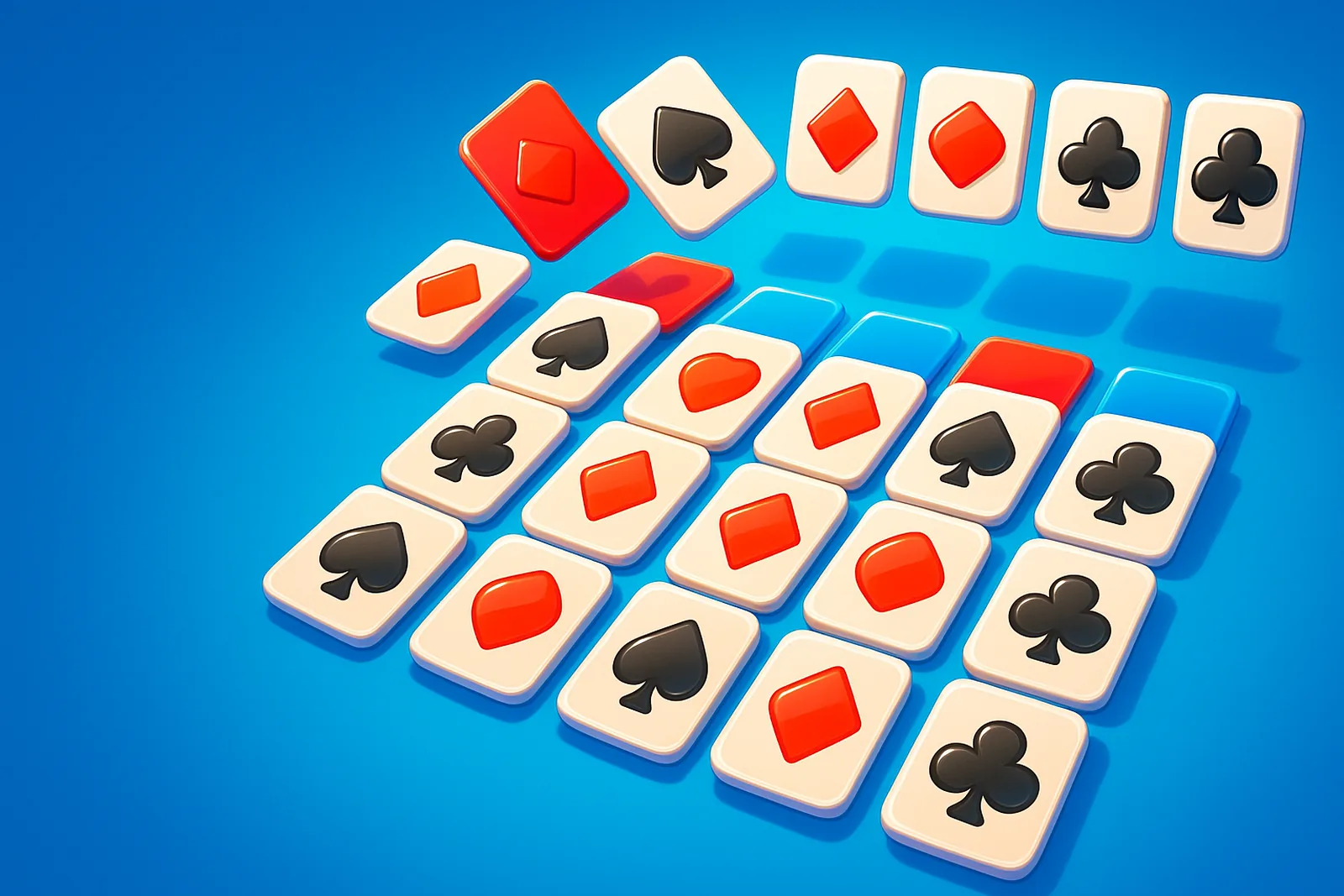
Eight Off sits close to FreeCell, but it is not FreeCell with extra storage. The headline difference is the cell count: Eight Off has eight free cells. Four of them start filled by the deal, so your first position normally gives you four empty cells to work with.
The stricter rule is on the tableau. In FreeCell, columns are usually built down by alternating colour. In Eight Off, tableau building is down in the same suit. The 7 of spades may go on the 8 of spades; it may not go on the 8 of hearts, clubs, or diamonds. This makes ordered runs cleaner once they form, but harder to start.
Empty columns are also more demanding. In Eight Off, only a king may be moved into an empty tableau column. That single rule changes the value of every cleared space. An empty column is powerful, but it is not a general-purpose parking bay.
The game remains an open-information solitaire. There is no stock, no waste pile, and no hidden card waiting to rescue a bad line. Nearly every deal is winnable with correct play, which is part of the appeal and part of the pressure. If a deal collapses, the interesting question is usually not whether the shuffle was cruel, but which earlier move spent too much freedom.
How is the deal set up?
Eight Off solitaire uses one standard pack of 52 cards, with no jokers. It is a one-player game. All cards are visible from the start, split between the tableau and the free cells.
- Tableau: eight columns are dealt with six face-up cards each. That accounts for 48 cards.
- Free cells: the remaining four cards are dealt into four of the eight cells. The other four cells begin empty.
- Foundations: four foundation piles begin empty, one for each suit.
- Goal: build each foundation up in suit from ace to king.
- Scoring: standard Eight Off rules have no points score. The deal is won or not won.
The first thing you meet is therefore a complete board, not a draw pile. Every ace, every trapped low card, and every buried king can be seen. That does not make the game mechanical. It means the difficulty is in order and timing.
The four occupied cells are not a penalty; they are part of the shape of the deal. They often hold useful cards, but they also reduce your early manoeuvring room. Clearing a cell is usually one of the first practical gains. Clearing a tableau column is even stronger, provided you have a king worth moving there.
The foundations are suit-specific. A foundation that starts with the ace of clubs must continue with the 2 of clubs, then the 3 of clubs, and so on. A completed game has all 52 cards on those four foundations.
What do you actually do on a turn?
- Look for safe foundation moves. Any exposed ace can move to an empty foundation. After that, the 2 of the same suit may go onto it, then the 3, and so on. A card is exposed if it is at the bottom of a tableau column or sitting in a cell.
- Move one exposed card at a time. The basic unit of play is a single available card. Some digital versions let you drag a tidy run, but that is only a shortcut when the same result could be made by legal single-card moves using cells and empty columns.
- Build tableau columns down in suit. You may move the 9 of hearts onto the 10 of hearts. You may not move it onto the 10 of diamonds, even though both cards are red, and you may not move it onto the 10 of spades just to make room.
- Use cells as temporary storage. Any exposed card may move into an empty free cell. Cells are precious because each occupied cell reduces the number of rearrangements you can make next turn. Filling all eight is rarely comfortable.
- Put only kings into empty columns. If a tableau column becomes empty, it can receive a king and no other rank. This is one of the core Eight Off rules, and it is where many FreeCell habits cause trouble.
- Win by completing the foundations. The game ends in a win when all four suits have been built from ace through king on the foundations. There is no separate point target. If the board no longer offers useful progress, the practical result is a stuck deal.
How do you know a deal is going well?
- You are gaining cells, not spending them. A good line often turns four empty cells into five or six before the hard work begins. If every move needs another cell, slow down.
- Aces and twos are coming out naturally. Early foundation progress matters most when it frees cards beneath it. Moving a low card up is best when it uncovers another useful card or opens a column.
- Your same-suit runs are getting longer. A column holding the 10, 9, and 8 of one suit in order is genuinely useful. Mixed clutter is just exposed clutter.
- You have a king plan before clearing a column. An empty column is wasted if no king can use it. Better still, the king you move should bring part of its suit with it or uncover a card you need.
- You are not racing every card to the foundations. Foundation moves are usually safe, but not always urgent. A middle card may still be needed as a landing place in the tableau before its lower cards are ready.
- The buried cards are becoming specific problems. Vague trouble feels like eight messy columns. A deal going well has named targets: free the ace of diamonds, release the black kings, clear one more cell.
Why play Eight Off at all?
Eight Off is worth playing because it gives you more room and then asks you to justify every inch of it. The eight cells feel generous at first. Then the same-suit rule starts to bite, and you realise that storage is not the same as freedom.
Compared with FreeCell, the game is a little more architectural. Alternating colours is no longer enough to keep cards moving. You are trying to gather each suit into useful downward runs while keeping enough cells open to lift pieces out of the way. A clean Eight Off win has a satisfying shape: cells empty, kings placed, long suit runs collapsing upward into the foundations.
It also suits short, serious games. There is no waiting for a stock pile to turn. Every card is visible, so the board gives you enough information to make a real plan within the first minute. A poor move can still be repaired, because the cells give you tools. A careless series of poor moves cannot be waved away.
Players who enjoy Baker's Game or FreeCell Kings Only will recognise the pleasure of stricter movement rules. Players coming from Relaxed FreeCell may find Eight Off less forgiving, but fairer than it first appears. The evidence on exact win rates depends on implementation and deal selection, but the broad truth is clear: this is a highly winnable solitaire when played with patience.
Frequently asked questions
Yes. Eight Off is usually more forgiving because you have eight free cells rather than four, and four of them start empty. The catch is that tableau building is stricter: you build down in the same suit, not by alternating colour. If you waste the extra space, it can feel harder than FreeCell.
8 free cells sit above the tableau. At the start, four are already occupied by dealt cards and four are open, so you begin with room to manoeuvre but not unlimited room. Those cells are temporary parking spaces; the win still comes from building each suit up on the foundations.
People often think Eight Off works like FreeCell with more spare spaces; it does not. In Eight Off, tableau cards build down by suit only. The 9 of clubs takes the 8 of clubs, not the 8 of hearts or 8 of diamonds. That single rule changes the whole rhythm of the game.
A hand with the 8 of hearts sitting on the 7 of hearts is already offering you a useful in-suit run. If moving one blocking card to a free cell releases the 6 of hearts beneath it, that is usually better than making a random low-card move. Early moves should uncover suit sequences, not just make the tableau look busy.
It depends on empty columns: if you have a king ready to use, an empty column is powerful; if you do not, it may sit uselessly while the rest of the board tightens. Empty columns are not general dumping grounds in Eight Off. They are king spaces, so clearing one before you can use it can waste a hard-won opening.
Compared with Baker's Game, Eight Off gives you more reserve space and a different starting feel. Both games care about suit order, so they punish sloppy colour-based habits from FreeCell. Eight Off is often the gentler entry point because the extra cells let you repair mistakes, but it still asks you to think in full suits.
Kings only in empty columns. The exception is that free cells are different: any single card can sit in an empty free cell, whatever its rank or suit. This is the rule that catches many FreeCell players. In FreeCell, an empty column is flexible. In Eight Off, it is a place prepared for a king.
Most people do wrong by treating free cells as storage rather than time. Every card parked there should have a reason and a planned exit. If you fill cells with awkward middle cards, you may have no room left to move the card that actually frees a column or joins a suit run.
A foundation is one of the four suit piles you build from ace upwards. The aim is to move every card onto the foundations, from ace through king in each suit. Tableau moves help you expose and organise cards, but foundations are where progress becomes permanent. Once a card is safely useful there, it stops blocking the board.
Keep at least one free cell open unless a move clearly improves the position. Use cells to lift blockers, connect same-suit sequences, and reach aces or low cards for the foundations. Do not fill them just because you can. A full row of free cells is not safety; it is usually the warning light.
Nobody knows precisely, because a definitive figure would require a clearly stated deal generator and a solver checking the deals. The best available figure for ordinary play is the one that matters: nearly every Eight Off deal is winnable. If you lose, assume first that the position was mishandled, not that the deal was impossible.
FreeCell was popularised for many players by Microsoft Windows, but Eight Off belongs to the same older patience family rather than being a modern casino-style card game. Its relatives include Baker's Game and FreeCell. The shared idea is open information, careful card movement, and a puzzle that is usually decided by planning rather than luck.
The cost is space. Once a king enters an empty column, it starts a lane that only its suit can use cleanly. If that king does not help you release buried cards or build a useful run, you may have spent your best resource on decoration. In Eight Off, a bad king move can trap half a suit behind it.
Final thoughts
The useful advice is to treat Eight Off as a game of exits. Before moving a card, ask what it releases. A cell should release a column. A column should release a king. A king should release a run. If a move only makes the board look tidier, it may be vanity.
FreeCell habits help, but they also mislead. In FreeCell, an empty column can rescue almost anything. In Eight Off, a non-king has to find a proper same-suit landing place or sit in a cell. That is why the first few moves matter more than they appear to. The board can look open while its real exits are already closing.
Do not rush the foundations as a reflex. Do not hoard every card in the tableau either. The skill is knowing when a card has finished its work below and can safely go up. That judgement improves quickly because the game shows you the consequences without hiding information.
If you lose, replay the position mentally from the moment the cells filled up. There is usually a point where one tempting move used the last spare cell without creating a new one. Find that moment. The next deal will feel less like a maze and more like a machine you are learning to operate.
-
 FreeCell
 Rules: How the Game Works and Why It Is Fair
A clear guide to FreeCell rules, from the opening layout and legal moves to the win condition, dead ends, scoring, and fair-play appeal.
13 August 2026
FreeCell
FreeCell Rules: How the Game Works and Why It Is Fair
A clear guide to FreeCell rules, from the opening layout and legal moves to the win condition, dead ends, scoring, and fair-play appeal.
13 August 2026
-
 FreeCell
Baker's Game vs FreeCell: One Rule, Twice the Difficulty
Baker's Game is the harder FreeCell variant: play FreeCell first for fluency, then Baker's Game when ordinary FreeCell feels too forgiving.
12 August 2026
FreeCell
Baker's Game vs FreeCell: One Rule, Twice the Difficulty
Baker's Game is the harder FreeCell variant: play FreeCell first for fluency, then Baker's Game when ordinary FreeCell feels too forgiving.
12 August 2026
-
FreeCell
FreeCell Game 11982: The Deal Nobody Can Win
FreeCell 11982 is famous because it is not merely difficult: under Microsoft deal numbering, exhaustive solvers classify it as unwinnable.
12 August 2026