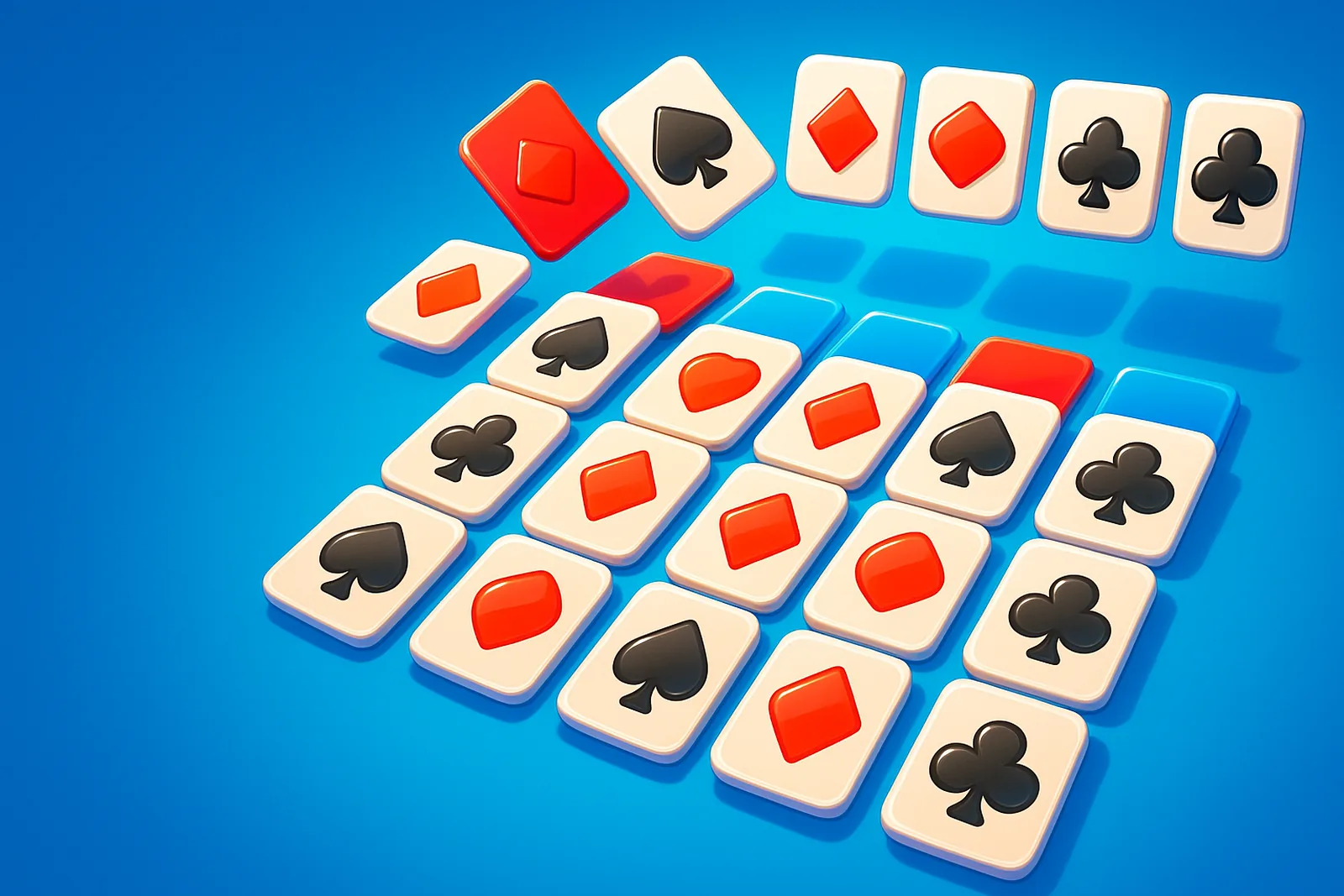
FreeCell is a one-player solitaire game with all 52 cards face up: build each suit from ace to king on the foundations, using four temporary cells and eight tableau columns to get there.
The attraction is that the puzzle is visible from the first deal. There is no stock pile, no hidden card waiting under a stack, and no draw rule that changes your options by chance. You can inspect the whole position before making the first move. That makes the freecell rules easy to state and harder to master: move cards in the right colour order, keep enough space to manoeuvre, and send cards home when their suit is ready.
If you want to know how to play freecell, start with the board. Learn what each area does. Then learn the few legal freecell moves that connect them. The game ends when every card has reached the foundations. The rules themselves do not award points; a deal is either solved or left unfinished, while some computer versions also count moves or time.
What are the rules of FreeCell, in plain terms?
FreeCell is solitaire for one player, played with a standard 52-card deck and no jokers. Every card is visible from the deal. Your job is to move all cards to the four foundations, one foundation for each suit, building each suit upwards from ace to king.
The main playing area is the tableau: eight columns of face-up cards. You may move the exposed card at the bottom of a column onto another exposed card if it is one rank lower and the opposite colour. A black 7 can go on a red 8. A red queen can go on a black king. Suits do not matter in the tableau; colour and rank do.
The four free cells are temporary parking spaces. Each free cell holds one card. They are powerful because they let you get at buried cards, but they are also a limit: fill them too early and you have fewer ways to uncover blocked cards.
Empty tableau columns are even more useful. In standard FreeCell, any single card may be moved into an empty column. Some related games restrict this, but FreeCell does not.
The card rules have no point scoring. If all 52 cards reach the foundations, you win. If you cannot finish the deal, you have not won it, no matter how tidy the board looks.
How is a FreeCell game set up?
The freecell setup has three areas: the tableau, the free cells, and the foundations. All cards start in the tableau. The free cells and foundations start empty.
- Deck: one standard 52-card deck, with no jokers.
- Players: one.
- Tableau: eight columns, all cards face up.
- Column sizes: the first four columns receive seven cards each; the last four columns receive six cards each.
- Free cells: four spaces above the tableau, each able to hold one card.
- Foundations: four spaces, one for each suit, built from ace up to king.
The deal is even enough to scan quickly, but uneven enough that the first four columns begin slightly deeper. Because every card is face up, you can see where each ace is, which kings block long columns, and which low cards are trapped under higher cards.
A useful first look is not complicated. Find the aces and twos. Look for emptying chances in the six-card columns, because shorter columns often clear first. Then check which cards would need a free cell before they can move. This is the first real decision in FreeCell: not what card can move, but what space you are spending to move it.
Nothing is drawn later. The opening deal is the whole puzzle.
What can you do on your turn?
- Move a card to a foundation. An ace may start its suit foundation. After that, the next card of the same suit may be placed on it: 2 on ace, 3 on 2, and so on up to king. Foundation cards normally stay there because the aim of the game is to get all cards home.
- Move a card between tableau columns. You may move an exposed card onto an exposed card of the opposite colour and one rank higher. For example, the 6 of hearts may go on the 7 of clubs or the 7 of spades. Only the bottom card of a tableau column is exposed for moving.
- Move a card into a free cell. Any exposed card may be put into an empty free cell. A free cell holds exactly one card. You can later move that card back to the tableau or onto a foundation, provided the destination is legal.
- Move a card into an empty tableau column. In FreeCell, any single exposed card may be placed into an empty column. This is often better than using a free cell, because an empty column can help shift several cards in sequence.
- Move a sequence when there is enough space. The rules only need single-card moves, but computer FreeCell often lets you drag a correctly ordered alternating-colour run if the same result could be made one card at a time. With two empty free cells and no empty columns, you can move a run of three cards. Extra empty columns increase that capacity.
Good freecell moves preserve space for the next problem. A legal move that fills the last free cell may be worse than waiting, even if it looks neat for one turn.
How do you win, and what counts as a dead end?
You win FreeCell by moving all 52 cards to the four foundations. Each foundation is a single suit built in order from ace to king. When the last king lands on its foundation, the game is over. There is no extra final move and no need to clear the tableau separately, because clearing the tableau is what happens as the cards go home.
The standard rules do not contain a points table. Cards do not have values, suits do not score differently, and a king is not worth more than an ace. Many digital versions show a move counter or a timer, but those measure how you played; they do not change the win condition. A slow win is still a win. A fast unfinished deal is still unfinished.
A dead end is a position from which you cannot complete the foundations by legal play. The obvious kind is when you have no legal moves at all. The more common kind is quieter: you still have moves, but they only cycle cards around without freeing the rank or suit you need.
Do not confuse a cramped board with a dead one. FreeCell often looks stuck just before a column opens. The usual warning sign is that all four free cells are occupied, no tableau column is empty, and the exposed cards cannot be moved to foundations or onto one another. At that point, the mistake may have happened several moves earlier.
Why do people say FreeCell is fair?
- All information is visible. Every card is face up from the start, so a loss cannot be blamed on a hidden card or an unlucky draw. You saw the problem; the question is whether you found the route through it.
- The rules are stable. The tableau builds down by alternating colour, the foundations build up by suit, and each free cell holds one card. Once you know those rules, the game does not surprise you with exceptions.
- Space is the real resource. The four free cells and empty columns give you control, but not comfort. Most hard positions are about spending space too early, not about receiving a bad card later.
- Almost every standard deal is winnable. That phrase matters. It does not mean every possible deal is guaranteed, and exact claims depend on which deal set is being discussed. The honest point is simpler: FreeCell is usually a test of planning rather than luck.
- Mistakes are legible. If a board collapses, you can often see why: a free cell was filled too soon, a column was not cleared, or a low card was buried behind the wrong colour order. That makes the next game sharper.
Frequently asked questions
Yes, if you have enough empty space to make the move legally one card at a time. A run such as 9 of clubs, 8 of hearts, 7 of spades can be moved together only when the free cells and empty columns could support the same transfer step by step.
2 free cells open is a good working minimum for much of the game. One free cell leaves you cramped. None leaves you stuck unless the next move is to a foundation or empty column. Empty tableau columns are even stronger than free cells because they can help shift longer runs.
People often think a free cell is a spare shelf; it is really a temporary parking space. A buried low card may be worth parking a king for, but filling cells with random high cards usually cuts off the moves you need to get them out again.
Suppose an ace is sitting under only one card in a column. Moving that covering card into a legal tableau spot, then sending the ace straight to the foundation, is usually stronger than shuffling a long run for no gain. Early foundation moves create space without spending a free cell.
It depends on whether the move traps a useful card or releases one. Aces are nearly always safe to move up, because nothing needs to be built on an ace in the tableau. Twos and threes usually follow soon after, but higher cards can matter if they are still needed to hold alternating-colour runs.
Compared with Baker's Game, FreeCell is usually more forgiving because tableau builds alternate colours. Baker's Game builds down by suit, which gives fewer landing places and makes blocked suits more painful. The layout looks close, but the building rule changes the feel of almost every decision.
The short rule is yes: any single card can be moved into an empty column in standard FreeCell. The exception is not about rank, but about reach. If the card is buried, you still need legal moves and enough temporary space to get it there.
Most people do wrong by spending free cells too early, then calling the deal unfair. The harder skill is leaving yourself exits. Before parking a card, ask how it gets out. Before filling an empty column, ask whether that column should be saved to move a longer run.
A supermove is the combined move of a valid descending, alternating-colour sequence, treated as one action by the computer. It is a shortcut, not a new rule. The game is calculating whether you could move those cards one by one using the empty free cells and empty columns available.
Look at the destination first. On the tableau, the card you move must be one rank lower and the opposite colour. On a foundation, it must be the next card up in the same suit. Into a free cell, it must be a single card and the cell must be empty.
Nobody knows precisely across every possible shuffled deal, because there are far too many deals to classify by hand. The best available benchmark is the first 1,000,000 Microsoft-style numbered deals, where 8 are generally listed as unwinnable. That puts the benchmark above 99.99% winnable.
Paul Alfille wrote an early computer version of FreeCell for the PLATO system in 1978. The game became widely known later through Microsoft Windows, especially because numbered deals let players compare the same puzzle. That fixed-deal habit is part of why fairness became central to FreeCell’s reputation.
The cost of getting it wrong is losing a useful building card. If a red 8 goes up before you have used it to hold a black 7, you may block a whole column for several moves. Foundation moves are safe when the card is no longer needed in the tableau.
Final thoughts
The best first habit is restraint. New players often move every card that can legally move, then wonder why the board has gone solid. FreeCell rewards the opposite instinct: make a move because it opens a card, creates a column, or sends something safely to a foundation. If it only tidies the tableau, be suspicious.
There is also a pleasant honesty to the game. You can stare at a deal for a minute before touching anything and learn more than you would from five rushed moves. Where is the first empty column likely to come from? Which free cell must stay clear? Which ace is accessible, and which one is trapped under a card you can realistically shift?
That is why FreeCell stays interesting after the rules are familiar. The mechanics are small enough to hold in your head, but the consequences of one cramped free cell can travel across the whole board. A good win feels less like luck arriving and more like a knot coming loose because you pulled the right strand.
-
 FreeCell
Eight Off: The FreeCell Variant with More Cells and Stricter Suits
Eight Off is a stricter FreeCell relative with more free cells, same-suit tableau building, and empty columns reserved for kings.
13 August 2026
FreeCell
Eight Off: The FreeCell Variant with More Cells and Stricter Suits
Eight Off is a stricter FreeCell relative with more free cells, same-suit tableau building, and empty columns reserved for kings.
13 August 2026
-
 FreeCell
Baker's Game vs FreeCell: One Rule, Twice the Difficulty
Baker's Game is the harder FreeCell variant: play FreeCell first for fluency, then Baker's Game when ordinary FreeCell feels too forgiving.
12 August 2026
FreeCell
Baker's Game vs FreeCell: One Rule, Twice the Difficulty
Baker's Game is the harder FreeCell variant: play FreeCell first for fluency, then Baker's Game when ordinary FreeCell feels too forgiving.
12 August 2026
-
FreeCell
FreeCell Game 11982: The Deal Nobody Can Win
FreeCell 11982 is famous because it is not merely difficult: under Microsoft deal numbering, exhaustive solvers classify it as unwinnable.
12 August 2026