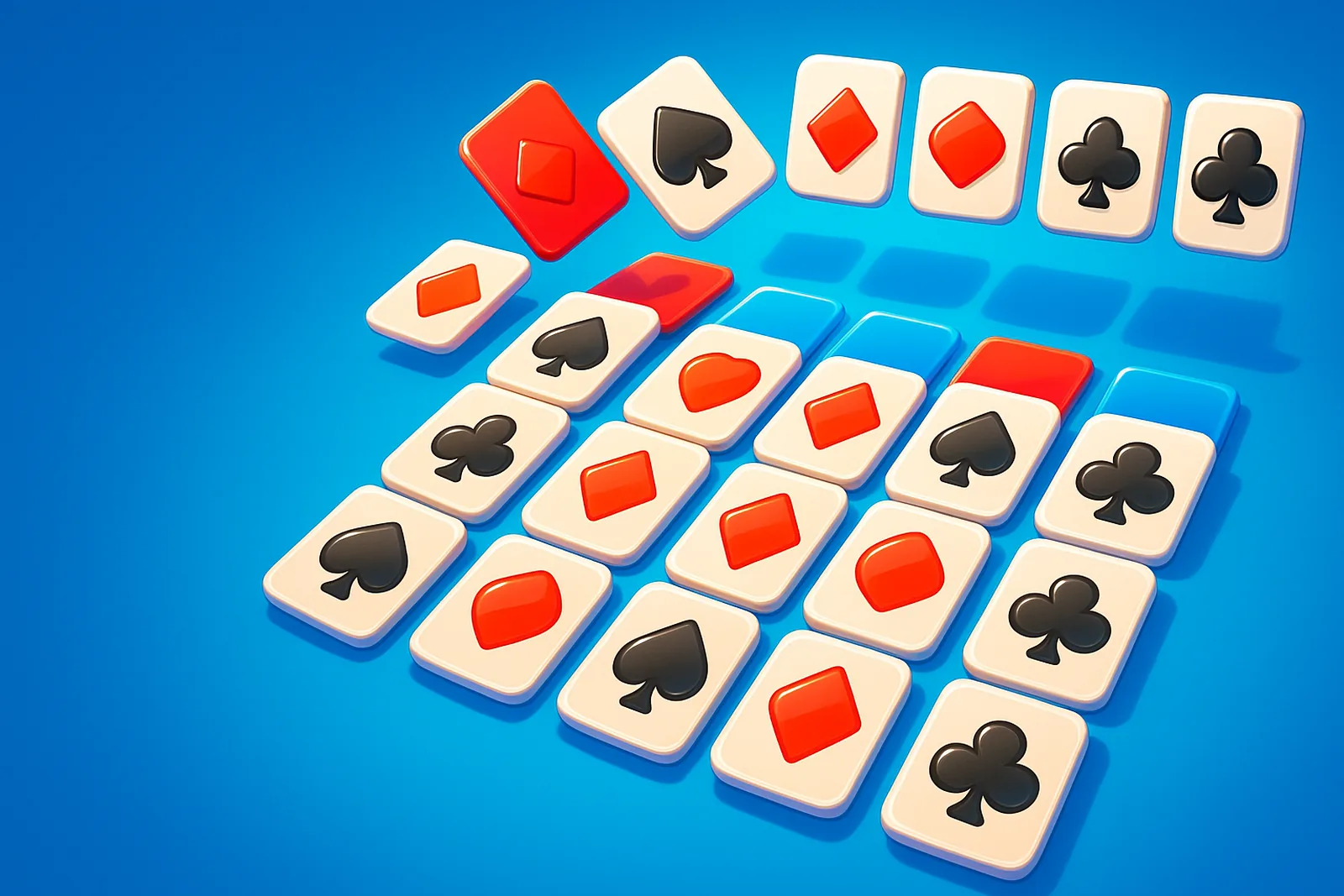
No one person solved the FreeCell 32000 deals. The best documented answer is the Internet FreeCell Project, a volunteer effort coordinated online in the 1990s. Its result was precise: 31,999 of Microsoft FreeCell’s first 32,000 deals were won; deal 11982 was the hold-out.
That distinction matters. People often write “all 32,000 were solved” as if every deal ended in a win. In FreeCell language, “solved” can mean something stricter: every deal was accounted for. A win was found, or the deal was identified as the exception that no human solution could dislodge and later solver work treated as unwinnable.
The story also shows why FreeCell stood apart from most solitaire games on early Windows. Every card is visible from the deal. Luck is mostly front-loaded into the layout, then the rest is planning, storage, and order. That made the game perfect for an internet-era crowd project: split the deal numbers, report the wins, argue over the failures, and keep going until the list stopped having gaps.
Who actually solved all 32,000 FreeCell deals, and when?
The honest answer is that no official body awarded a personal record for “solving all 32,000”. The credited achievement belongs to the Internet FreeCell Project, a volunteer effort associated with Dave Ring and other players who divided up Microsoft FreeCell’s original numbered deals during the 1990s.
The best documented figure is not 32,000 wins. It is 31,999 wins out of the 32,000 deals shipped with Microsoft FreeCell, with deal 11982 left as the exception. The project’s commonly cited completion point is 1995, when the numbered list had been worked through and the remaining argument centred on that one deal rather than thousands of unknowns.
That is the record worth keeping in your head: a collective internet project, completed in 1995, accounted for the first 32,000 Microsoft FreeCell deals and found wins for all but one. The wording is fussy because the record deserves it. “Solved all 32,000” is a tempting headline, but it hides deal 11982, the important bit.
FreeCell was suited to this kind of record because every card is face up at the start. A player looking at deal 2837 sees the whole problem, not a shuffled secret waiting underneath. Volunteers could compare results in a meaningful way. If two people selected the same deal number in Microsoft FreeCell, they were working on the same layout.
What does “32,000 solved” really mean?
In this story, “solved” does not mean “won 32,000 times”. It means the original Microsoft FreeCell deal list was systematically checked. Most deals were solved by finding a legal route to the foundations. One deal, 11982, became the documented exception.
- The set: the first 32,000 numbered deals in Microsoft FreeCell, the version many players met through Windows.
- The normal result: a winning sequence was found and recorded for the deal.
- The awkward result: deal 11982 resisted solution and became the famous outlier.
- The common misquote: “all 32,000 FreeCell deals were won”. That is not the reliable claim.
- The useful record: 31,999 wins, 1 exceptional deal, 32,000 deals accounted for.
The number also does not describe every possible FreeCell deal. A 52-card deck can be arranged in vastly more ways than 32,000. The 32,000 figure belongs to Microsoft’s original numbered deal list and the way its game let players choose a deal by number.
That is the detail many quick summaries miss. The FreeCell Project did not solve “FreeCell” as a mathematical universe. It solved a famous public list that millions of players could reproduce on their own machines.
How did the Internet FreeCell Project keep track of every deal?
The project worked because the target was finite and shared. Microsoft FreeCell gave players deal numbers, so the work could be split cleanly. A volunteer could take a block of numbers, play those deals, then report which ones had been won and which ones were still causing trouble.
That sounds ordinary now. In the mid-1990s it was exactly the sort of job the public internet was beginning to do well: many small contributions, a master list, and enough obsession to catch mistakes. The record was not one brilliant sitting by one player. It was clerical persistence attached to a hard puzzle.
The tracking problem was as important as the playing problem. If deal 17342 had already been won, another player did not need to spend a night on it unless they were checking the result. If a deal appeared unsolved, it could be pushed back into the crowd and tested by stronger players. Deal 11982 kept surviving that process.
There is no useful official scoreboard from Microsoft naming a single champion for the 32,000. What survives best is the project identity, the 1995 completion claim, and the stubborn count: 31,999 won. Careful answers name the project before they name any player.
Why did one stubborn deal matter so much?
- It stopped the clean headline. A perfect 32,000 out of 32,000 would be easy to repeat and easy to misunderstand. Deal 11982 forces the more accurate version: the list was accounted for, but not every deal was won.
- It tested the meaning of “almost”. FreeCell has a reputation for being nearly always winnable. The original Microsoft set supports that reputation: 31,999 wins from 32,000 deals. The exception makes the claim sharper, not weaker.
- It changed the burden of proof. At first, an unsolved deal only means nobody has found the line. After enough attempts, and later computer search work, 11982 became the deal people cite when they need the documented exception.
- It gave solver writers a benchmark. A FreeCell solver that crushes thousands of deals still has to behave sensibly when a deal cannot be won. A hard no is a different result from a slow yes.
- It made the record memorable. People forget a smooth count. They remember the one number that would not move: 11982.
What record can you trust today, and what should you ignore?
There is no official world-record certificate for the Internet FreeCell Project in the way there is for a timed sporting event. Treat the record as a documented community result, not a trophy held by one named player.
| Claim | Trust it? | Why it matters |
|---|---|---|
| The Internet FreeCell Project accounted for Microsoft’s first 32,000 deals. | Yes | It matches the documented project aim and the surviving public story of the work. |
| 31,999 of those deals were won. | Yes | This is the standard cited figure and it preserves the one known exception. |
| Deal 11982 is the famous unsolved exception. | Yes | It is the specific number attached to the record, not a vague “one deal”. |
| One person holds the record for solving all 32,000. | No | The work was a volunteer internet project, and the reliable result is collective. |
| All possible FreeCell deals have been solved. | No | The 32,000 refers to Microsoft’s numbered list, not every possible 52-card arrangement. |
If a page gives you a single heroic winner, a perfect 32,000 wins, and no mention of 11982, it is smoothing away the part that makes the record trustworthy.
Frequently asked questions
No. FreeCell is mostly skill because every card is visible, but the rules still allow unwinnable positions. The original Microsoft set is famous because almost every numbered deal could be finished, not because FreeCell itself guarantees a win. A strong player can lose a bad deal and can also lose a good deal by using the four cells carelessly.
52 cards are visible from the first move. That is the main difference between FreeCell and many other solitaire games: you are not guessing what sits under a pile. The difficulty comes from order, space, and timing. Four free cells look generous until you use all of them and discover you have no spare move left.
The common misconception is that someone at Microsoft designed 32,000 puzzles one by one. The correction is duller and more useful: the deals were generated by software and identified by number. That is why different players could discuss the same deal, replay it, and report whether it had been solved without needing to describe the whole layout.
Deal 11982 is the useful test case: if a FreeCell program lets you choose Microsoft-style deal numbers, enter 11982 and you are looking at the famous holdout, not a normal hard puzzle. On Veena Games you can play FreeCell quickly without hunting that historical number; the lesson is to read any “all deals solved” claim carefully.
It depends on the deal: with every card face up, most of the game is planning rather than chance. You can inspect the buried aces, see which suits are blocked, and choose a route. Luck still exists in the deal itself. Some layouts are gentle, some are tight, and a tiny minority are not winnable under the normal rules.
Compared with Baker's Game, FreeCell is usually more forgiving because tableau builds by alternating colour. Baker's Game builds by suit, which means fewer cards can sit on each other and the columns jam more easily. The games look close at first glance: open cells, visible cards, foundation building. The small rule change makes the planning feel much stricter.
Move low cards to the foundations when they cannot block anything. The exception is a card that still helps you organise the tableau. A black two, for example, may be needed under a red three while you free a buried ace. Foundation moves are safe more often than not, but automatic play can remove a stepping stone too early.
Most people use the free cells as storage instead of as breathing room. One spare cell can let you shift a short sequence; four occupied cells can leave you unable to move a single useful card. Before parking a card, ask what it releases and how it gets out again. If you cannot answer both, the move is probably clutter.
A seed is the number or value a program uses to generate a particular shuffle. In everyday FreeCell talk, players often say “deal number” instead. The point is repeatability. If two people load the same numbered deal in the same system, they should see the same starting layout and can compare solutions fairly.
Stop moving cards for a moment and look for the lowest buried card in each suit. Free an ace or two before chasing long sequences. Keep at least one cell empty if you can. Empty columns are stronger than free cells, so try to create one, then use it to reorder a whole run rather than making single-card shuffles.
Nobody knows precisely how many people took part; the best available figure is the project’s real unit of work, 32,000 deal numbers. The records that mattered were deal results, not a clean membership list. Volunteers came and went, reported solves, checked awkward cases, and left behind a better audit trail for the deals than for themselves.
Microsoft’s early FreeCell made numbered deals from 1 to 32000 familiar to millions of players. Those numbers gave the Internet FreeCell Project a fixed target: not “lots of FreeCell”, but this known block of deals. Later programs and versions are a different matter, so a claim about the old 32,000 should not be stretched to every FreeCell shuffle.
The cost of getting it wrong is trust. Saying all 32,000 are winnable erases the one case that made the project interesting and turns a careful record into a slogan. It also confuses new players: if they think every numbered deal has a clean solution, they may blame themselves for a position the rules do not allow them to finish.
Final thoughts
The best FreeCell record is not the neatest one. It is better than that. A perfect 32,000-win claim would be easier to print on a badge, but the real story has the texture of people doing careful work in public: thousands of ordinary wins, one deal that refused to co-operate, and a number everyone could check for themselves.
That is why deal 11982 still gets mentioned. It is not famous because it is fun to play. It is famous because it kept the record honest. FreeCell gives you all the information at the start, so failure feels personal for longer than it should. You stare at the columns. You make space. You undo the plan in your head. Then, eventually, the question changes from “What am I missing?” to “Is there anything to miss?”
Most games will not put you there. Most FreeCell deals are won by calm housekeeping: clear an ace, protect an empty column, do not fill a free cell just because it is free. The old project’s 31,999 wins came from that sort of play repeated until the list was quiet. If you want the habit, start a deal and look for the move that creates space rather than the move that merely moves a card.
-
FreeCell
FreeCell Openings: The First Ten Moves Decide the Game
A practical opening order for repeat FreeCell players who want decidable moves, clear reasons, and the exceptions that stop rules becoming traps.
15 August 2026
-
FreeCell
The FreeCell Supermove: The Formula for Moving Big Stacks
Use the FreeCell supermove formula as a limit, then judge the move by what it opens, what it spends, and what remains playable.
15 August 2026
-
FreeCell
FreeCell Strategy: How Good Players Never Get Stuck
A practical guide to FreeCell decisions: what to check first, which cards to release, when to build, and how to avoid dead stalls.
14 August 2026