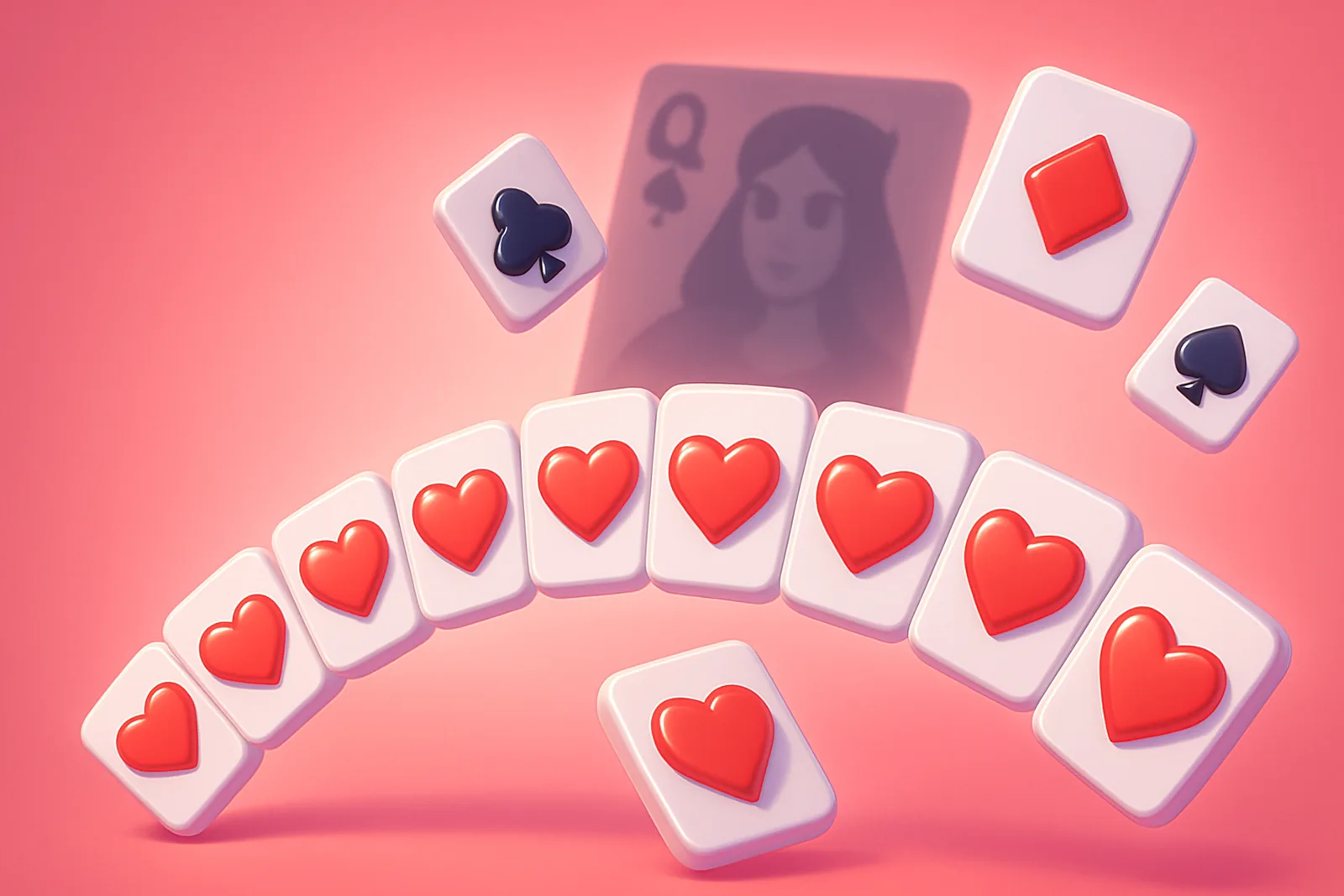
Spot Hearts is Hearts with the queen of spades switched off: only hearts score, one point each, thirteen raw points in the hand. You still play a 4-player trick-taking game with a full 52-card deck, and you still want the lowest score when the game ends.
The first game feels familiar until the danger moves. In Hearts, the queen of spades can dominate a hand because it carries the same penalty as all hearts combined. In Spot Hearts, that one explosive card becomes an ordinary spade. The damage is spread across the suit instead. A small heart on the wrong trick is no longer a harmless bit of drift; it is part of the whole bill.
A hand follows the usual Hearts order. Cards are dealt, cards may be passed, the player with the 2 of clubs leads, and everyone plays 1 card to each trick. You must follow suit if you can. The highest card in the led suit wins the trick and collects any hearts in it. A game ends after a hand in which at least one player has 100 or more points; lowest total wins.
What makes Spot Hearts different from ordinary Hearts?
The difference is one card, but it changes the weight of the whole hand. In Hearts, the queen of spades is a 13-point penalty. In Spot Hearts, the queen of spades scores 0. It can still win a spade trick, block a suit, or force an awkward lead. It no longer hurts your score by itself.
That leaves the hearts. There are 13 of them in the deck, and each heart is worth 1 penalty point. So the raw score available in a normal hand is 13 points, all spread across one suit. You are not waiting for one disaster card to appear. You are trying to avoid a series of smaller leaks.
These spot hearts rules make timing more visible. A low heart dumped on somebody else is a clean escape. A high heart kept too long can become a forced payment when that suit is led and you cannot dodge. Because the queen has no penalty, spade management is less about fear and more about control: do you want to win this trick, lose it, or make another player lead next?
Shooting the moon still exists in the practical sense: take all 13 hearts and you have taken every scoring card. The payout is smaller than in Hearts, but the idea is the same. Either avoid points, or take all of them. Half measures hurt.
How do you set up a hand and deal the cards?
Spot Hearts uses a standard 52-card deck with no jokers. There are 4 players. The whole deck is dealt out, face down, so every player starts with 13 cards. Aces are high. There is no trump suit.
- Players: 4 seats, each playing for their own score.
- Cards: all 52 cards are used.
- Hand size: 13 cards per player after the deal.
- Scoring cards: hearts only; the queen of spades is a normal card for scoring.
- Game target: the game is checked after each hand, and ends when at least one player has 100 or more points.
Before play begins, there is usually a pass. Each player chooses 3 cards and sends them to another player, then receives 3 cards in return. The pass direction rotates by hand: left, right, across, then no pass. After the no-pass hand, the pattern repeats.
The pass is part of the setup, not a side rule. It is where you decide what kind of trouble you can live with. Short suits help you get rid of hearts later. High cards can be useful if you want control, but they can also trap you into winning a heart-loaded trick. Once the pass is complete, the player holding the 2 of clubs leads the first trick.
What happens on each turn?
- The leader plays 1 card. The first leader of the hand is the player with the 2 of clubs, and that card starts the first trick. After that, the winner of each trick leads the next one.
- The led suit sets the rule for the trick. If clubs are led, every player with a club must play a club. If diamonds are led, diamonds must be followed. The same rule applies to spades and hearts.
- If you cannot follow suit, you may discard another suit. This is where many points move. If you are void in the led suit, you can throw a heart onto the trick and make somebody else take it. On the first trick, play a non-heart if you can; a heart is allowed only if it is all you have.
- Hearts cannot be led until they are broken. Hearts are broken when a heart has been discarded on a trick led in another suit. After that, a player who wins a trick may lead a heart. If a player has only hearts left, they may lead one even if hearts have not yet been broken.
- The highest card of the led suit wins. There is no trump. A spade cannot beat a club if clubs were led. Aces are high, then kings, queens, jacks, and down to 2.
- The trick winner takes the cards. Any hearts in those 4 cards are added to that player’s score for the hand. The queen of spades is just a spade here, so it adds no penalty.
- The hand ends after 13 tricks. Every card has been played. Count the hearts each player took, apply the moon rule if one player took all of them, then add the hand score to the running totals.
How does scoring work when the queen of spades is out?
Spot Hearts scoring removes the easiest misconception: the queen of spades remains in the deck, but it stops being a scoring card. With only 13 raw points available, attention moves from one dangerous card to one dangerous suit.
| Rule point | Hearts | Spot Hearts | Why it changes decisions |
|---|---|---|---|
| Scoring cards | All hearts and the queen of spades score. | Only hearts score. | You track one scoring suit instead of one suit plus a single dangerous queen. |
| Card values | Each heart is 1 point; the queen of spades is 13 points. | Each heart is 1 point; the queen of spades is 0 points. | A spade trick can still cost tempo, but not score. |
| Raw points in a hand | 26 points before any moon adjustment. | 13 points before any moon adjustment. | Small mistakes matter because there are fewer total points to share out. |
| Shooting the moon | Take every scoring card and the other players receive 26 points. | Take all 13 hearts and the other players receive 13 points. | A moon is still powerful, but it is a smaller swing. |
| End of game | After a hand, if any player has 100 or more, the lowest total wins. | After a hand, if any player has 100 or more, the lowest total wins. | The win condition is familiar; the route to it is tighter. |
If no one shoots the moon, the 4 hand scores add up to 13. A player who takes 4 hearts records 4 points for that hand. A player who takes none records 0. Lower is always better.
Why play Spot Hearts instead of standard Hearts?
Hearts often has a single shadow over the table: where is the queen of spades, and who is going to be stuck with it? That pressure is useful, but it can drown out the quieter parts of the hand. Spot Hearts removes that shadow. What remains is suit reading, timing, and the steady problem of thirteen small penalties.
The result is less dramatic and more exact. You notice who is void in clubs. You remember which hearts are gone. You think twice before winning a clean trick, because the lead you earn may be worse than the trick you avoided. A player can lose ground through 3 small errors rather than 1 spectacular one.
It also changes how high spades feel. In Hearts, holding the ace or king of spades can be a liability if the queen is still loose. In Spot Hearts, those cards are mainly control cards. You may use them to take a safe trick, force a lead, or stop another player from escaping. They are not safe in every position, but they are no longer branded with the queen’s penalty.
Spot Hearts is worth playing when you want a leaner version of the same argument. It keeps the follow-suit discipline, the passing decisions, the broken-hearts rule, and the race to the lowest total. It just makes every heart visible.
Frequently asked questions
No. Spot Hearts runs in your browser against three bots, so there is no account, download or payment step between you and the first deal. Open the game, take your seat, and play. If you know the basic Hearts rhythm, you will recognise the table within one hand.
4 players sit at the table: you and three computer opponents. Each deal produces 13 tricks, because the whole 52-card deck is dealt out. That four-handed shape matters. You are not trying to beat one opponent every trick; you are trying to control which of the other three players takes the dangerous cards.
Many players assume a heart is a heart. The correction is the whole point of Spot Hearts: high hearts deserve more respect than low hearts. A small heart may be a nuisance; a large one can shape the hand. Count the hearts still missing, then ask who is likely to be forced to take them.
You hold the 2, 7 and king of clubs, with several hearts still out. Leading the 2 looks safe, but if another player is void in clubs, they may throw a costly heart onto the trick. The lead was legal and ordinary; the danger came from not knowing who had run out of that suit.
It depends on your hand shape: passing a high heart is sensible when you have no clear way to shed it later, but less attractive when it helps you build a safe long suit. A lone high heart is often worse than several hearts together, because you may have no choice about when it appears.
Compared with Omnibus Hearts, Spot Hearts feels stricter and less swingy in its incentives. Omnibus Hearts adds an extra target card; Spot Hearts removes the queen of spades from the scoring story and makes the heart suit carry the punishment. If you like Hearts but want cleaner pressure on every heart, Spot Hearts is the nearer fit.
Do not lead hearts until they are broken; the exception is when your hand gives you no legal alternative. Breaking hearts means someone has already played a heart because they could not follow the suit led. This rule stops a player opening the hand by firing penalty cards before anyone has had to show shape.
Most people protect themselves from the queen of spades, even though she is not the danger here. That habit wastes attention in Spot Hearts. Watch the heart suit instead: which high hearts have gone, which players are void, and whether your safe exits are disappearing. The threats are spread across the suit, not concentrated in one card.
A void is a suit you no longer hold. If clubs are led and you have no clubs, you are void in clubs and may play another suit according to the rules. Voids are powerful because they let you discard unwanted cards, but they also reveal information. Once you show a void, the table can plan around it.
Keep one safe card in a suit you expect others still to hold, especially late in the hand. Before leading, ask who might be void in that suit. If two players have already failed to follow it, leading it again invites punishment. Sometimes the best defence is a dull middle card in a suit that is still alive.
Nobody knows precisely, because skill depends on what you already know from Hearts and other trick-taking games. The best practical figure is a few full deals: one deal contains 13 tricks, and after 3 or 4 deals you have seen enough suit breaks, voids and late-hand traps to start predicting them.
By the late nineteenth century, Hearts was already being described in American card-game books. Spot Hearts belongs to that family of penalty trick-taking games, where taking certain cards is bad rather than good. The exact first table that played this scoring variant is not well evidenced, so it is better not to invent a neat origin story.
The cost of getting it wrong is usually one loaded trick you can no longer avoid. Late in the hand, every remaining card is partly known from what has already been played. If you forget which suits are exhausted, you can lead a card that lets an opponent unload the heart you spent the whole hand trying to dodge.
Final thoughts
Your first few hands will probably feel too gentle if you come from Hearts. Then you take 3 hearts on a trick you thought was safe, watch nobody else take more than 2, and understand the point of the variant.
Do not play as if the queen has merely gone missing. Play as if the scoring has been flattened. Count hearts. Notice who failed to follow a suit. Be careful about winning the third round of a suit, because that is often when players who were waiting to dump points finally get their chance. A clean trick is only clean if the next lead is also tolerable.
Passing matters more than it first appears. Getting short in one suit is still valuable, but dumping every high card can leave you unable to control the hand when someone else starts collecting hearts on purpose. Keep one or two cards that let you decide a trick, not thirteen cards that only hope for mercy.
The best Spot Hearts hands have tight margins. No fireworks are required. One avoided heart, one forced lead, one player made to win at the wrong time; that can be enough.
-
 Hearts
Omnibus Hearts vs Standard: The Ten of Diamonds Problem
Omnibus Hearts suits players who want a chase card; standard Hearts suits players who prefer clean avoidance and sterner punishment.
19 August 2026
Hearts
Omnibus Hearts vs Standard: The Ten of Diamonds Problem
Omnibus Hearts suits players who want a chase card; standard Hearts suits players who prefer clean avoidance and sterner punishment.
19 August 2026
-
 Hearts
Short Hearts: The Quick-Round Variant
Short Hearts is ordinary four-player Hearts played to 50 points, so the same decisions arrive in fewer hands.
19 August 2026
Hearts
Short Hearts: The Quick-Round Variant
Short Hearts is ordinary four-player Hearts played to 50 points, so the same decisions arrive in fewer hands.
19 August 2026
-
 Hearts
: From Reversis to the Windows Install Disc
A clear account of Hearts history, separating the Reversis origin story from better-attested changes such as Black Lady and Microsoft Hearts.
18 August 2026
Hearts
Hearts: From Reversis to the Windows Install Disc
A clear account of Hearts history, separating the Reversis origin story from better-attested changes such as Black Lady and Microsoft Hearts.
18 August 2026