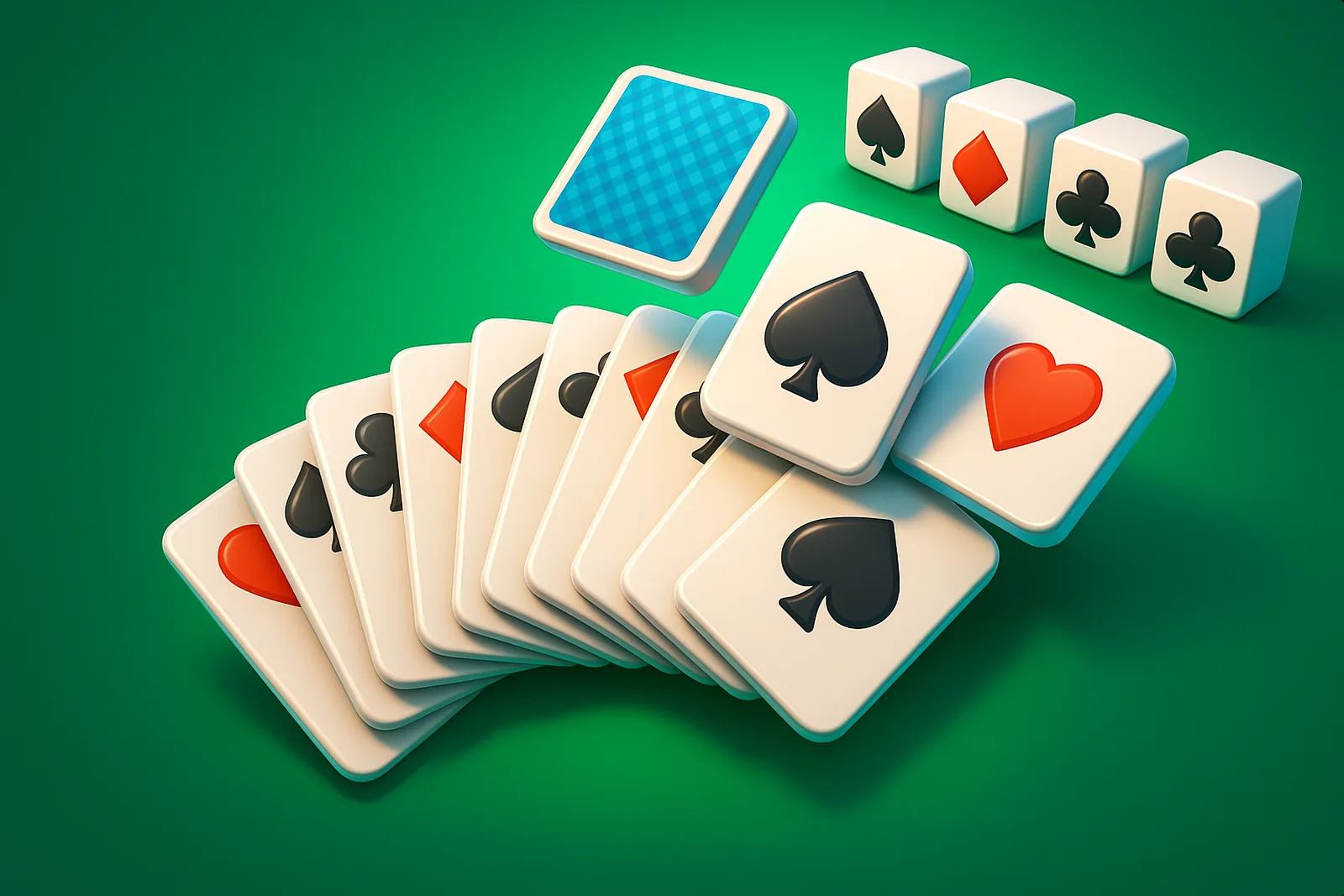
Klondike Solitaire is called Klondike because its name was tied to the Klondike Gold Rush of the late 1890s. The usual story, unverified, is that the game became associated with prospectors heading for gold in Yukon and Alaska.
That answer is tidy, but the history is not. Card patience games were already circulating in Europe before the rush. The layout we now recognise as Klondike did not arrive with a signed certificate saying who invented it, where, or on what night. What we have is a name that appears to have caught the fever of a famous event.
So the honest version is this: the origin of solitaire as a family of card games is older and European; the Klondike name is North American and late Victorian; the one-card draw version most people play now is a modern standard shaped by printed rule books, home play, and computer solitaire.
Why is it called Klondike Solitaire?
It is called Klondike Solitaire because the game’s name became attached to the Klondike Gold Rush. The usual story, unverified, is that prospectors played it during the rush, or that publishers used the fashionable Klondike name because gold fever sold everything.
The second explanation fits the surviving evidence better. In the late 1890s, Klondike was not a quiet place-name. It was a headline word. It meant risk, waiting, bad odds, sudden fortune, and men with more hope than food. A solitaire game built around blocked cards and buried rewards fitted that mood rather well, even if nobody in Dawson City ever sat down and named it.
There is no clean inventor to credit. There is no known first table, first player, or first printed rule sheet that proves the name was born in the Yukon. Older patience games had already spread through Europe and North America, and similar layouts could travel under more than one name.
The question why is it called Klondike splits in two. The name points to the gold rush. The game itself comes from the wider patience tradition. One is a cultural label; the other is a card-game lineage. They met at the end of the 19th century, and the name stuck because it was short, memorable, and already charged with drama.
What does the Klondike name have to do with the Klondike Gold Rush?
The Klondike Gold Rush began after gold was found on Bonanza Creek in Yukon in 1896. News reached major west-coast cities in 1897, and the stampede followed. Thousands of people tried to reach the Klondike through Alaska and north-west Canada. Many did not get rich. Some did not even get there.
The name Klondike became commercial shorthand almost at once. Newspapers used it constantly. Businesses borrowed it. Popular entertainment borrowed it. A card game using that name did not need a formal connection with a mine or a camp to make sense to players of the period.
The usual story, unverified, says miners played solitaire in the camps between long periods of work, weather, and waiting. That is believable as a human picture. A pack of cards is small, cheap, and useful when people are stuck in rough places. It is not, by itself, proof of the name’s origin.
The stronger historical claim is narrower: the name belongs to the same burst of North American popular culture as the rush. Klondike meant chance. It meant looking for value hidden under dirt, ice, and bad information. In the card game, valuable cards are also buried, revealed one at a time, and often unreachable because of earlier choices. The metaphor is almost too neat, which is one reason it should be treated carefully. Good stories travel faster than documents.
Where did the game itself come from?
The game came from the older family of patience games, not from a single camp in Yukon. The origin of solitaire is European: written references to card patience appear by the late 18th century, and the games became especially visible in 19th-century printed collections.
Britain generally used the word patience. American English preferred solitaire. Both names describe the same broad idea: one player arranging cards by rule, usually with a mixture of skill, memory, and luck. The English word solitaire had already been used for solitary games before Klondike became the famous card version.
By the Victorian period, patience books were common enough for the form to be respectable parlour play. Lady Adelaide Cadogan’s Illustrated Games of Patience, published in 1870, is an important English example. It did not create the whole tradition, but it shows that organised, named patience games were already part of ordinary card culture before the Klondike rush.
Klondike’s exact route through that culture is hard to pin down. Its tableau of seven columns, alternating colours, foundations built by suit, and a stock turned from the hand all feel familiar now, but familiarity is not the same as origin evidence. Rule families shift by copying, teaching, and house preference. A game can become standard long before anyone bothers to record how it first appeared.
How did the modern one-card draw version take over?
The one-card draw version took over because it is easier to read, easier to teach, and kinder to casual players than the three-card draw. It did not replace every older rule. It became the version many people mean when they say plain Klondike Solitaire.
Printed rules kept several forms alive, but computers changed the centre of gravity. Microsoft included Solitaire with Windows 3.0 in 1990, and that did more for Klondike’s daily visibility than any rule book. It also made fiddly habits feel normal: dragging cards, undoing errors, restarting instantly, and playing a quick deal while half-thinking about something else.
- One-card draw shows more information. Each pass through the stock is easier to plan because every card appears in order.
- Three-card draw is harsher. Cards can sit visible but unreachable because of their position in the waste pile.
- Unlimited redeals soften the game. Older or stricter rules may limit passes through the stock, which changes the whole risk calculation.
- Computer play removed the chores. Shuffling, laying out, moving stacks, and checking legal plays stopped being effort.
- Hints and undo changed learning. Players could experiment without spoiling the table or losing track of the deal.
Modern Klondike Solitaire (Turn 1) is therefore not a museum copy of one fixed 1890s rule. It is the approachable branch of a much older game tree.
Why do different versions still feel like the same game?
Different Klondike versions feel alike because the skeleton stays in place. You still build four foundations by suit, uncover hidden tableau cards, alternate colours in descending runs, and use the stock to break jams.
| Version or rule change | What changes | What stays the same | What it means for play |
|---|---|---|---|
| Klondike Solitaire (Turn 1) | One stock card appears at a time. | The seven-column tableau and four suit foundations remain. | More cards become usable, so planning is clearer and frustration is lower. |
| Klondike Solitaire (Turn 3) | Three stock cards turn together, with only the top card normally playable. | The aim and tableau rules are still recognisably Klondike. | Order in the waste pile matters more, and a good-looking card may be trapped. |
| Limited redeals | The stock cannot be cycled forever. | Tableau building and foundation building do not change. | Early choices carry more weight because waiting may not fix a blocked game. |
| Unlimited redeals | The stock can be reused without a hard pass limit. | You still need legal moves and hidden cards still control the pace. | The game becomes more exploratory, especially for players learning patterns. |
| Computer Klondike | Undo, hints, and instant redeal may be available. | The core race to expose and place all cards remains. | The feel becomes quicker, but the same bottlenecks decide most deals. |
The name survives these changes because players recognise the work: free cards, expose face-down cards, build suits, and hope the stock gives you one more useful turn.
Frequently asked questions
Mostly. In many places, “Solitaire” means Klondike because it is the version people met first on computers. Strictly, solitaire is the family name and Klondike is one game inside it. FreeCell, Spider Solitaire (1 Suit), Pyramid Solitaire and TriPeaks Solitaire are solitaire games too, but they use different layouts and rules.
52 cards are used in Klondike Solitaire, with no jokers. You deal 28 cards into the tableau, spread across 7 columns, and leave 24 cards in the stock. The aim is to build 4 foundation piles by suit from ace to king. That structure is why the game feels familiar even when small rules change.
The common misconception is that prospectors in the Klondike Gold Rush invented the game around a camp table. The correction is duller and more likely: the name appears to have attached itself to an existing patience game during or after the rush. The gold rush gave the game a memorable label, not a proven birthplace.
A real hand starts with 7 tableau columns: the first has 1 card, the second has 2, and so on up to 7. Only the top card of each column is face up. If your exposed cards include a black 9 and a red 8, you can place the red 8 on the black 9 and expose what was underneath.
It depends on the deal: the starting layout and the order of the stock decide whether a win is possible. Some deals block vital cards under impossible layers. Others are winnable but easy to spoil with a poor move. Undo and hints help you learn, but they do not turn every deal into a guaranteed win.
FreeCell gives you more information because nearly every card is visible from the start. Klondike hides many cards face down, so you make decisions with less certainty. That usually makes Klondike feel more luck-shaped, especially in Turn 3. FreeCell feels more like a puzzle; Klondike feels more like controlled risk.
Only kings may fill an empty tableau space. The exception is not a different card but a sequence headed by a king: for example, a black king with a red queen beneath it can move into the space together. Empty columns are powerful because they let you uncover buried cards and reorganise long runs.
Most people move cards just because they can. In Klondike, a legal move is not always a useful move. The better habit is to ask what the move exposes. Turning over a face-down tableau card is usually worth more than shifting a card between two open columns for no gain. Chasing foundations too early can also trap useful building cards.
The stock pile is the face-down pile of undealt cards left after the tableau is set up. In Klondike Solitaire (Turn 1), you turn over 1 card at a time from the stock to the waste. Cards from the waste can go to the tableau or foundations if they fit the rules.
Look for aces, then look for moves that expose face-down tableau cards. Play an ace to the foundation when you can. Build down in alternating colours on the tableau, but prefer moves that reveal hidden cards. Use the stock when the tableau gives you nothing useful. In Klondike Solitaire (Turn 1) on Veena Games, undo is there when you want to test a line.
Nobody knows precisely. The best available answer is a period rather than a neat year: after the 1896–1899 Klondike Gold Rush, and before the name became standard in many twentieth-century patience and computer versions. The evidence is thin, which is why confident single-date claims deserve suspicion.
Microsoft shipped Solitaire with Windows 3.0 in 1990, and that version was Klondike. It put the game in front of millions of office and home computer users who might never have opened a book of patience games. Microsoft did not invent Klondike, but it strongly fixed the idea that “Solitaire” on a computer meant Klondike.
The cost is confusion. Canfield Solitaire and Klondike use a 52-card deck and build foundations, but their layouts and pressures are different. If you ask for Klondike and get Canfield Solitaire, you will expect the wrong tableau, the wrong reserve structure, and the wrong rhythm. Names matter because rules matter.
Final thoughts
The nice thing about Klondike’s history is that it refuses to be too neat. A clean origin story would be easier to print on a rule card: one miner, one cabin, one snowy evening, one name. The evidence does not give us that. It gives us a European patience tradition, a North American gold rush, and a late-19th-century public hungry for anything called Klondike.
That should make the game more interesting, not less. Many card games are like this. They are carried by people who teach them at kitchen tables, rename them, misremember them, simplify them, and pass them on. By the time the rules reach print, the real beginning has already gone quiet.
There is also a useful warning in the name. Klondike sounds like luck, and luck is plainly there. Some deals are dead. Some are generous. But the game has lasted because it gives you small, repeated decisions: which face-down card to chase, when to empty a column, when to move an ace, when to leave a useful card where it is. The old gold-rush label sells the romance. The staying power comes from those choices.
-
 Klondike
Is Klondike Turn 3 Actually Winnable?
Turn 3 is not turn 1 with extra clicks. It hides two thirds of the stock behind a counter you can only move one way — and once you can see that, it stops feeling random.
11 August 2026
Klondike
Is Klondike Turn 3 Actually Winnable?
Turn 3 is not turn 1 with extra clicks. It hides two thirds of the stock behind a counter you can only move one way — and once you can see that, it stops feeling random.
11 August 2026
-
Klondike
Klondike Turn 1 vs Turn 3: Which Should You Play?
Turn 1 is the better pick for learning and quicker wins; Turn 3 is for players who want stricter stock management.
11 August 2026
-
Klondike
What Is the Best Opening Move in Klondike Solitaire?
The best Klondike opening move is the one that reveals a buried tableau card, with longer covered columns winning most ties.
11 August 2026