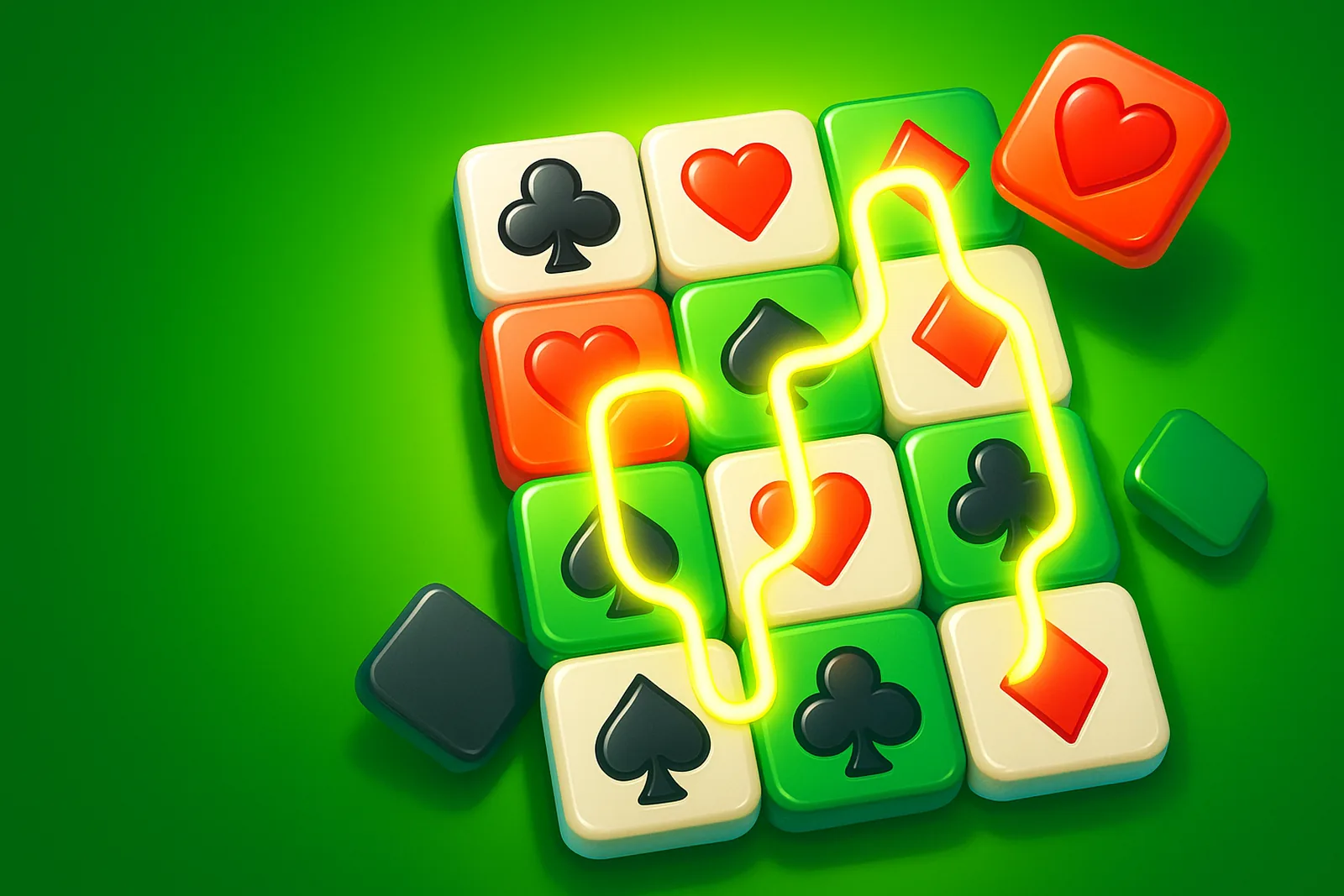
See missed words by changing the order of your search: rare letters first, endings second, then cramped corners, then long paths. Do not sweep the grid like text. A 4x4 word grid rewards routes, joins and awkward turns more than neat left-to-right reading.
Most boggle strategy fails because it gives you moods instead of decisions. Look harder. Think faster. Stay calm. None of that tells your eyes where to go on the next deal. Better word grid strategy is mechanical: choose a square, test its useful neighbours, abandon it under a clear condition, then move to the next pattern.
You already know how touching squares work. The useful work now is choosing where to look, when to stop, and which pattern deserves the next few seconds. Each tip below has a reason, and each one has a point where it becomes the wrong move. That matters. A good habit that never stops becomes a rut.
How do I see the words other people miss on the first pass?
Use the same first pass every time, but make it a pass for shapes rather than words. First, tap the rare or awkward letters with your eyes: Q, X, Z, J, K, and any consonant trapped in a corner. The reason is simple. These squares have fewer plausible jobs, so you can clear or use them quickly. It is the wrong move when the rare letter has no vowel, no familiar partner, and no second exit; then it becomes a time sink.
Second, scan for endings before beginnings. S, D, R, G, and E often finish words you already half-see. Start beside them and run backwards. Many players only build left-to-right in their head, even when the grid allows any direction. It is wrong when the ending square is the only bridge between better letters; using it as a tail too early can blind you to a longer route through it.
Third, check every corner as a small triangle. A corner has only three neighbours, which makes the search decidable: test each neighbour as the next square, then stop. Corners produce missed words because people feel the middle is richer. The wrong case is a corner filled with a common vowel and three weak consonants; do not worship it.
Fourth, reverse any word you nearly found. If you see STARE but cannot complete it, try RATES, TEARS, TARES, or shorter turns from the same letters. English reuses clusters. The wrong move is an anagram hunt with no path; the board, not the alphabet, is the judge.
Which letter shapes should I hunt first, and why?
- Rare-letter anchors. Start with Q, X, Z, J, and K when they touch a vowel or a strong consonant partner. They are worth hunting because fewer legal routes run through them, so one good route often stands out. It is wrong when the letter is isolated by neighbours that cannot start or finish anything you know.
- Digraph pairs. Look for T-H, C-H, S-H, P-H, and W-H in either order. They compress two squares into one sound, which helps you see words as spoken units rather than separate letters. It is wrong when the pair has no vowel exit; a digraph without a way out is just decoration.
- Vowel bridges. Hunt vowels that touch two or more useful consonants. A vowel in the middle of a route lets you pivot into several words from the same start. It is wrong on vowel-heavy patches, where every route looks possible and none is constrained enough to decide quickly.
- Suffix hooks. Check S, E, D, R, and G as final squares. They create endings such as plural-looking tails, past-tense-looking tails, and agent-looking tails. It is wrong when you have not found a base route; an ending cannot rescue letters that do not connect.
- Corner bends. Trace L-shapes and tight turns near the edge. These are missed because the eye prefers straight lines. They are wrong to chase when the same letters also sit in the centre with more exits; choose the version with more options first.
When should I break away from the longest word and take the sure thing?
Break away as soon as the long word stops being a word and becomes a wish. A visible short word is not a consolation prize; it is a banked find and a fresh starting point. The discipline is to tell route uncertainty from spelling uncertainty, and both from plain hope.
- Take the sure word when the extension needs two exact unseen steps. The reason is that each extra square must both touch and make sense. It is wrong when the whole longer route is already visible and you are only hesitating over entering it.
- Leave a stem after ten seconds with no new branch. Ten seconds is long enough to test the obvious neighbours without letting one attractive start eat the board. It is wrong late in a deal when only a few words remain and the stem is one of the few untested structures.
- Bank shorter forms before adding a suffix. If you see a base word and a possible ending, take the base first. The reason is memory: once you start stretching, you often forget the word you had. It is wrong if the interface clearly keeps your current path and you can enter both without losing rhythm.
- Abandon any long candidate that requires reusing a square illegally. Many convincing ghost words fail there. The wrong move is to throw away all related routes; shorten before you discard.
This is one place where boggle strategy and ordinary card-game judgement overlap: protect the certain gain, then spend attention on the speculative line.
What am I doing wrong when the board feels empty even though it is not?
- You are reading rows. Rows are tidy, and tidy is comforting. Word grids are built from touching squares, so diagonal and bent routes matter as much as straight ones. The wrong correction is to ignore rows completely; take the obvious row word, then leave the habit.
- You are starting every search from the top left. That makes your attention stale by the bottom right. Start each new pass from a different corner or from the rarest useful letter. It is wrong when you have a board timer in your head and changing starts costs more focus than it saves.
- You are treating rejected paths as dead ground. A failed long path may still contain a shorter word, a reversed word, or a suffix route. The wrong move is to keep poking the same failed path after all its neighbours have been tested.
- You are looking only for picture words. If you wait for animals, objects, and obvious nouns, you miss verbs, short connectors, and plain little words. It is wrong to enter nonsense just because it looks word-like; the board will teach you, but random stabbing slows the next search.
- You are not using the remaining-word count. If many words remain, switch patterns rather than blaming the letters. If only one remains, slow down and inspect untested corners, suffixes, and reversals. The wrong case is chasing the count so hard that you stop seeing the route in front of you.
- You are searching for length too early. Long words are pleasing, but short words reveal the board’s working parts. This is one of the most reliable word hunt tips: collect the small routes first. It is wrong when a long word is fully visible and costs no extra thought.
How do I get faster without just staring harder?
| Drill | How to do it | Why it works | Wrong time to use it |
|---|---|---|---|
| Prefix ladder | Pick one start square and test each neighbour as the second letter before moving on. | It stops vague staring and turns the first move into a checklist. | Skip it when the start square has no vowel access or no familiar pair. |
| Suffix sweep | Choose S, D, R, G, or E and build backwards from it. | Many missed words are seen more easily from their tail than their head. | Do not use it on an ending with no route back to a complete stem. |
| Corner minute | Spend a short pass on the four corners, testing their three exits one by one. | Corners are constrained, so decisions come quickly and expose tight bends. | Wrong on a board where the centre contains the rare letters and all strong joins. |
| Reverse replay | After every near-miss, run the same letters in the opposite direction if the path allows it. | It catches words hidden by your normal reading direction. | Stop when you are rearranging letters that do not actually touch. |
| Stop-loss rule | Leave any stem that gives no new word after ten seconds, then mark it mentally for later. | Speed improves when attention keeps moving through live options. | Wrong near the end, when few words remain and revisiting stubborn stems is necessary. |
Frequently asked questions
Yes. Small words train the exact skill that finds larger ones: seeing legal paths quickly. A three-letter word often marks a useful cluster of consonant plus vowel plus ending. Once you have it, test the same start backwards, add a nearby S, or look for an extra vowel. The small find is often the handle for the bigger one.
8 directions are possible from a square that has neighbours on every side: up, down, left, right and the four diagonals. Corners have fewer options, and edge squares have fewer than centre squares. That is why a middle consonant with common vowels around it is usually more useful than the same consonant stuck in a corner.
The common misconception is that Q, X and Z are the treasure. The correction is duller: a rare letter is only useful if it has the right support around it. Q without U is mostly noise. X with E, A or I nearby may be worth checking. Start with letters that connect to many plausible neighbours, not letters that merely look dramatic.
On a real deal, a path such as S-A-L-E is not one find but a workbench. After SALE, check SEAL if the route can reverse through the same letters in a legal order. Look for SALES if another S touches the end. Try LEAS as well. One found path tells you which squares are already cooperating.
It depends on the remaining word count: if plenty are left, take the quick short words as soon as you see them; if only a few remain, slow down and inspect the high-value clusters. Short words are not a lesser aim. They reduce the counter, reveal productive areas, and stop you wasting attention on a long word that may not be on the board.
Squares is closer to FreeCell than Klondike Solitaire (Turn 3) in one useful sense: the important information is visible. You can see all 16 letters and the remaining word count. There is no hidden stock deciding what appears next. The skill is not waiting for luck to turn over. It is using the open position more carefully than you did ten seconds ago.
Short rule: scan all three. Rows are easiest for the eye, columns catch words you skipped, and diagonals often join letters that look separate at first glance. The exception is a dense centre cluster. If the middle of the grid has several vowels and common consonants touching, spend a little longer there before sweeping the outer edge again.
Most people do the wrong thing after a find: they leave the area too soon. A good word proves that its letters sit in a useful order. Stay there for a few beats. Change the first letter, reverse the direction, add a common ending, then test a plural. Only move away once the local variations have stopped producing anything.
Touching means the next letter is in a square that meets the current square by a side or a corner. So a letter can connect horizontally, vertically or diagonally, as long as the next square is adjacent. This matters because a word that looks broken in a straight line may still be perfectly traceable through a diagonal bend.
Stop scanning the whole grid at the same speed. Pick one common ending, such as S, D, R or E, and work backwards from it. Then pick a strong starting consonant and work forwards. If that fails, inspect the corners, because they are easy to underuse. The last word is often missed because your eyes keep repeating the same route.
Nobody knows precisely before the board is generated. The best available figure is the board’s own solved count, shown in the game, because every Squares board is solved in advance. Treat that number as practical information. If the counter says many words remain, your problem is pattern coverage. If it says one or two remain, your problem is precision.
The Sator square, a 5 by 5 Latin word square, has been found at Roman sites including Pompeii. That is a historical cousin, not the same puzzle: Squares asks you to trace words through touching letters on a 4 by 4 grid. The old appeal is still recognisable, though. Fixed letters, limited space, and a surprising number of possible readings.
The cost of getting it wrong is attention. Squares is free, runs in the browser, and does not involve money, but random stabbing still teaches your eyes to be lazy. A bad guess also breaks your rhythm. If you are unsure, make the guess a proper test: identify the path first, say the letters in order, then enter it.
Final thoughts
The evidence is thin for a universal best scan order. Players differ, word lists differ, and a board with a nasty Q is not the same problem as a board full of soft vowels. So do not treat any tip here as a charm. Treat it as a way to make the next decision smaller.
If a friend had just read this, I would tell them to play the next few boards a little less romantically. Do not admire the grid. Interrogate it. Ask one square a precise question, then another. Can this rare letter leave? Can this S finish anything? Can this corner make a bend? Did that failed long word contain a shorter one?
Speed comes from fewer pointless seconds, not from panic. The calm player is often quicker because they abandon bad lines earlier. The impatient player keeps trying to force a word that the board has already refused.
One last useful annoyance: say the route in your head as letters, not as a hoped-for word, when you are checking legality. It catches gaps. It catches illegal reuse. It also makes finding words feel less like waiting for inspiration and more like doing a job with your eyes.
-
Squares
Squares: Finding Words in a 4x4 Grid
Squares is a one-player 4x4 word game about tracing connected letters until every hidden word on the solved board is found.
14 August 2026
-
 Blackjack
 Basic Strategy, Explained Line by Line
A practical guide to blackjack basic strategy, showing how to order blackjack decisions by hand type, dealer upcard, reason and exception.
15 August 2026
Blackjack
Blackjack Basic Strategy, Explained Line by Line
A practical guide to blackjack basic strategy, showing how to order blackjack decisions by hand type, dealer upcard, reason and exception.
15 August 2026
-
Blackjack
Blackjack Strategies Ranked: What Works, What Doesn't, What Gets You Banned
Basic strategy sits first; betting systems sit near the bottom, and counting only works where the remaining deck can matter.
15 August 2026