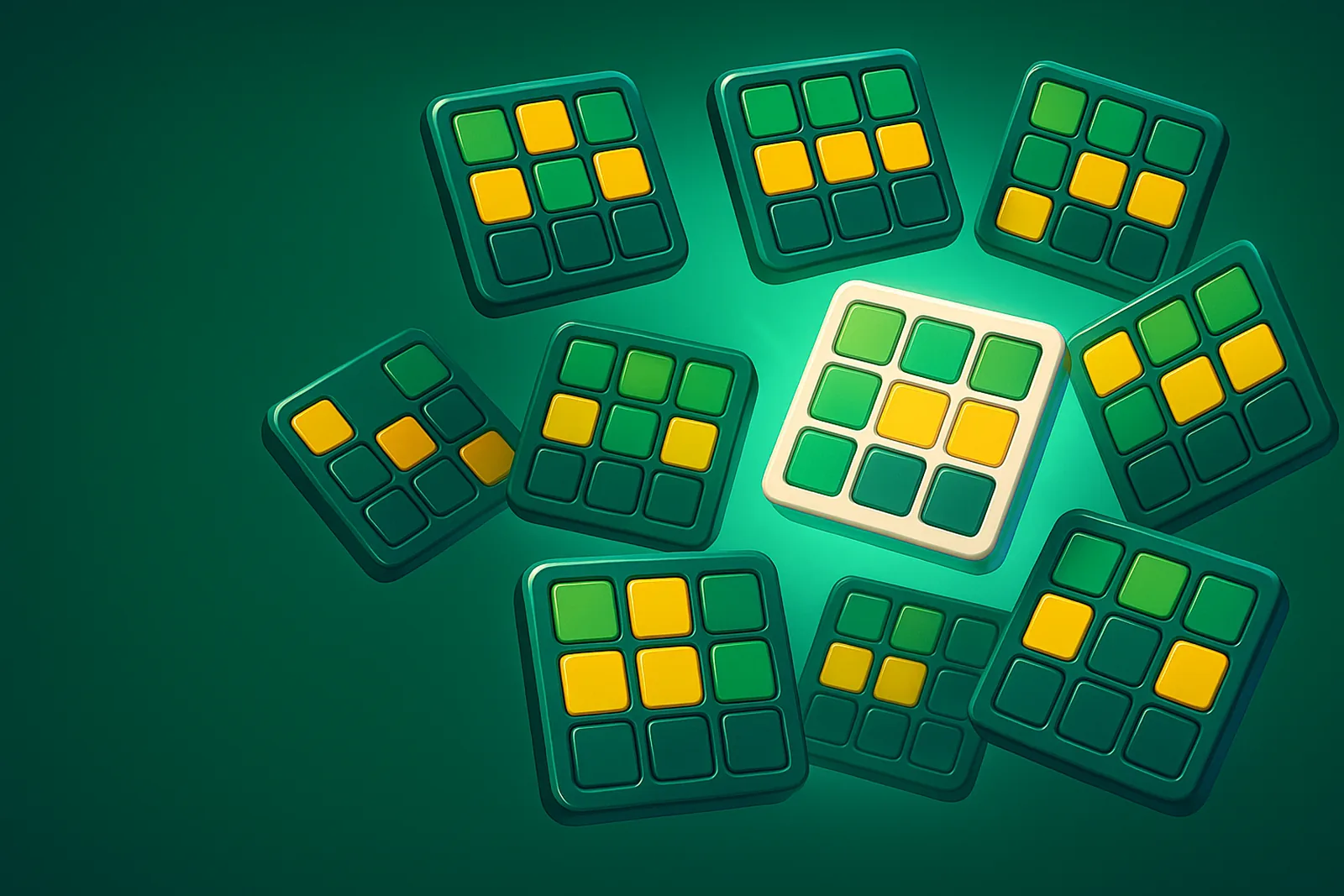
Treat Octordle as a queue, not as eight separate emergencies. Your job is to buy information early, bank easy solves before they rot, and ignore one awkward board until a guess helps more than that board alone.
The trap is attention. A nearly solved board looks urgent because it gives you something to do. Meanwhile, three quieter boards may still be missing their first useful consonant. Good Octordle strategy is less about genius vocabulary and more about choosing the guess that helps the most boards at that exact moment.
This guide assumes you already know the rules and have lost enough games to recognise the feeling: six boards under control, one board half-seen, one board screaming for a miracle. The Octordle tips below are ordered and testable. Each gives you a reason, then tells you when to break it, because rigid rules lose games too. If you want to know how to play Octordle well, the short answer is discipline: collect shared evidence first, solve only when the solve changes the whole position, and keep a few guesses for dirty endings.
How do I keep eight boards moving without wasting my best guesses?
Start each turn by asking one question: how many boards does this guess help? If the answer is one, the guess needs to be a solve or a rescue. Reason: Octordle rewards guesses that move several grids at once, especially before the middlegame. It is the wrong move when one board has only one credible answer and leaving it open would clutter your attention for the next two turns.
Use a three-pass scan. First, mark boards that are solved in your head: fixed pattern, no serious rival. Second, mark boards that need one letter test. Third, mark boards with too many blanks to deserve a private guess. Reason: this stops the loudest board stealing the whole turn. It is wrong when the clock of remaining guesses is tight and an unsolved board can still fail through simple neglect.
Bank easy solves once they have one credible answer. A solved board stops demanding working memory, and working memory is the scarce resource here. Do not, however, solve a board just because you can if the answer burns a precious letter pattern that would have tested four other boards. Use that word for evidence first if it can do more work before the solve.
Prefer guesses that contain letters you can place on at least two boards. Reason: position is stronger than presence, and a shared positional test can turn several yellow letters into answers. It is wrong when all active boards already know those letters exist; then you need exclusion, not confirmation.
Which opening guesses give the most information across all eight boards?
- Open with broad coverage, not a favourite answer. A first guess should expose common vowels and consonants across all eight boards. Reason: one guess produces eight sets of evidence, so coverage compounds. Wrong when you are playing a known answer list or personal challenge where a particular opener is part of the test.
- Use two starters with little overlap. A pair such as RAISE and MOUNT tests all five standard vowels plus several useful consonants. Reason: repeated letters early usually tell you less than new letters. Wrong when the first guess gives a near-solve on several boards; then a solve or positional word may beat the planned second starter.
- Make the third guess a response, not a script. If the first two guesses leave many blanks, add fresh consonants. If they reveal clusters, test positions. Reason: fixed three-word systems ignore what the boards have already told you. Wrong when your first two guesses were unusually poor and you still lack basic vowel evidence.
- Avoid double letters in the opener. Reason: double letters spend two slots on one signal when eight boards need breadth. Wrong when you already know, from a later pattern, that a double is highly likely; then testing it can settle a board quickly.
- Do not chase the mathematically perfect opener. The evidence for one universal best Octordle opener is thin because word lists and accepted guesses vary. Reason: a practical Octordle strategy must survive the second and third guess. Wrong only if you have measured your exact word list and play style over many games.
When should I stop chasing one board and spread a guess across the rest?
Stop chasing when the board needs a private distinction and at least two other boards still need broad evidence. Reason: a private distinction, such as choosing between several words that differ by one consonant, may fix only one grid. A broad guess can also create future solves elsewhere. It is the wrong move when that one board is already close to failure and no shared guess can include its needed test.
After your opening phase, choose by cost:
- Chase if there is one credible answer. Reason: a confirmed solve reduces noise immediately. Wrong when the answer uses letters you urgently need to test on other boards first.
- Spread if the board has three or more plausible endings. Reason: guessing one ending is often a coin toss dressed up as confidence. Wrong when all plausible endings share a letter you can test inside a useful solve.
- Chase if the stuck board blocks your whole scan. Reason: mental load causes bad misses on easier boards. Wrong when the block is emotional rather than informational; take ten seconds and rescan before spending the turn.
- Spread when the guess can place letters on multiple boards. Reason: placement converts yellow clutter into green structure. Wrong when those placements are in low-value slots you already understand.
A useful rule is brutal: if a guess helps one board and does not solve it, it must prevent a real loss. Otherwise, make the rest of the position richer.
What should I do with a board that looks stuck?
- Write the pattern mentally as slots, not as a word shape. For example, think blank, R, blank, E, blank rather than nearly THERE. Reason: word-shape thinking invites one attractive answer too early. Wrong when you truly have only one legal answer left; then extra abstraction wastes time.
- List the missing jobs: vowel, first consonant, ending, or double. Reason: a stuck board usually lacks one type of evidence, not general inspiration. Wrong when several jobs remain; then the board is not stuck, it is under-tested.
- Look for a shared test word before a private test word. Reason: the same consonant may settle another board while rescuing this one. Wrong when the private test is also a likely answer and you are short of guesses.
- Check for repeated letters late, not early. Reason: doubles often explain awkward patterns after common single letters fail. Wrong when the pattern strongly signals a double, such as a known letter with no other workable placement.
- Abandon the board for one turn if your next guess is a guess, not a test. Reason: a blind stab can burn the exact consonant you need elsewhere. Wrong when every remaining board is in the same state; then you must choose the cleanest risk.
Which board patterns deserve a special plan?
Some patterns are dangerous because they feel more solved than they are. Name the plan before you type.
| Pattern | Plan | Reason | Wrong when |
|---|---|---|---|
| Four greens with one blank | Do not fire the first answer if several letters fit. Use a wider test unless the solve is certain. | This is the classic trap: one unknown slot can hide a family of words, and each miss costs a full turn across all boards. | The blank has only one credible letter, or the answer also clears another board. |
| Many yellows, few greens | Spend a positional guess that rearranges the known letters and adds at least one new consonant. | Presence is old news. You need to learn where the letters can live. | You already have enough exclusion to solve; then rearranging becomes theatre. |
| No vowel confirmed after the opener | Test remaining vowel possibilities in a word that also checks useful consonants. | Without a vowel anchor, consonant patterns multiply fast and guesses become wishful. | The board clearly uses a known vowel as yellow and only needs placement. |
| Likely double letter | Delay the double until single-letter options have been tested by shared guesses. | A double test is narrow. It may be right, but it gives little help if wrong. | The pattern cannot be filled sensibly without the double, especially in the middle slots. |
| One board far behind | Feed it through guesses chosen for stronger boards, then rescue it with a private test only if needed. | A weak board often improves for free while you solve the rest. | Remaining guesses are low enough that waiting would leave no room for correction. |
Frequently asked questions
No. Solving the easiest board first can waste letters you already understand. Treat an easy board as a safe banked point unless it is blocking a later guess. If it needs one obvious answer and that answer also tests useful letters elsewhere, take it. If not, leave it for a turn and spend the guess where it reduces more uncertainty.
2 opening guesses are usually the minimum before you can read the position properly; 3 is often more comfortable if the boards are still wide open. After that, stop using stock openers and start solving. Octordle gives you 13 tries, but eight answers take space fast. A fourth general probe is only worth it if several boards still lack vowels or clear consonants.
People often think Octordle is mainly luck because eight boards create more awkward moments. The correction is that the luck is spread out, not removed. A bad trap on one board can be balanced by clean progress on five others. Your job is to avoid letting one unlucky board dictate every guess before the rest have given you enough information.
A common late-board case is a pattern like _IGHT, where several answers may fit. If one candidate uses a letter that is still useful on two other boards, play that one first. If both candidates are equally useless elsewhere, look at the boards with fewer options and choose the guess that cannot damage their progress. The right answer is not always the narrowest one.
It depends on your aim: practice discipline or win more often. If you want discipline, obey known green and yellow information on every guess. If you want the best chance to win, allow occasional information guesses that break those rules on a nearly solved board. Octordle is built around shared guesses, so strict single-board thinking can make the whole game worse.
Compared with Quordle, Octordle gives you twice as many boards and more total tries, but the pressure rises because every poor guess can fail in eight places at once. Quordle often lets you recover with focused solving. Octordle punishes tunnel vision more severely. If Quordle feels busy, Octordle feels like managing a queue that keeps changing order.
The short rule is: only use a dead guess if it gives live information on several boards. The exception is the final stretch, when you may need to spend a guess to separate two dangerous traps on one board. Even then, count the remaining answers first. A beautiful information word is still a losing move if you no longer have enough turns to finish.
Most people do wrong by treating the last three boards as separate emergencies. They solve one, then discover the next one still has four possible answers. Earlier, mark which boards are answer-ready and which are only half-known. Near the end, prefer guesses that settle two boards at once, even if one board has a tempting obvious answer waiting.
Balancing boards means keeping all eight puzzles close enough to completion that no single board becomes a rescue mission. It does not mean giving every board equal attention on every turn. A board with three greens can wait. A board with one yellow and six plausible routes needs help before the endgame starts squeezing your options.
Scan the boards in the same order after every guess. First note solved boards. Then find boards with three or more fixed letters. Then find boards with no strong shape. Write the next guess for the weakest group, not the loudest board. If you keep changing your reading order, you will miss a yellow letter that should have settled a later answer.
Nobody knows precisely, because public win-rate data for free browser word games is not collected in one reliable, comparable place. The best available figure is your own record over 20 or 50 games. If the number is rising, your strategy is improving. If it is flat, check where losses happen: early wasted probes, midgame tunnel vision, or late traps.
Wordle popularised the modern daily five-letter guessing format in 2021, and Octordle belongs to the wave of larger multi-board variants that followed it. The key difference is scale. Wordle asks you to solve one puzzle with one stream of clues. Octordle asks you to make that same stream of guesses serve eight puzzles at once.
The cost of getting repeated letters wrong is usually a wasted turn late in the game. Early on, ignoring them is tolerable because you are still mapping the boards. Later, it can be fatal. If a board has a tight pattern but one missing slot, check doubles before guessing a fresh consonant. Words with repeated letters hide in plain sight.
Final thoughts
The best Octordle players I know are not the ones with the flashiest vocabulary. They are the ones who can leave an annoying board alone for one turn. That feels unnatural. The human eye wants closure, and a board with three greens offers the pleasant lie that closure is close.
Play a little colder. Before each guess, count its jobs. Does it solve? Does it place? Does it exclude a whole family? Does it help more than one board? If you cannot name the job, the guess is probably a mood. Moods lose late games.
There is still room for nerve. Sometimes you must take the single-board solve because the whole position becomes readable once it is gone. Sometimes you must test an ugly consonant because every pretty word has failed. The point is not to be timid. The point is to know what risk you are buying.
One small habit changes a lot: pause after the opening and rank the boards from cleanest to dirtiest. Solve the clean ones, feed the middle ones, and quarantine the dirtiest until a guess can do honest work. You will still lose some. Octordle has enough moving parts for that. But the losses will feel less like panic and more like a line you chose.
-
 Word Games
Wordle Hard Mode: Strategy When Every Guess Must Count
Use ordered hard-mode checks to choose guesses that split live answers, respect forced hints, and avoid traps when the board narrows.
16 August 2026
Word Games
Wordle Hard Mode: Strategy When Every Guess Must Count
Use ordered hard-mode checks to choose guesses that split live answers, respect forced hints, and avoid traps when the board narrows.
16 August 2026
-
 Word Games
Wordle Strategy After the First Word
A practical guide to choosing your Wordle second word, handling crowded boards, and knowing when to solve rather than gather more letters.
15 August 2026
Word Games
Wordle Strategy After the First Word
A practical guide to choosing your Wordle second word, handling crowded boards, and knowing when to solve rather than gather more letters.
15 August 2026
-
Word Games
How to Play Wordle (and What the Colours Really Tell You)
A clear guide to Wordle rules: the six-by-five grid, valid guesses, colour clues, duplicate letters, and what counts as a win.
14 August 2026