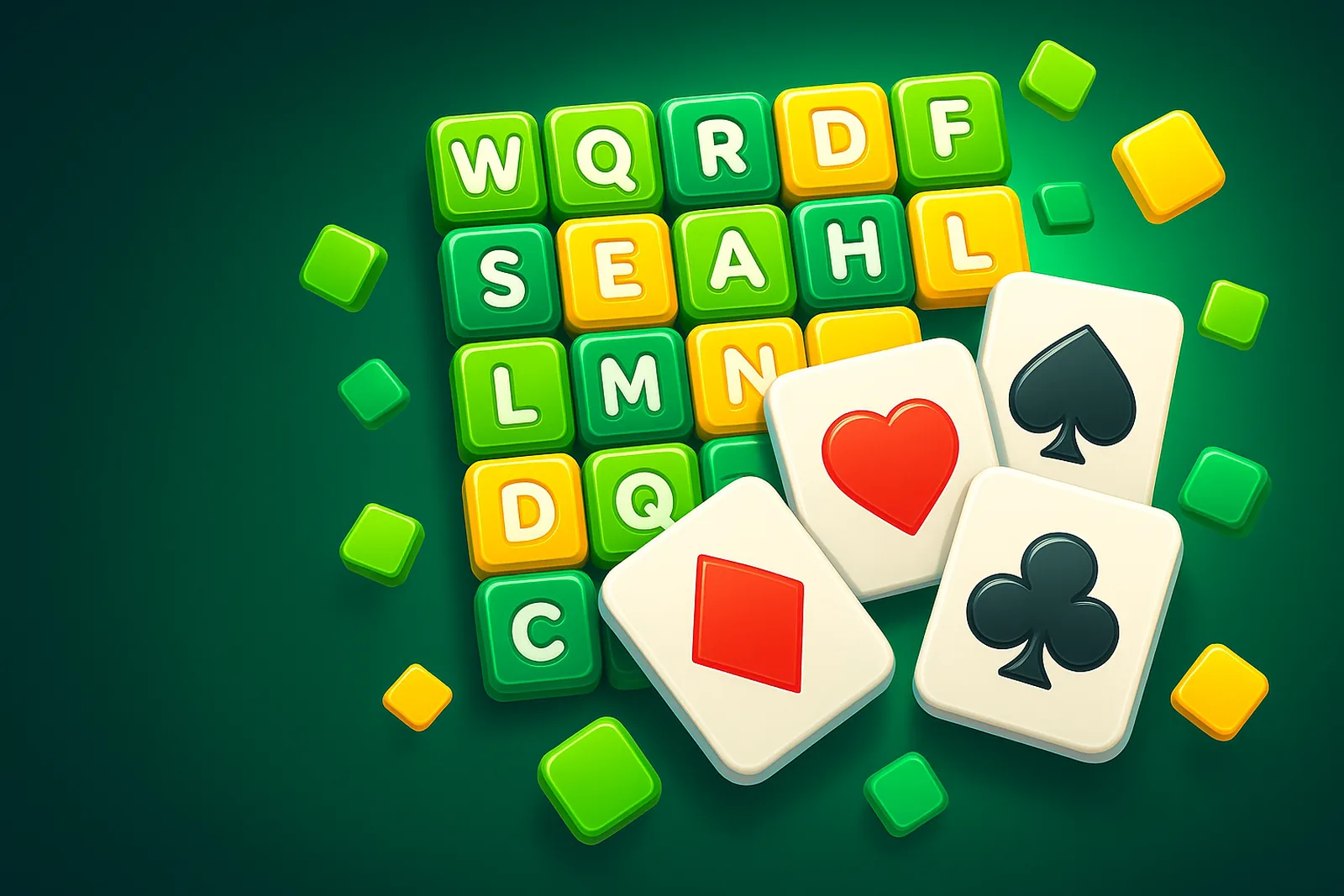
Sedecordle feels unfair because it gives you 16 boards but only 21 guesses, and every guess is shared across all boards. The deal is not rigged; the rule turns one word puzzle into a tracking job.
If you came from Wordle, the shock is reasonable. Wordle lets you stare at one answer for 6 guesses. Sedecordle asks you to manage 16 answers at once, so a guess that helps 4 boards can still leave 12 boards sulking in grey and yellow. That feels like bad luck even when it is ordinary pressure.
Calling it a 16-board Wordle is useful only at the door. After that, it behaves differently. The strongest players do not solve one board, celebrate, then drift to the next. They gather letters, mark the boards that are nearly done, and spend late guesses only where the return is clear. If it feels like the hardest word game on your screen, the culprit is usually not vocabulary. It is lost bookkeeping.
Why does Sedecordle feel like 16 boards of bad news at once?
Sedecordle hurts because the losses arrive in parallel. In Wordle, a poor opener is one small mess. In Sedecordle, the same opener can create 16 separate problems, then ask you to remember which yellow letter belonged where.
The game is not mainly asking whether you know more five-letter words. It is asking whether you can keep unfinished information tidy under pressure. A green letter on board 3, a repeated consonant on board 9, and a nearly solved answer on board 14 all compete for the same next guess. Miss one detail and you spend a turn learning something you already knew.
That is why Sedecordle can feel unfair even when the answers are normal. You are seeing 16 streams of feedback after every guess. Some boards will look friendly early. Others will give almost nothing for several turns. The mind notices the empty ones and starts treating them as evidence that the puzzle is hostile.
The better explanation is arithmetic. You have 21 guesses for 16 boards, so there is little room for private experiments. A guess that tests a single doubtful word may be correct locally and still costly overall. This is the named rule that bites: one shared guess pool covers every board.
Sedecordle becomes calmer when you stop asking, what is this one answer, and start asking, which guess helps the most unfinished boards right now. That change is dull. It wins games.
What rule makes this harder than Wordle?
The hard rule is the shared guess pool. Wordle gives 1 board and 6 guesses. Sedecordle gives 16 boards and 21 guesses, with each entered word applied to every board. The extra guesses look generous until you divide your attention across 16 answers.
In Wordle, a narrow guess can be good play. If you know the answer is one of 2 patterns, you may test a letter and accept the cost. In Sedecordle, that same test has to justify itself across many boards. Late in the game, a single-board guess can be necessary. Early on, it is usually a leak.
- Wordle rewards focus. You can spend 6 turns reducing one word, and every clue belongs to that one answer.
- Sedecordle rewards coverage. A strong guess checks useful letters across several unsolved boards at once.
- Wordle hides little. There is one grid, so forgotten clues are rare.
- Sedecordle punishes drift. You can overlook a green position because another board is shouting louder.
The rule also changes what a good mistake looks like. In Wordle, a wrong guess that removes 4 letters may be fine. In Sedecordle, a wrong guess should ideally move several boards closer to solved. If it only serves the board you happened to be staring at, it had better finish that board.
This is why many Sedecordle tips sound like office work: scan, group, prioritise, then spend. The puzzle is less romantic than Wordle. It is a ledger with vowels.
How does Sedecordle compare with Quordle and Octordle?
Quordle and Octordle are the cleanest comparisons because they use the same broad idea: several boards, one stream of guesses. The difference is scale. Sedecordle has 12 more boards than Quordle and 8 more boards than Octordle, so the pressure rises before the words get difficult.
| Game | Boards | Guesses | Main pressure | Best reason to choose it |
|---|---|---|---|---|
| Wordle | 1 | 6 | Solving one answer cleanly | You want a short, focused puzzle |
| Quordle | 4 | 9 | Balancing 4 answers without much clutter | You want multi-board play that still feels manageable |
| Octordle | 8 | 13 | Tracking enough boards that weak notes start to hurt | You want a middle step before Sedecordle |
| Sedecordle | 16 | 21 | Keeping information organised across a full wall of boards | You want the bookkeeping version of the word puzzle |
The jump from Quordle to Sedecordle is not small. Four boards let you remember most clues by sight. Sixteen boards demand a routine. Octordle is the better halfway house because its 8 boards expose the tracking problem without doubling it again.
Which Sedecordle tips actually save guesses?
- Use early guesses for coverage, not glory. The first few turns should expose common letters across as many boards as possible. A flashy near-solve on one board is less useful than a guess that gives 10 boards something to work with.
- Do not chase the first green board too soon. A board with 3 green letters is tempting. If finishing it costs a guess that helps almost nowhere else, leave it parked until the shared information stops improving.
- Scan for boards with the fewest unknown positions. Late guesses should convert nearly solved boards into finished boards. Removing a board from the set reduces noise, and less noise matters when 16 grids are competing for your eyes.
- Separate letter-finding from solving. Early on, play words that reveal. Later, play words that finish. Mixing those jobs is how you burn a guess on a word that neither confirms enough letters nor closes a board.
- Respect repeated letters, but do not worship them. Sedecordle often tempts you into testing doubled letters for one board. Make that play when the board is nearly forced, not when you are merely irritated by it.
- Stop guessing from memory. Before entering a late word, check every board where it might matter. The most expensive miss is playing a word that cannot fit because a yellow letter was already ruled out in that position.
- Accept boring words. The best Sedecordle guess is often a plain, information-heavy word. If it advances 6 unfinished boards, it has done its work, even if it solves none of them immediately.
Should you switch to a lighter variant if you are stuck?
- Switch to Quordle if the screen feels noisy. Quordle has 4 boards, which is 12 fewer than Sedecordle. The shared-guess idea remains, but you can hold most of the state in your head. If your Sedecordle losses come from missing obvious clues, this is the useful drop.
- Switch to Octordle if you can track, but not for 21 guesses. Octordle has 8 boards, half as many as Sedecordle, and 13 guesses. It keeps the multi-board strain while cutting the clutter. Players who find Quordle too light often fit here.
- Switch to Wordle if you are making vocabulary errors. Wordle has 1 board and 6 guesses. It will not train Sedecordle bookkeeping, but it will sharpen answer selection, position logic, and the habit of ruling out impossible patterns before typing.
- Use Wordle Hard Mode for discipline, not rest. Wordle Hard Mode forces you to use revealed hints in later guesses. That can improve clue respect. It is not a lighter mental load in the same way, because its constraint is stricter even though there is only 1 board.
- Return to Sedecordle when the failure changes. If you lose because 2 or 3 boards survive, you are close. If you lose with half the wall unresolved, the variant is still teaching you to scan. There is no prize for learning the slow lesson at full size.
Frequently asked questions
No. The reason is simple: Veena Games runs Sedecordle in the browser, without accounts, downloads or payments. Open the game and play. That also makes it a good place to practise messy multi-board play, because a failed run costs nothing except the few minutes you spent making the grid worse.
21 guesses cover all sixteen boards. Every word you enter is applied to every unsolved puzzle, so one careless guess can be wasteful in sixteen places at once. The spare room looks generous beside Wordle’s 6 guesses, but it shrinks quickly once you have to finish awkward boards with similar patterns.
People often think each board gets its own line of guesses. It does not. One guess goes everywhere, and every board returns its own colour pattern for that same word. The work is deciding which board deserves attention now, which board can wait, and which guess gives useful information across several boards at once.
On a real late-game board, a pattern like STO_E can feel solved before it is. If N, L and R are grey, you still may have more than one live ending. Do not spend a whole global guess on that board unless it is urgent. Check the other fifteen boards first, then choose a word that settles the gap without wasting the rest of the grid.
It depends on your bookkeeping: if you track letters cleanly, Sedecordle is a logic and triage game; if you try to remember sixteen boards in your head, it becomes a memory test you did not need to take. Use the visible feedback. Recheck grey letters before typing. The biggest gains come from not solving the same clue twice.
Octordle trains the same broad habit of reading several boards after one guess, but Sedecordle doubles the board count. That changes the pressure. In Octordle you can often chase a promising board early. In Sedecordle, chasing one board too soon can leave ten half-read boards waiting with too few guesses left.
Use probe words early; avoid them late. The exception is when one non-answer word gives decisive letters for several unsolved boards at once. A guess that cannot solve anything is still defensible if it turns five uncertain boards into five near-certainties. If it only helps one board, it is usually too expensive.
Most people do the wrong thing after a good start: they celebrate the solved boards and stop managing the unsolved ones. A fast eight solves can hide the fact that the remaining eight are all starved of consonants. Keep scanning the whole grid. The boards you have not solved are the game, not the ones already done.
Sedecordle is a word game where you solve sixteen five-letter puzzles at the same time with 21 total guesses. Each guess is tested against every board. Green, yellow and grey feedback tell you how each word fits. It looks like Wordle from a distance, but the real skill is choosing priorities across a crowded grid.
Start with a word that tests common letters and gives clean feedback across many boards. Then read all sixteen results before making the second guess. Do not lock onto the first board that looks promising. Two or three broad guesses usually give you a better map than one clever attempt to solve a single board immediately.
Nobody knows precisely; Veena Games does not require accounts, and public win-rate data without a controlled player base is weak. The best available figure is your own rolling percentage over the games you actually finish. Count wins and losses, including abandoned games as losses if you want a number that reflects play, not mood.
Wordle made the six-guess, five-letter format famous in 2021. Sedecordle belongs to the later wave of multi-board word games that stretched the same feedback idea across more answers. The exact family tree between every variant is not well documented, but the design debt to Wordle is clear enough.
The cost of getting it wrong is paid in forced guesses. An ignored board with a pattern like _ATCH may leave you choosing between several ordinary answers when there is no time left to test them. Sedecordle punishes late attention. Give awkward boards a quick look after every guess, even if you are not ready to solve them.
Final thoughts
If a friend told me Sedecordle was cheating, I would ask how many guesses they spent on one-board hunches. Not to be smug. That is where the game quietly takes payment.
The fair way to play is colder than the fun way to play. You will see a board that looks almost solved, and your hand will want to finish it. Sometimes you should. More often, you should scan the rest of the wall and ask whether the guess earns its keep elsewhere. If the answer is no, wait.
There is also no shame in stepping down. Quordle is not baby Sedecordle; it is the same pressure in a smaller room. Octordle is where many players learn the habit that Sedecordle demands: finish boards when they are cheap, gather letters when they are not, and never let one loud grid bully the whole turn.
The satisfying Sedecordle win rarely feels like a lightning strike. It feels like a desk cleared one pile at a time. A few boards fall early, the middle becomes readable, and the last guesses stop being panic. That is the point where the game changes from impossible to merely rude.
-
 Word Games
Quordle Strategy: Four Boards, Nine Guesses
A practical Quordle strategy for repeat players who want ordered choices, not vague advice, across four boards and ten tries.
19 August 2026
Word Games
Quordle Strategy: Four Boards, Nine Guesses
A practical Quordle strategy for repeat players who want ordered choices, not vague advice, across four boards and ten tries.
19 August 2026
-
 Word Games
Can the Same Word Be a Wordle Answer Twice?
Official daily Wordle has no confirmed repeat answer; the best documented count is zero, despite split-answer days that often cause confusion.
18 August 2026
Word Games
Can the Same Word Be a Wordle Answer Twice?
Official daily Wordle has no confirmed repeat answer; the best documented count is zero, despite split-answer days that often cause confusion.
18 August 2026
-
 Word Games
Dordle: Two Boards, One Brain
Dordle suits Wordle players who want more pressure without the full overload of Quordle, Octordle, or Sedecordle.
18 August 2026
Word Games
Dordle: Two Boards, One Brain
Dordle suits Wordle players who want more pressure without the full overload of Quordle, Octordle, or Sedecordle.
18 August 2026