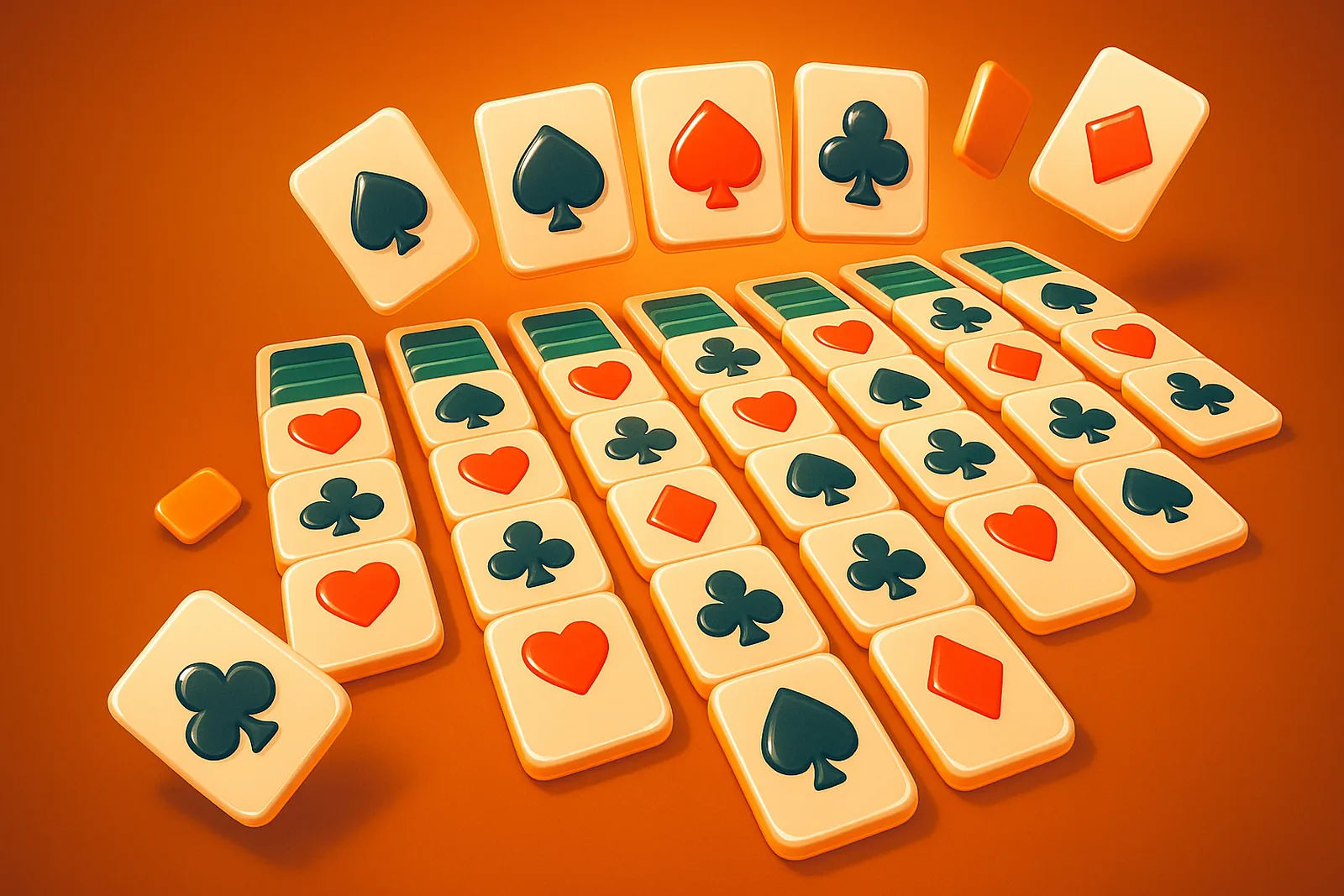
Win more Forty Thieves games by treating every move as a purchase: pay only when it opens a column, builds a foundation, or preserves a future stock card. The game punishes tidy-looking moves that reduce choice. Your first job is not to make the tableau neat. It is to keep the deal alive.
Forty Thieves is hard because it gives you two decks, ten columns, single-card moves, and only one pass through the stock. That combination makes small mistakes permanent. A card placed in the wrong column may block a whole suit. A stock card passed without a landing place may be gone for the game.
Players who already know the rules gain most by improving the next decision, not by memorising slogans. The evidence for exact win rates is thin, and different software handles deals differently, so this guide avoids fake percentages. Instead, it gives ordered, decidable forty thieves tips: what to check, why it works, and when the usual move is wrong.
What should I do first if I want to beat Forty Thieves more often?
First, look for foundation moves that cannot damage the tableau. If an Ace or the next card of a suit is available and no lower card of that suit still needs it as a stepping stone, play it. The reason is plain: foundations are safe storage, and every safe card reduces blockage. The wrong case is a low suited card in the tableau that needs that exact card above it to move. Do not promote the Five of Hearts if the Four of Hearts is buried under a card you can only shift onto that Five.
Second, search for moves that uncover a buried card or make a column empty. In Forty Thieves, a visible card is worth more than a pretty run, because single-card movement means sequences do not travel together. Empty columns are stronger still: they hold any card, rescue stock cards, and let you break jams. The wrong case is emptying a column by dumping a useful low card onto a pile where it traps the matching foundation suit behind a higher card.
Third, before touching the stock, count immediate landing places for the next useful ranks. This is the stock discipline that matters most in two deck solitaire strategy. A stock card can be played only once from the waste order you see; if it has no home, you may lose it. The wrong case is waiting so long that a column move you already had gets blocked by a higher suited card from the stock.
Fourth, avoid moves that only join same-suit cards because they look orderly. Same-suit building matters, but only when it creates access, storage, or foundation progress. The wrong case is refusing a temporary off-column hold in an empty space when it saves a vital stock card.
Which moves are usually right, and which ones are traps?
- Usually right: play a free Ace or Two to the foundation. The reason is that early foundation cards open permanent space and rarely serve as tableau tools. The wrong move is automatic promotion when that card is the only place for a lower suited card that must be shifted first.
- Usually right: make an empty column before making a tidy build. An empty column can receive any single card, which is powerful in a game where nothing moves as a packed run. The wrong move is sacrificing a live low card to empty a column that you cannot use within the next few moves.
- Usually right: move a card that exposes another card. Forty Thieves is often lost by hidden or buried key ranks, not by lack of neat piles. The wrong move is exposing a card while placing the mover on a column that blocks its own suit from reaching the foundation.
- Trap: building high cards onto medium cards just because the suit matches. It can freeze the medium card when the foundation is still low. The move is right only if the lower card is already safe, or the build creates an empty column or reveals something important.
- Trap: spending the stock to see more cards when the tableau has work available. The stock is not a search button; it is a one-pass queue. The exception is when every tableau move is cosmetic and the next stock card has a clear landing place or foundation path.
- Usually right: keep duplicate ranks in different places when possible. With two decks, a second copy can save you from one blocked copy. The wrong case is preserving both copies so carefully that you refuse a foundation move that would clear a column.
How do I decide when to spend a stock pass and when to wait?
- Spend the stock when the top card can be played safely now. The reason is that a playable stock card becomes new material: it may reach a foundation, fill an empty column, or create a needed same-suit landing place. The wrong case is playing it onto a column that buries a card you were close to releasing.
- Wait when the tableau contains a move that creates a new landing place. Stock cards are more valuable after you have space. If you can empty a column or free a suited predecessor first, do that before drawing. The wrong case is waiting on a long chain of speculative tableau moves while a known stock card already solves a real blockage.
- Spend when all remaining tableau moves only reduce flexibility. If every available move stacks a higher card onto a lower card without revealing, emptying, or building foundations, drawing is often better. The wrong case is ignoring a dull-looking move that puts the exact next foundation card into reach.
- Wait when you cannot hold the ranks you expect to need. Before drawing, ask where the next Aces, Twos, or suited connectors would go. If the answer is nowhere, improve the tableau first. The wrong case is over-preparing for imaginary cards while refusing to play the card actually in front of you.
- Spend late when the tableau is stable but stuck. Once columns are open and foundations are moving, the stock must supply missing links. The wrong case is burning through several stock cards because the first draw helped; one good draw does not make the next one safe.
Which columns matter most once the layout starts to open?
Give first priority to columns that can become empty with the fewest damaging moves. Count the blockers, not the height. A tall column with movable top cards may be easier than a short column capped by a card whose suit is still far from the foundation. The reason is that an empty column changes the whole deal. The wrong case is tearing apart a useful same-suit lane to empty a column you then fill with junk.
Second, protect columns that contain low cards of slow suits. In Forty Thieves, a buried Ace, Two, or Three can hold back both decks of that suit. Freeing it is usually worth more than advancing a suit that is already flowing. The wrong case is chasing a low card so hard that you block another suit with no empty column left to repair the damage.
- Work on columns with foundation pressure. If a column holds the next card needed by a foundation, it matters now. Reason: that single card may release several later stock plays. Wrong case: the card above it is a useful landing card you still need.
- Use empty columns for temporary storage, not decoration. A parked card should have a planned exit. Reason: storage that never empties again is just another blocked column. Wrong case: refusing to park a card briefly when it saves a stock card you cannot recover later.
- Keep one flexible column if you can. Do not fill every space at once. Reason: single-card movement needs breathing room. Wrong case: leaving a space empty while a rare playable stock card passes by.
Once the layout opens, refuse any move that spends your last repair tool unless it frees a card, advances a foundation, or saves a stock card you cannot recover later.
How does Forty Thieves compare with other hard solitaire games?
Hard solitaire games test different habits. A good move in FreeCell may be poor Forty Thieves play, because FreeCell gives open cells and complete information. Spider Solitaire (4 Suits) rewards long-term suit packing. Forty Thieves rewards restraint, especially around the stock.
| Game | Main pressure | Decision that wins more often | Habit that misleads you |
|---|---|---|---|
| Forty Thieves | One stock pass, ten columns, single-card movement | Make space before drawing, and play stock cards only when they have a real home | Building neat same-suit piles that do not reveal cards or create an empty column |
| Canfield Solitaire | A reserve pile that controls access to many cards | Use moves that reduce reserve pressure before improving ordinary tableau shape | Treating every foundation move as harmless when the reserve still needs landing places |
| FreeCell | Temporary spaces and full information | Plan reversible sequences and keep enough free cells to undo trouble | Expecting Forty Thieves to let you repair mistakes in the same way |
| Spider Solitaire (4 Suits) | Mixed suits block packed sequences | Build clean suit runs when they improve future mobility | Carrying Spider habits into Forty Thieves, where a run cannot move as one unit |
| Klondike Solitaire (Turn 3) | Waste order and hidden tableau cards | Time waste plays so key cards are not buried behind the turn cycle | Assuming the stock will cycle again; Forty Thieves does not give that comfort |
The useful comparison is not which game is hardest. It is which skill transfers. Patience transfers. Exact memory of stock order transfers from Klondike Solitaire (Turn 3). Run-building confidence from Spider Solitaire (4 Suits) transfers badly unless you keep checking whether the move gives access.
Frequently asked questions
No. Some deals are blocked so badly that perfect play still runs out of useful moves. Forty Thieves gives you one pass through the stock, builds by suit, and only lets you move one card at a time. That combination means luck matters. Good strategy raises your chances; it does not turn every layout into a win.
104 cards are used, because Forty Thieves is played with two full decks. The opening layout puts 40 cards into ten columns, leaving the rest in the stock. That big stock looks generous, but the one-pass rule makes it tight. Every card you turn over is a chance you may not get again.
The common misconception is that any empty column is a win in itself. The correction is that an empty column is only valuable if it improves access. Filling it with a random card can waste the best resource on the table. Use spaces to expose buried cards, join a same-suit run, or hold a card that is blocking several useful moves.
You see the 6 of clubs open, and the 7 of clubs is sitting on top of another column. Moving the 6 looks tidy, but if it uncovers nothing and uses up a useful landing point, it may be worse than waiting. A legal move is not automatically a helpful move. Ask what new card or new space it creates.
It depends on the card’s future use: play it if it opens a foundation, extends a same-suit run, or clears a blocker; leave it if playing it merely tidies the table. Waste-pile discipline matters because you cannot cycle the stock again. A card played too early can occupy the one place you later needed for a better card.
FreeCell gives you visible cards and temporary holding spaces, so many mistakes can be repaired if you see them soon enough. Forty Thieves hides much of its work in the stock and limits you to single-card moves. The result is harsher: one casual placement can block a suit sequence for the rest of the deal.
Build foundations when the move is clearly safe; pause when the card may still be needed as a stepping stone in the tableau. A low card is usually fine to send up, especially an ace or two. The exception is a card that lets you move a buried same-suit sequence or create an empty column.
Most people treat the stock as a rescue pile rather than a scarce supply. They turn cards quickly, make every obvious play, and only then notice that the tableau is still jammed. Slow down before each stock card. If the table has no plan for the next few ranks in a suit, another stock card may only add clutter.
A single-card move means you can move only the exposed top card of a column, not a packed sequence of several cards. Even if five cards are correctly ordered by suit, they do not travel as a group under the standard rule used here. This is the rule that makes spaces, timing, and suit order so important.
Use an empty column to release cards, not to make the table look neat. Put a card there only if it helps uncover a hidden card, build a same-suit chain, or park a blocker while you free something better. If two choices look equal, prefer the move that exposes more information. Information is often worth more than a tidy column.
Nobody knows precisely, because published win rates mix different rules, different shuffles, and different standards of play. The best available figure is rough: standard Forty Thieves is often quoted at about one win in ten for careful play. Treat that as a useful warning, not a guarantee. The evidence is thin, and the deal still has a large say.
A historical fact: Forty Thieves is widely known by the older patience name Napoleon at St Helena. Names vary across books and sites, and small rule details can vary with them. On Veena Games, the important facts are the rules in front of you: two decks, ten columns, single-card moves, and one pass through the stock.
Final thoughts
If you want one habit to carry into the next deal, pause before any move that feels obvious. Ask what it buys. A foundation move buys safety. An exposure move buys information. An empty column buys repair power. A stock draw buys a chance, but it can also spend a card forever.
Good Forty Thieves players are not magicians. They are less wasteful. They leave themselves a column to fix trouble. They do not panic-draw because the tableau looks stuck for 5 seconds. They also do not worship rules so rigidly that they miss the present deal. Sometimes the ugly move is right because it saves a stock card. Sometimes the elegant same-suit build is poison because it locks the card underneath.
You will still lose plenty. The game is built that way, and the evidence for precise win expectations is too thin to dress up. That is part of its appeal. A strong deal can collapse after one greedy stock pass; a poor deal can survive because you kept one space open and refused three tempting moves. Play for those margins. They are small enough to miss and large enough to matter.
-
Canfield
Forty Thieves: The Two-Deck Game That Takes No Prisoners
Forty Thieves Solitaire uses two decks, ten columns and one pass through the stock, making every blocked card matter from the first deal.
14 August 2026
-
 Canfield
How to Play Canfield, the Casino Solitaire
A clear guide to Canfield Solitaire rules, from the 13-card reserve and random foundation rank to legal moves, scoring, and why demon patience bites.
14 August 2026
Canfield
How to Play Canfield, the Casino Solitaire
A clear guide to Canfield Solitaire rules, from the 13-card reserve and random foundation rank to legal moves, scoring, and why demon patience bites.
14 August 2026
-
 Blackjack
 Basic Strategy, Explained Line by Line
A practical guide to blackjack basic strategy, showing how to order blackjack decisions by hand type, dealer upcard, reason and exception.
15 August 2026
Blackjack
Blackjack Basic Strategy, Explained Line by Line
A practical guide to blackjack basic strategy, showing how to order blackjack decisions by hand type, dealer upcard, reason and exception.
15 August 2026