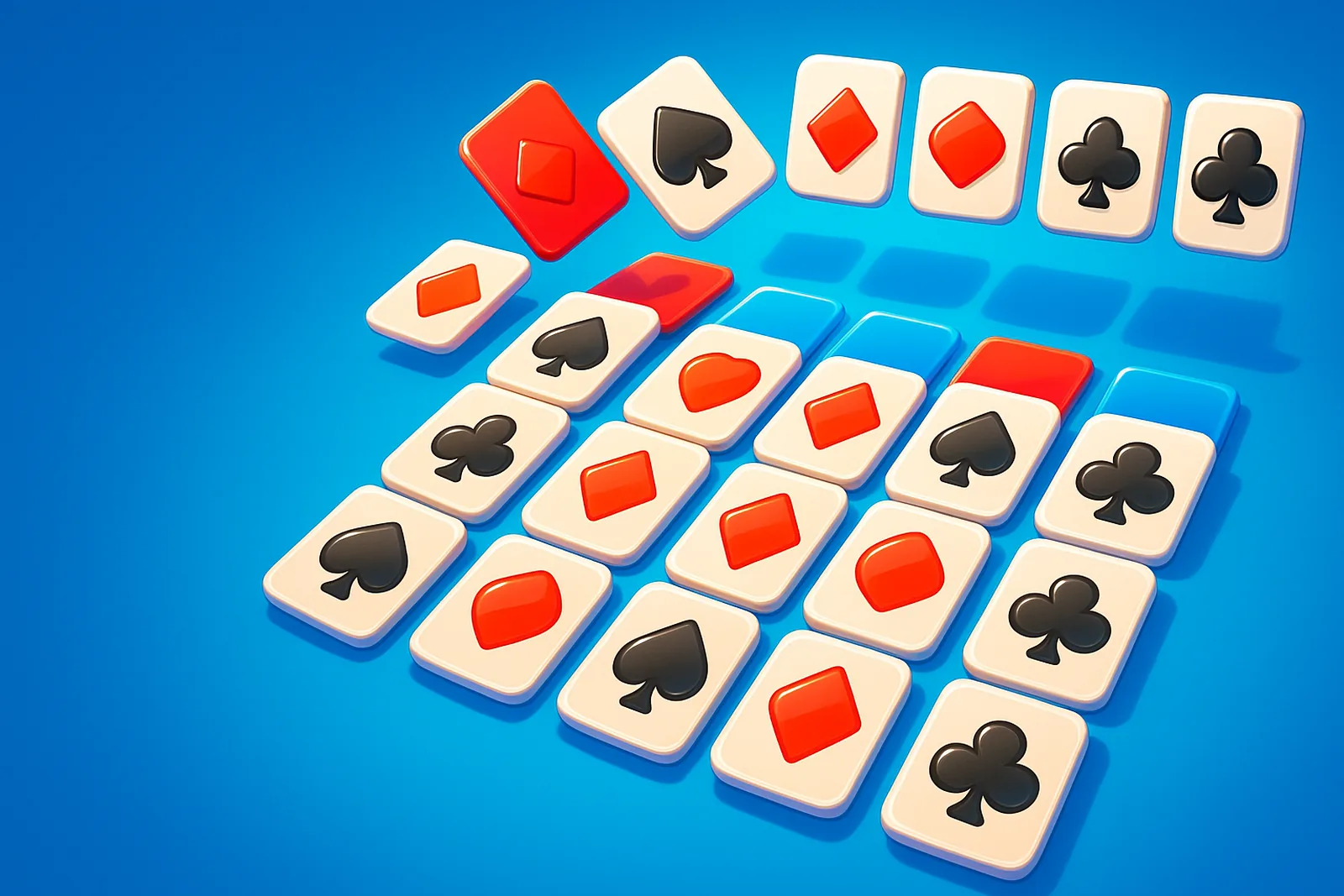
If you mean no luck after the deal, play FreeCell first. All 52 cards are visible, there are 4 open cells, and the outcome mostly comes from planning rather than guessing. The shuffle still matters, so a solitaire deal is not pure skill in the chess sense.
Best players win more often; that still leaves a shuffled start. Many pages call card games pure skill games because the best player wins more often. That is not the same as saying there is no luck at all. A shuffled deck creates a starting position you did not choose. After that, some games give you perfect information, while others hide cards, draw stock, or depend on turns you cannot see yet.
The useful question is not “which game has zero chance?” It is “which game gives me a fair problem, then lets my choices decide most of it?” On that measure, FreeCell, Baker's Game, Eight Off, and several open-layout solitaire games are the place to start. They reward patient sequencing, empty-column control, and restraint. Fast clearing feels good. Saving the right move wins more often.
Which card games ask you to win without relying on luck?
The no-luck part starts after the deal. Card games begin with a shuffle unless the deal is fixed, so the starting position contains luck. The best skill-based card games then stop adding uncertainty. They show you enough information to make a plan, punish waste, and reward clean ordering.
FreeCell is the standard answer because every card is face up from the start. You can see the problem before touching it. The 4 free cells help you borrow space, but they also tempt you into clogging your own board. It suits someone who wants a fair test and does not mind losing because of an early shortcut.
Baker's Game is for players who already like FreeCell but want stricter building. It uses the same visible-deal family of thinking, yet suit-building makes casual pile-shifting less forgiving. You spend more time asking whether a sequence can ever be moved again.
Eight Off is for someone who likes planning with more temporary storage. Its 8 reserve cells make the board feel spacious at first, but the game still punishes messy order. It is generous in one area and stern in another.
Yukon Solitaire is a different sort of skill test. You can move large exposed groups, which creates bold rescue lines and sudden collapses. It suits players who want open information with a more tangled, less tidy board. None of these are pure skill games before the deal. They are games of skill once the deal is in front of you, and the bad moves are usually visible afterwards.
Which games suit someone who wants every card visible from the start?
Visible-card games are best when you dislike guessing. You want to study the whole position, make a promise to yourself, and then see whether your plan survives contact with the board. FreeCell, Baker's Game, Eight Off, and Yukon Solitaire all give you that pleasure in different shapes.
- FreeCell is for the player who wants the cleanest all-round test. You see every card, use 4 open cells, and build towards the foundations while keeping enough space to move sequences.
- Baker's Game is for someone who thinks FreeCell can feel too permissive. Suit restrictions make planning sharper. A move that looks harmless can trap a vital card behind the wrong colour and suit order.
- Eight Off is for players who like having room to arrange ideas. The extra reserve cells make it feel friendly, but poor timing still fills the table with half-solutions.
- Yukon Solitaire is for someone who enjoys visible chaos. The board is open, yet not neat. You can shift packed groups, uncover buried structure, and sometimes create a winning line from a position that looked jammed.
This is the core difference from Klondike Solitaire (Turn 1) and Klondike Solitaire (Turn 3). Those games have face-down cards and stock decisions, so part of the experience is managing uncertainty. That can be satisfying, but it is not what most people mean by no-luck games.
Which games suit a cleaner, stricter sort of puzzle?
- Baker's Game is for the tidy thinker. It looks close to FreeCell, but the stricter building rules change the mood. You cannot treat piles as loose storage. You have to preserve suit order, protect access to low cards, and keep a route back out of every temporary move.
- Eight Off is for the planner who likes reserves. Its reserve cells create a more open start, which can make the first few minutes calmer. The catch is that reserves are easy to waste. If you fill them with cards that do not help each other, the extra space becomes a row of locked doors.
- FreeCell Kings Only is for someone who wants one familiar rule to bite harder. Empty columns are precious in FreeCell-style games. Limiting what can enter them makes every cleared column a decision, not a convenience. It suits players who already understand why empty space matters.
- Relaxed FreeCell is for practice without pretending the puzzle is the same. It keeps the visible, plan-ahead feeling but softens the experience. That makes it useful when you want the logic of FreeCell without the same pressure on every spare cell.
- Forty Thieves is for patient players who like hard sorting problems. It is less open than FreeCell-style games, and it asks for discipline across many piles. The game suits someone who would rather build slowly than chase quick clears.
Which games are good if you want to think ahead, not just clear the board?
Look for games where space is a resource, not a reward. A game about clearing the board can still be clever, but the deepest solitaire decisions often happen before anything disappears. You are asking: if I move this card now, which future card loses its route?
FreeCell is strong here because every tempting move has a visible cost. A free cell used for a red 7 is no longer available for the black 6 that would release a buried ace. An empty column can move a long sequence, but only if you have kept enough cells clear. The board teaches cause and effect quickly.
Baker's Game makes that cause and effect stricter. Because building is by suit, you cannot rely on broad colour alternation to tidy up later. The price of a casual move may not appear for 10 turns, but it was set the moment you placed a card where it could not join its own suit line.
Yukon Solitaire gives a more dramatic version of thinking ahead. Since packed groups can move, you often have several loud-looking options. The best one is not always the move that uncovers a card immediately. Sometimes you move a clumsy stack to create a lane for a future release.
Spider Solitaire (2 Suits) also suits planners, though it uses hidden cards, so it is not in the same no-luck category. It is worth mentioning because it rewards long-range ordering. If you want every fact visible, choose FreeCell or its close relatives. If you can accept some uncertainty, Spider Solitaire (2 Suits) gives a heavier strategic workout.
Which one should you open first if you want a fair test of skill?
Start with the version that matches your patience today. A fair test is not always the hardest test. If the rules are too severe while you are still learning the shape of FreeCell-style play, you spend more time feeling blocked than making useful decisions.
| Game | Best for | Why it feels fair | What to watch |
|---|---|---|---|
| FreeCell | Someone choosing their first serious game of skill | All cards are visible and the 4 cells make the logic clear | Filling cells early makes good positions collapse |
| Baker's Game | FreeCell players who want stricter order | The open deal lets you see why a mistake happened | Suit-building leaves fewer rescue moves |
| Eight Off | Players who like more working space | Reserve cells let you test plans without hidden information | Extra space encourages lazy storage |
| Yukon Solitaire | Players who like messy visible boards | The whole tableau is exposed, so risks can be inspected | Big moves can hide a bad long-term shape |
| Relaxed FreeCell | Someone practising the pattern | It keeps the visible-card logic with a gentler feel | It may teach habits the stricter games punish |
If you want the cleanest first answer, open FreeCell. If it feels too kind, move to Baker's Game. If it feels too tight, spend time with Eight Off or Relaxed FreeCell, then come back with better habits.
Frequently asked questions
Mostly. Once the deal is on the table, FreeCell gives you every card face-up, so you are not guessing at hidden cards or waiting for a lucky draw. The shuffle still creates the starting puzzle, and a tiny number of deals may be impossible, but the play itself is a skill test.
4 open cells are available in standard FreeCell, alongside 4 foundations and 8 tableau columns. Those cells are temporary parking spaces, not waste bins. Because empty cells and empty columns control how long a sequence you can move, counting them before you start a rearrangement is often the difference between a tidy recovery and a locked board.
The common misconception is that FreeCell is won or lost by the shuffle. The correction is that most ordinary deals are winnable with accurate play, because all 52 cards are visible from move 1. A poor early choice can make a winnable deal look dead, especially if you fill every free cell before creating an empty column.
A black 7 may be blocking a red 6, while the black 8 it needs sits under three unrelated cards. Good play is not moving the red 6 at once; it is first making a spare cell, freeing the black 8, then moving the 7-6 pair without stranding the cards beneath them.
It depends on your tolerance for suit-building. Baker's Game makes you build tableau sequences by suit, which gives fewer useful landing places than FreeCell's alternating colours. If you enjoy stricter logic and more blocked moves, Baker's Game may feel cleaner. If you want the same family of puzzle with more flexibility, start with FreeCell.
Compared with Baker's Game, Eight Off gives you more reserve spaces but tighter building rules. It asks for descending sequences by suit, so the extra cells do not make it loose or casual. FreeCell is usually the better first test; Eight Off suits players who already like planning several moves before touching the obvious card.
Keep one free cell empty. The exception is a move that immediately opens a column, releases an ace, or lets you place several cards safely on foundations. A full row of cells feels powerful for one move and miserable for the next five, because every buried card now needs a space you no longer have.
Most people do the same thing wrong: they treat free cells as storage. They move awkward cards into them, then solve the next two moves instead of the next ten. In FreeCell, a free cell is more like breathing room. Use it to complete a planned transfer, then empty it as soon as the transfer has done its job.
Open information means there are no hidden cards and no draw pile surprises. You can see the full problem before your first move. FreeCell is the clear example on Veena Games: every card is dealt face-up, so mistakes come from planning, order, and space management, not from discovering the wrong card later.
Find the aces, then check what is sitting on top of them and what blocks them. Create an empty column early if you can do it without filling all 4 cells. Move cards to foundations when they cannot still help in the tableau. If a move only feels useful, wait.
Nobody knows precisely, because the full set of possible shuffled FreeCell deals is far beyond anyone checking by hand. The best-known public benchmark is the original Microsoft set of 32,000 deals: 31,999 are known to be winnable, with deal 11982 the famous exception. That is a set result, not a proof for every shuffle.
FreeCell reached computers before Windows. Paul Alfille wrote a FreeCell program for the PLATO system in 1978, and Microsoft later made the game widely familiar on Windows. The idea belongs to the patience family, but the computer version mattered because it could number deals, track them, and make repeatable puzzles easy to share.
The cost of getting it wrong is losing mobility. A card placed on a foundation may no longer be available to support a descending sequence in the tableau, so an early tidy-up can block a later rescue. Safe foundation moves are usually low cards whose opposite-colour neighbours have already moved or are no longer needed.
Final thoughts
If you are choosing for tonight, do not start with the most severe game just to prove something. Start with the one that lets you notice your own mistakes. FreeCell is good at that. You can point to the moment you spent a cell too cheaply, buried a useful card, or cleared a column with no plan for using it.
After a few games, you will know what kind of difficulty you enjoy. If you like rules that keep asking for exact order, Baker's Game will suit you. If you like having more room to breathe while still solving a visible puzzle, Eight Off is a better next step. If you enjoy untangling a board that looks awkward from move 1, Yukon Solitaire has that satisfying sense of pulling one thread and watching the rest shift.
Keep one thought in mind: games of skill are not always calm. They can be irritating because the excuse supply is smaller. A hidden draw did not ruin the position. You did. That is also why the next deal is appealing. You have a specific fault to repair, not a vague hope that the cards will be nicer.
-
 Card Games
Blackjack vs Video Poker: The Two Lowest House Edges
Video poker wins only with the right full-pay machine and perfect play; for most real seats, fair 3:2 blackjack is the cleaner low-edge choice.
18 August 2026
Card Games
Blackjack vs Video Poker: The Two Lowest House Edges
Video poker wins only with the right full-pay machine and perfect play; for most real seats, fair 3:2 blackjack is the cleaner low-edge choice.
18 August 2026
-
 Card Games
 You Can Finish in Five Minutes
A practical guide to quick card games, matching fast solitaire and blackjack choices to the kind of break you actually have.
18 August 2026
Card Games
Card Games You Can Finish in Five Minutes
A practical guide to quick card games, matching fast solitaire and blackjack choices to the kind of break you actually have.
18 August 2026
-
 Card Games
Is Solitaire Actually Good for Your Brain?
Solitaire gives light attention and memory practice, and can be calming, but the evidence for broad cognitive improvement is thinner than adverts suggest.
13 August 2026
Card Games
Is Solitaire Actually Good for Your Brain?
Solitaire gives light attention and memory practice, and can be calming, but the evidence for broad cognitive improvement is thinner than adverts suggest.
13 August 2026