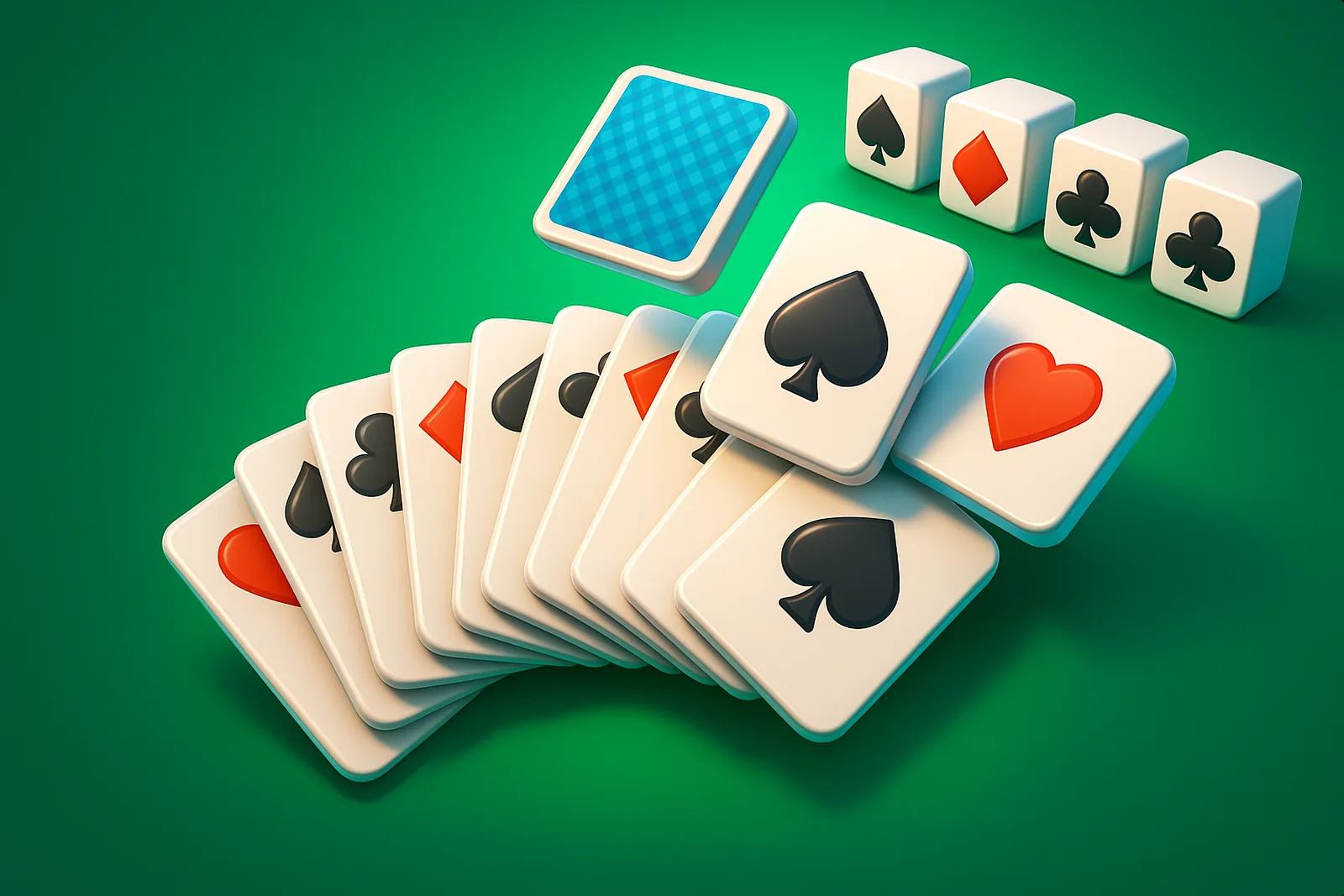
Solitaire can be good for your brain in a modest, practical sense: it asks for attention, short-term memory and planning. It is not proved to make you generally smarter, prevent dementia or repair poor concentration. Treat it as light mental exercise, not medicine.
That distinction matters because the question “is solitaire good for your brain” often gets answered with more confidence than the evidence allows. Solitaire is a real cognitive task. You scan for moves, remember where useful cards sit, judge whether to uncover a face-down card or build a foundation, and resist the lazy move that feels tidy but blocks the game later.
Those are useful demands while you are playing. The harder claim is transfer: does a card game improve attention, memory or everyday thinking outside the game? For solitaire specifically, strong evidence is thin. Broader research on card games cognition and brain-training-style tasks is mixed, especially when people promise wide, lasting benefits. The honest case for solitaire is smaller and more believable: it can give your mind a structured, low-pressure task, and that may be exactly what you want from a ten-minute break.
Is solitaire actually good for your brain, or is that just marketing?
Yes, solitaire is good for your brain if the claim means “uses your brain”. No, the evidence does not support the bigger marketing claim that solitaire reliably improves general intelligence, stops cognitive decline, or works like clinical memory training.
A game of Klondike Solitaire asks for several real mental operations. You must keep the rules active, track suits and ranks, notice hidden-card opportunities, and choose between moves that help now and moves that may help later. In Turn 1, every stock draw is visible one card at a time, so the puzzle is less about wrestling the draw pile and more about reading the tableau cleanly.
That is enough to make solitaire a worthwhile cognitive pastime. It is not enough to call it treatment. Most bold claims about solitaire memory benefits borrow authority from broader ideas: puzzles are good, older adults should stay mentally active, card play involves attention, and so on. Those ideas are not nonsense, but they do not prove that one specific solitaire habit produces broad brain change.
The clearest benefit is near the task itself. If you play often, you are likely to get better at spotting solitaire moves, remembering useful patterns, and avoiding common traps. That is learning. Far transfer is the hard part: becoming better at solitaire does not automatically mean you will remember names better, focus at work longer, or think faster in unrelated tasks.
The fair answer is still positive. Solitaire beats passive scrolling when you want a quiet task with rules and consequences. It gives the mind something orderly to do. Just do not buy the inflated version of the claim.
What does solitaire do for attention and memory, and what does it not do?
The sensible way to judge solitaire is to separate what the game clearly asks of you from what people sometimes sell around it. Each claim should stay tied to a decision a player actually faces, not drift into a promise about life outside the game.
| Area | What solitaire clearly uses | What is not shown | Practical reading |
|---|---|---|---|
| Attention | You scan columns, spot legal moves, and return to blocked cards after each change. | There is no solid solitaire-specific proof that this raises attention in daily life. | Good for practising focus during the game; do not treat it as an attention cure. |
| Working memory | You hold short runs, buried cards, and possible suit sequences in mind. | Solitaire memory practice has not been shown to create broad memory improvement. | Useful if you want a small memory load without pressure. |
| Long-term memory | You learn patterns, such as when an empty column is valuable or risky. | Learning solitaire patterns is not the same as improving recall of events, names or appointments. | Expect game skill, not a general memory upgrade. |
| Planning | You compare immediate moves with future access to hidden cards. | The evidence does not show that solitaire alone improves general planning ability. | It is a neat planning exercise, especially if you pause before obvious moves. |
| Mood and stress | A familiar rule set can narrow attention and give a sense of order. | Claims about clinical stress reduction from solitaire are much stronger than the evidence. | Use it as a break, not as your only way to cope. |
If a claim jumps from “this uses attention” to “this improves attention everywhere”, it has left the safe ground.
Can a short game calm you down without making you lazy or foggy?
A short game can calm you down if it works as a clean break. Solitaire gives you rules, visible choices and a finish point. That is different from an endless feed, where the next item is chosen for you and there is no natural place to stop.
The calming effect is plausible, not magical. A familiar game reduces the number of decisions you have to invent from scratch. You know what a red seven can do. You know why an empty column matters. That predictable structure can be pleasant when your day has been noisy or scattered.
- Good use: one game between tasks, with the aim of resetting attention.
- Less good use: replaying after every loss because you are avoiding the next thing.
- Good sign: you return to work, reading or sleep with a quieter mind.
- Warning sign: you feel dulled, irritable, or annoyed by interruptions to the game.
Solitaire does not make you lazy. Habits can. If a game replaces rest, movement, sleep or the difficult conversation you are putting off, the problem is not the cards. It is the way the break has swollen into avoidance.
Foggy play is usually a signal, too. If you are missing obvious moves, clicking without looking, or chasing a win past the point of enjoyment, stop. A useful break should leave a little more space in your head, not less.
Which card games are better bets if you want more mental work?
If you want heavier thinking, choose the game by the kind of work you want. None of these is proven medicine. They are better bets for effort because their rules ask for more planning, memory or calculation.
- FreeCell: all cards are visible, so blame shifts from luck towards planning. You need to manage empty cells, preserve space, and think several moves ahead before moving a sequence.
- Spider Solitaire (2 Suits): harder than a single-suit layout because suits start to matter. You can still build runs easily enough to learn from mistakes.
- Spider Solitaire (4 Suits): the toughest Spider option on the site. It demands patience, suit discipline and careful sequencing. It is a poor choice for a quick calm-down game.
- Yukon Solitaire: movable stacks create big tactical swings. You can often see an attractive move that opens trouble two moves later.
- Forty Thieves: with two decks and strict building, it asks for a slower style. You often have to decide whether using a card now will block an entire suit later.
- Blackjack or Single Deck Blackjack: these add arithmetic and risk judgement rather than tableau planning. They are useful when you want totals, probabilities and restraint, not a long solitaire puzzle.
For a middle ground, Klondike Solitaire (Turn 3) adds more friction than Turn 1 because the stock order matters more. The best game is the one that makes you pause without making you tense.
How should you play if you want the benefit without pretending it is training?
Play in a way that makes the mental work visible. The benefit is not hidden in the cards; it comes from paying attention, making choices, and noticing why those choices worked or failed.
- Set the claim low before you start. Tell yourself: “I am taking a focused break.” That is honest. “I am training my brain” is too grand for the evidence.
- Play one clean game, not a blur. A single attentive game has more value than five half-watched games played beside a video. If you cannot give it attention, take a real rest instead.
- Pause before automatic moves. Moving an ace to the foundation is usually harmless; moving a low card from the tableau may not be. Ask what the move reveals, blocks or preserves.
- Use undo as review, not rescue. Undo is most useful when it teaches cause and effect. If you undo every inconvenience, you stop feeling the cost of earlier choices.
- Notice your common mistake. Some players empty columns too early. Some bury useful cards. Some chase foundations and strand the tableau. One named mistake is easier to fix than vague frustration.
- Stop while the game is still doing its job. If you began for a break, leave when you feel reset. If you began for challenge, leave when you are no longer thinking carefully.
After a loss, ask which earlier move made the board tight. If you can name it, the game has given you feedback you can use.
Frequently asked questions
No. A card game has not been shown to prevent dementia. It can make you attend to suit, colour, rank and order, which is real mental activity, but that is not medical protection. If memory loss, confusion or mood changes worry you, solitaire is a pleasant habit, not a substitute for proper advice.
3 mental skills show up most often: scanning the tableau, remembering hidden information, and delaying an obvious move until you have checked the alternatives. Klondike Solitaire (Turn 1) asks for all 3, but in small doses. You are choosing between visible options, not solving a formal memory test.
People often think brain training means any hard-feeling puzzle will transfer into sharper thinking everywhere, but the correction is narrower. Solitaire mainly trains you at solitaire-like choices: spotting sequences, managing uncertainty, and pausing before a move. That can support a useful habit of attention. It does not prove a broad rise in intelligence or long-term memory.
Picture this: red 7 on black 8, with a face-down card underneath the 7. Moving it opens a hidden card, but it also blocks a red 6 you may need later. A good decision is not move if legal. It is checking which move creates new information, which move frees a column, and which move can wait.
It depends on the rules you use: undo and hints are helpful if they make you review why a move worked, and less useful if they let you click without looking. For brain benefit, try one deal with full help, then replay more slowly and predict the hint before asking for it.
Compared with FreeCell, Klondike Solitaire (Turn 1) gives you more hidden information and more luck. FreeCell shows every card from the start, so the work is cleaner planning. Klondike still has value because you must manage partial information. If you want heavier mental work, FreeCell is the sharper test.
Read the stock with purpose; the exception is when you are deliberately relaxing and do not care about efficiency. In Klondike Solitaire (Turn 1), every pass through the stock can reveal timing: which card is useful now, which is bait, and which should be left until a column opens. Unlimited redeals make this forgiving.
Most people blame luck first and check their tempo last. They move cards to foundations too early, fill empty columns with the first king they see, or expose a card without asking what happens next. Klondike has luck, but hurried legal moves waste the good deals and make the bad deals look hopeless sooner.
A cognitive workout is mental effort that makes you hold a goal in mind while choosing between alternatives. In solitaire, that might mean remembering where a black 9 is, deciding whether to uncover a face-down card, and resisting a tidy move to the foundation. It is effort. It is not a measured treatment.
Set a timer for 5 or 10 minutes, play Klondike Solitaire (Turn 1), and stop when the timer ends or the deal ends. Use undo only to inspect your own mistake, not to erase every risk. If you return to work calmer and still alert, the break did its job.
Nobody knows precisely how long is best, because solitaire has not been given a reliable, agreed dose like a medicine. The best available figure for ordinary use is practical: one short session of about 5 to 10 minutes. Long enough to settle into the rules; short enough that the break does not become avoidance.
Patience games were being played in Europe by the late eighteenth century, long before browser solitaire and brain-training adverts. They were treated as pastimes of order, attention and chance. That history matters because the appeal did not begin with health claims. People kept playing because the loop is satisfying: reveal, choose, regret, recover.
The cost of getting it wrong is misplaced confidence. If you use solitaire as a quiet break, fine. If you use it to avoid sleep, exercise, social contact, medical advice or difficult work, the game becomes cover for the thing you are not doing. The difference is not moral. It is practical.
Final thoughts
I would put solitaire in the same category as a crossword, a quiet walk, or making tea properly. It will not rescue your brain. It can still be a decent thing to do with it.
The danger is not solitaire. The danger is turning every pleasant activity into a health claim. A game does not need to prevent dementia to be worth playing. It does not need to raise your IQ to give you ten minutes of order, choice and concentration. Those smaller goods are real enough.
If you are worried about memory, attention or mood in a serious way, a browser card game is the wrong place to seek reassurance. Speak to someone qualified, sleep more if you can, move your body, reduce the obvious drains, and use games as part of ordinary life rather than proof that you are fixing yourself.
If you simply like cards, there is no need to apologise for that. Play carefully when you want a puzzle. Play gently when you want a break. Stop when the game starts taking more than it gives. Close the tab while you still want another deal.
-
 Card Games
The Best Solitaire Games for Complete Beginners
Pick a beginner-friendly solitaire game by mood: visible information, gentle rules, quick rounds, or a slower puzzle with fewer nasty surprises.
13 August 2026
Card Games
The Best Solitaire Games for Complete Beginners
Pick a beginner-friendly solitaire game by mood: visible information, gentle rules, quick rounds, or a slower puzzle with fewer nasty surprises.
13 August 2026
-
 Card Games
Which Card Game Should You Play to Wind Down?
Choose a card game by how tired you are, how much pressure you want, and whether you prefer short puzzles or a longer sit-down.
13 August 2026
Card Games
Which Card Game Should You Play to Wind Down?
Choose a card game by how tired you are, how much pressure you want, and whether you prefer short puzzles or a longer sit-down.
13 August 2026
-
 Card Games
Why Do Some Solitaire Games Deal You an Unwinnable Hand?
Some solitaire deals are unwinnable because fixed hidden-card order can trap the very cards needed to open the game.
13 August 2026
Card Games
Why Do Some Solitaire Games Deal You an Unwinnable Hand?
Some solitaire deals are unwinnable because fixed hidden-card order can trap the very cards needed to open the game.
13 August 2026