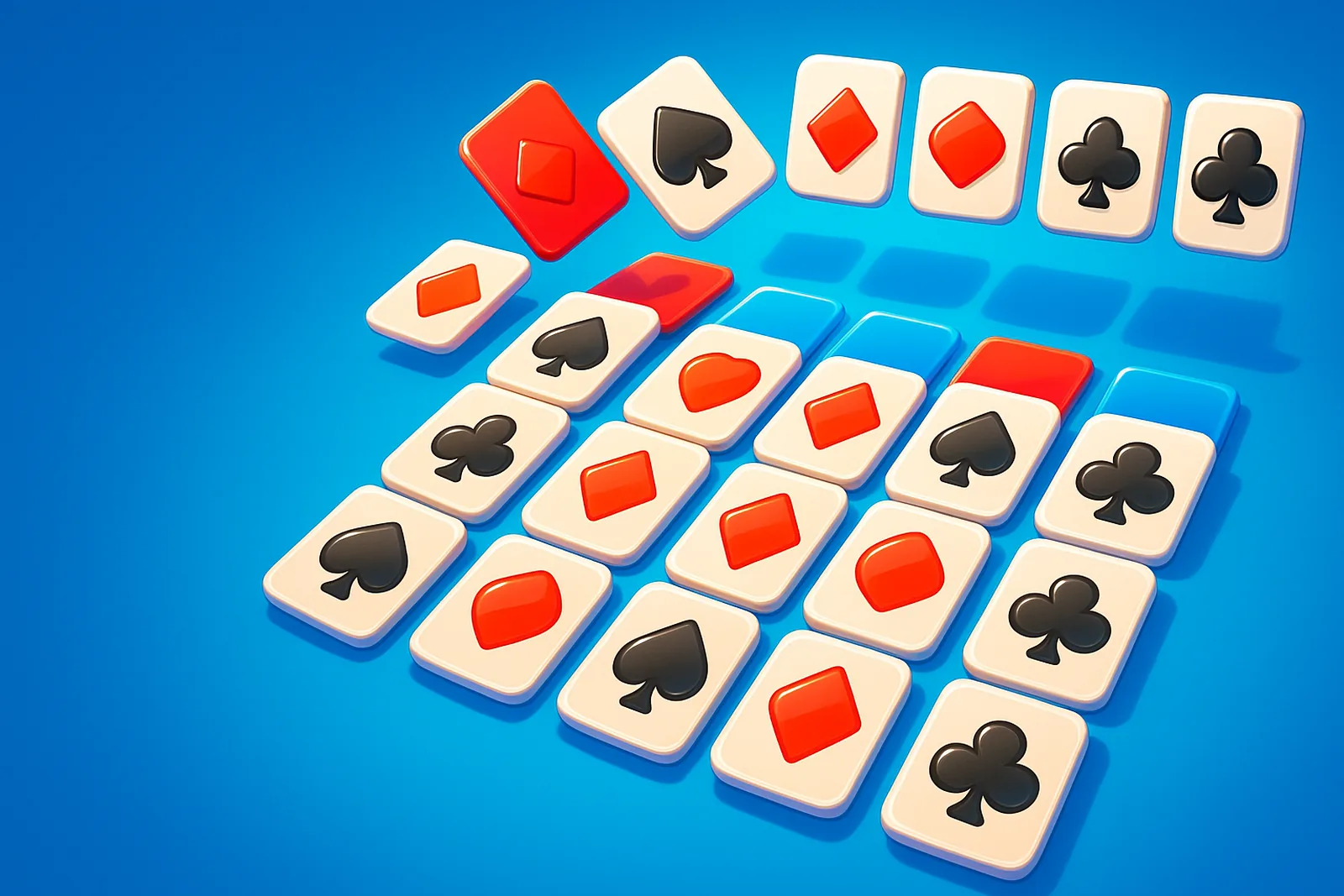
FreeCell is the best solitaire to start with if you want fair decisions; Klondike Solitaire (Turn 1) is the best first pick if you want the classic version most people recognise. Both are solitaire for beginners, but they teach different habits from the first deal.
A beginner does not need the absolute easiest solitaire game. You need a game where the rules are visible, mistakes are readable, and one bad click does not make the next ten minutes pointless. FreeCell works well here because every card is face up from the deal and the four open cells give you a clear place to think. You lose by tying your own hands, not because a buried card never appeared.
Klondike Solitaire (Turn 1) feels more familiar: build down in alternating colours, uncover face-down cards, move aces to foundations. It has more luck than FreeCell, but it is gentle enough to learn in small pieces. If you want quick, light rounds, Golf Solitaire and TriPeaks Solitaire are easier to read at a glance. If you want a slower puzzle, Spider Solitaire (1 Suit) gives you room to plan without the full bite of the harder Spider versions.
Which solitaire should a complete beginner start with?
Start with FreeCell if you want the fairest lesson, and Klondike Solitaire (Turn 1) if you want the most familiar lesson. The best solitaire to start with depends on what frustrates you first: hidden cards, long rules, or running out of moves before you understand why.
FreeCell is unusually good for a first serious solitaire game because every card is visible from the deal. There are still hard choices, but there is very little mystery. The four open cells act like parking spaces. You use them to move awkward cards out of the way, then try to free low cards and build foundations from aces upwards. A bad FreeCell position usually teaches you something specific: you filled the cells too soon, blocked a column, or moved a sequence before making room for it.
Klondike Solitaire (Turn 1) is for the player who wants the version they half-remember from old computers, kitchen tables, or a relative explaining it too quickly. It has hidden cards and the deck order matters, so it is less fair than FreeCell. Still, turning 1 card at a time gives you more chances to use the waste pile than Klondike Solitaire (Turn 3), and the main aim is easy to grasp after a few hands.
If you are truly brand new, play 2 or 3 deals of each. Choose the one where your mistakes feel understandable, not the one you win first.
Which easy solitaire games feel fair from the first deal?
- FreeCell is for beginners who dislike guessing. Every card is visible, so the game feels like a puzzle rather than a lottery. It suits players who enjoy planning 3 or 4 moves ahead and learning from exact mistakes.
- Klondike Solitaire (Turn 1) is for someone who wants classic solitaire with a softer start. You still have hidden tableau cards, but turning 1 waste card at a time makes the deck easier to use than in Klondike Solitaire (Turn 3).
- Golf Solitaire is for the player who wants quick rules and quick endings. You remove cards 1 rank higher or lower than the waste card. There is still luck, but the choice on each turn is plain.
- TriPeaks Solitaire is for beginners who like the Golf Solitaire rhythm but want a clearer visual target. The three peaks show your progress well, and a round moves quickly without asking you to remember many rules.
- Pyramid Solitaire is for people who enjoy simple arithmetic. Pair cards to make 13. It is easy to learn, but it can be sharp: the wrong pair may trap a useful card underneath.
- Spider Solitaire (1 Suit) is for someone who wants a longer game without juggling suit colours yet. It teaches ordering, empty-column value, and patience before the 2-suit and 4-suit versions add pressure.
What if you want something slower and less punishing?
Choose Relaxed FreeCell or Spider Solitaire (1 Suit) if you want time to think without every early mistake feeling fatal. Both suit a beginner who prefers a steady board to a fast round.
Relaxed FreeCell is for the player who likes FreeCell’s open information but wants a gentler first step. The appeal is psychological as much as technical: you can look at the whole deal, pause, and make a plan before moving anything. That matters. New players often lose solitaire because they move the first legal card they see, then spend the rest of the game repairing that impulse.
Spider Solitaire (1 Suit) is slower in a different way. It uses a larger tableau and asks you to build descending runs, but the single suit removes a major source of confusion. You can focus on making empty columns, uncovering face-down cards, and keeping long sequences usable. It is not the easiest solitaire game, yet it is a good beginner choice for someone who enjoys methodical clean-up.
Faster games such as Golf Solitaire, TriPeaks Solitaire, and Pyramid Solitaire are excellent when you want light pressure. They are less good when you want to study. A short game can be over before you understand the mistake. Slower solitaire gives you more time with the consequences.
Which game should you pick if you want more choice than luck?
A good rule: the more cards you can see, the more the game rewards choice over fortune. The evidence for one single easiest solitaire game is thin, because difficulty depends on deal design, variant rules, and player taste. A comparison by visibility, control, and remaining luck is more useful than a ranking.
| Game | What you control | Luck you still face | Best for |
|---|---|---|---|
| FreeCell | All cards are visible, and 4 open cells let you rearrange blocked sequences. | A few deals are awkward, but hidden information is not the problem. | Beginners who want a fair puzzle and clear blame for mistakes. |
| Baker's Game | You can see the whole deal and plan around the free cells. | Building by suit makes the same open layout stricter than standard FreeCell. | FreeCell players who want a harder, cleaner rule set later. |
| Eight Off | Extra reserve spaces give you more room to sort cards and repair positions. | Suit-based building still demands careful order and can choke the board. | Patient beginners who like open-card puzzles with more parking space. |
| Spider Solitaire (1 Suit) | You choose when to expose cards, clear columns, and deal new rows. | Face-down cards and new deals can bury the card you need. | Players who want a longer planning game without suit confusion. |
| Klondike Solitaire (Turn 1) | You choose tableau moves, foundation timing, and waste-pile use. | Hidden tableau cards and deck order can decide some games. | Beginners who want the classic feel more than perfect fairness. |
How do you choose the right game for your first few tries?
- Pick by annoyance first. If hidden cards annoy you, start with FreeCell. If long boards annoy you, start with Golf Solitaire or TriPeaks Solitaire. If arithmetic feels pleasant, Pyramid Solitaire may be your best solitaire to start with.
- Give each candidate 2 deals. One win proves little, and one loss proves even less. On the second deal you begin to notice whether the rules are sticking or whether you are still clicking at random.
- Use Klondike Solitaire (Turn 1) before Turn 3. The Turn 1 version shows one waste card at a time, so beginners get more usable chances. Move to Klondike Solitaire (Turn 3) when you want a tighter classic game.
- Choose Spider Solitaire (1 Suit) before harder Spider. Spider Solitaire (2 Suits) and Spider Solitaire (4 Suits) are better saved for later. The 1-suit game teaches columns, runs, and timing without making suit management the main lesson.
- Move on when losses stop explaining themselves. A good beginner game should make you think, not make you shrug. If every defeat feels like fog, switch. Solitaire for beginners works best when the next hand changes how you play.
Frequently asked questions
No. FreeCell is often a better lesson because every card is visible from the deal, so you can see why a plan failed. Klondike Solitaire (Turn 1) is familiar and friendly, but hidden cards mean some losses feel mysterious. If you want to learn cause and effect, start with FreeCell or Relaxed FreeCell.
4 open cells sit above the tableau in standard FreeCell, and they are the whole trick. Each one can hold 1 card, giving you room to unjam columns and move sequences. Use them as temporary parking, not storage. If all 4 are full, even a simple move can become impossible.
People often think solitaire is mostly luck; the correction is that it depends heavily on the variant. Klondike Solitaire (Turn 3) can hide useful cards for a long time. FreeCell shows every card from the start, so planning matters far more. Beginner luck still exists, but it is not the whole game.
A red 7 is blocking a low card, and a black 8 is open in another column. Moving the red 7 onto the black 8 clears the card beneath it and keeps your free cells untouched. That is a good early move: it reveals or releases something useful without spending one of your 4 spare spaces.
It depends on suit count: Spider Solitaire (1 Suit) is a reasonable first Spider game, while Spider Solitaire (4 Suits) is a steep start. With 1 suit, you learn ordering and empty-column play without worrying about mixed suits. With 4 suits, even tidy-looking rows can refuse to move together.
Compared with Klondike Solitaire (Turn 1), Klondike Solitaire (Turn 3) gives you fewer chances to use the waste pile at the exact moment you want. Turn 1 lets you see and play one new card at a time. Turn 3 asks you to think about the order of the stock, which is a harder habit for a beginner.
Move safe cards to the foundation; the exception is when that card is still needed in the tableau. An ace is always safe. A low card is usually safe once both opposite-colour cards beneath it have already moved or are no longer useful. If moving a 5 removes the only place for a 4, wait.
Most people spend their spare spaces too early. In FreeCell, filling all 4 cells feels productive for about ten seconds, then the board locks. In Klondike Solitaire (Turn 1), the common mistake is moving cards around without exposing face-down cards. Prefer moves that open a column, reveal a card, or free a buried low card.
A foundation is one of the piles where cards are built up, usually from ace to king by suit. The tableau is the main playing area, where you arrange cards to uncover, move, or release them. In FreeCell, all tableau cards are visible. In Klondike Solitaire (Turn 1), some tableau cards begin face down.
Keep one free cell empty, avoid moving kings into empty columns unless you have a reason, and look for aces and twos before chasing long sequences. Try Relaxed FreeCell if standard FreeCell feels tight. Play slowly enough to ask one question before each move: what new card or space does this actually create?
Nobody knows precisely the exact share of all possible FreeCell deals that can be solved, but the classic Microsoft set gives a useful anchor: 31,999 of its 32,000 numbered deals are solvable. That is why FreeCell feels fair. A loss usually points to a missed plan, not a hopeless shuffle.
FreeCell was created as a computer solitaire game by Paul Alfille on the PLATO system in 1978, then reached a mass audience when Microsoft included it with Windows in the 1990s. Its lasting appeal is practical: the full deal is visible, the rules are short, and the puzzle is usually in your hands.
The cost of getting it wrong is frustration, not money, especially on Veena Games where the games are free and run in the browser. If Spider Solitaire (4 Suits) makes you feel lost, stop. Try FreeCell, Relaxed FreeCell, or Klondike Solitaire (Turn 1) instead. A good first game should teach you, not trap you.
Final thoughts
If a friend asked me what to play first, I would not hand them the hardest respectable game. I would hand them the game that makes them curious after a loss. That is why FreeCell is such a strong first recommendation: you can look back at the board and see the point where you spent your freedom too early.
A stubborn beginner can learn from almost any solitaire game, but there is no prize for making the first hour unpleasant. Klondike Solitaire (Turn 1) is fine if you want tradition. Golf Solitaire is fine if you want 5 quiet minutes. Pyramid Solitaire is fine if you like the small satisfaction of making 13. Spider Solitaire (1 Suit) is fine if you want to settle in and tidy a messy table.
The only bad choice is treating one early loss as evidence that solitaire is not for you. Some games are built around luck. Some are built around memory. Some are built around planning space. Try the one that matches your patience today, then change games without guilt when your patience changes.
-
 Card Games
Is Solitaire Actually Good for Your Brain?
Solitaire gives light attention and memory practice, and can be calming, but the evidence for broad cognitive improvement is thinner than adverts suggest.
13 August 2026
Card Games
Is Solitaire Actually Good for Your Brain?
Solitaire gives light attention and memory practice, and can be calming, but the evidence for broad cognitive improvement is thinner than adverts suggest.
13 August 2026
-
 Card Games
Which Card Game Should You Play to Wind Down?
Choose a card game by how tired you are, how much pressure you want, and whether you prefer short puzzles or a longer sit-down.
13 August 2026
Card Games
Which Card Game Should You Play to Wind Down?
Choose a card game by how tired you are, how much pressure you want, and whether you prefer short puzzles or a longer sit-down.
13 August 2026
-
 Card Games
Why Do Some Solitaire Games Deal You an Unwinnable Hand?
Some solitaire deals are unwinnable because fixed hidden-card order can trap the very cards needed to open the game.
13 August 2026
Card Games
Why Do Some Solitaire Games Deal You an Unwinnable Hand?
Some solitaire deals are unwinnable because fixed hidden-card order can trap the very cards needed to open the game.
13 August 2026