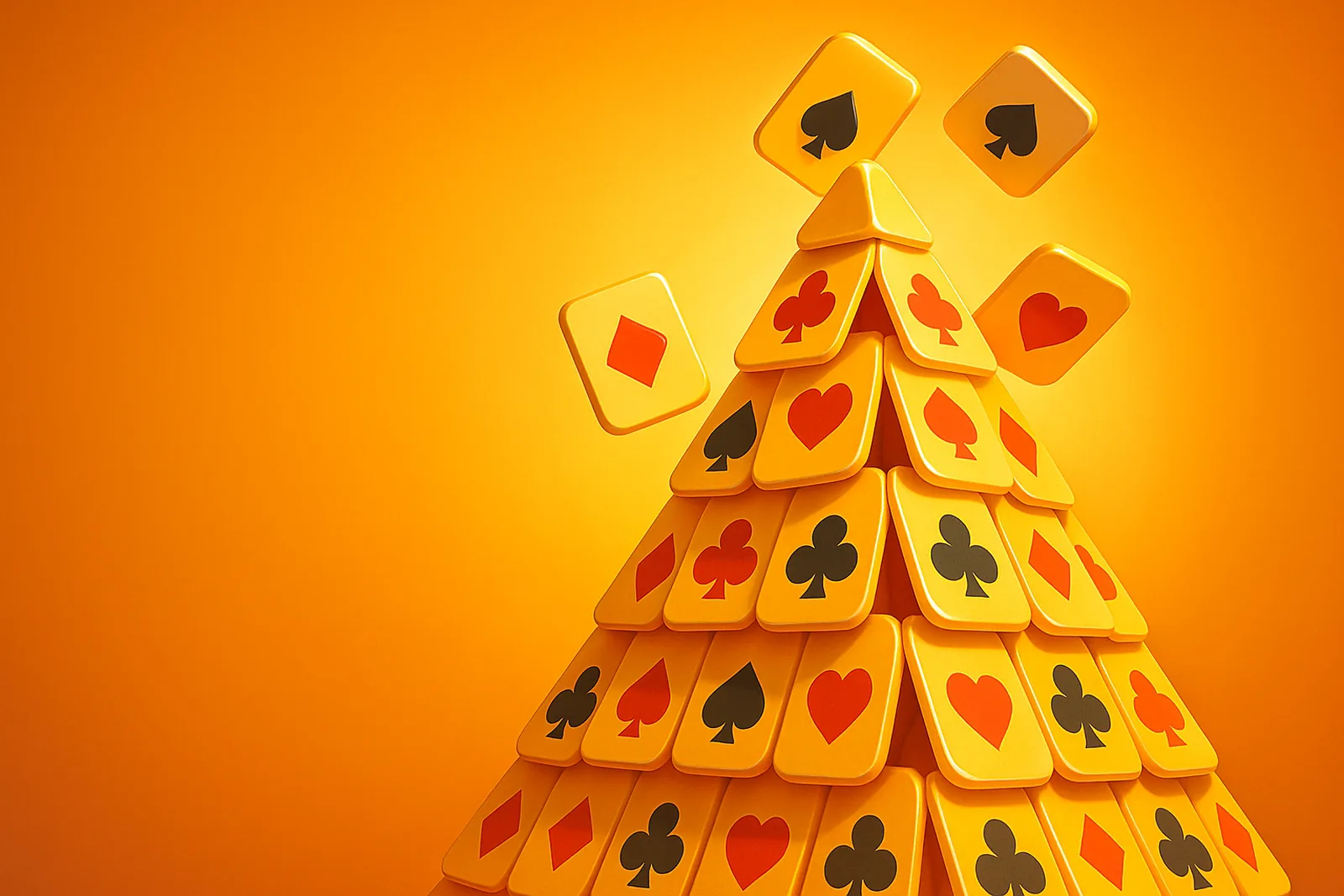
Play Pyramid Solitaire if you want to wind down fast: the aim is clear, the turns are small, and pairing cards to make 13 gives your brain something neat to do without asking for a long commitment.
The best card games to unwind are rarely the most complicated ones. They are the games with enough structure to keep your hands busy and enough familiarity to stop you from feeling tested. For some people that means calm solitaire, one sensible move at a time. For others it means Blackjack, because a little pressure is easier than a wide-open puzzle.
The honest answer is that relaxation is personal. The evidence for a single most relaxing card game is thin, and anyone pretending otherwise is selling certainty they do not have. A better question is: what sort of tired are you? Frazzled, bored, restless, foggy, or still a bit wired from the day. Match the game to that, and the choice becomes easier.
Which card game should I play if I want to wind down fast?
Pick Pyramid Solitaire when you want the quickest shift from busy head to simple task. You are not planning ten moves in silence or counting odds like a serious card-room player. You are scanning the pyramid, finding pairs that add to 13, and clearing what you can.
That makes it a strong choice after work, between chores, or at the end of a screen-heavy day when you still want to play something. The rules are easy to hold in memory. The board gives you visible progress. A cleared row feels like a small job finished.
TriPeaks Solitaire is for a similar mood, but with more flow. Instead of making sums, you look for cards one rank higher or lower than the current card. It suits players who want movement more than calculation. Golf Solitaire is also brisk, and good for anyone who likes a clean run of choices without much decoration.
Klondike Solitaire (Turn 1) is the familiar option. It is for someone who wants the comfort of a game they already understand: build foundations, shift columns, keep an eye on hidden cards. It asks for more organisation than Pyramid Solitaire, but not so much that it feels like homework.
If you are properly tired, choose the game with the smallest question. In Pyramid Solitaire, the question is almost always the same: which two cards fit? That repetition is the point. It gives the evening a rail to run on.
Which relaxing card game fits my mood right now?
- I am tired and want a neat puzzle: Pyramid Solitaire fits. It gives you one main job, pair cards that sum to 13, and the pyramid shape makes progress visible. It is one of the better relaxing card games when you want focus without fuss.
- I want something familiar: Klondike Solitaire (Turn 1) is for the player who finds comfort in known routines. It is easier-going than Klondike Solitaire (Turn 3), because the stock gives you more immediate chances to use cards.
- I want calm but not automatic: FreeCell is for someone who likes control. Almost every card is visible, so the game feels less like waiting for luck and more like sorting out a crowded desk.
- I want a gentle rhythm: TriPeaks Solitaire suits a restless mood. You are often making quick rank-by-rank decisions, which can feel lighter than building long columns.
- I want something sparse: Golf Solitaire is for players who like short, clean choices. There is little ceremony. You either can play the next card or you cannot.
- I want a longer calm solitaire challenge: Spider Solitaire (1 Suit) is the soft entry point. It is for a player who wants to arrange, stack, and gradually make order without taking on the full bite of Spider Solitaire (4 Suits).
- I am still wired: Blackjack gives you pressure in small bursts. It is not the calmest choice, but it can suit a mind that refuses to slow down.
Why do some calm solitaire games feel easier on a tired brain?
Some games are easier on a tired brain because they reduce the number of things you must hold at once. Pyramid Solitaire asks you to recognise pairs that make 13. Golf Solitaire asks whether the next card is one rank away. TriPeaks Solitaire uses a similar rhythm, with more places to look.
Those games still require attention. They are not empty. The difference is that the decision repeats, so you spend less energy remembering the rules and more time noticing the board. Repetition can be restful when the day has already been full of switching, messages, and half-finished tasks.
Open-information games relax a different kind of player. FreeCell shows the cards, so the work is in planning rather than guessing. That can feel fair and calming if hidden cards usually annoy you. It can also feel too demanding if you are already mentally spent.
Klondike Solitaire (Turn 1) sits between the two. It has hidden cards, but the pattern is familiar to many players. Familiarity matters. A game you know well has fewer surprises, and fewer surprises mean less effort spent getting settled.
The trick is to choose the type of effort you can bear. Matching, sorting, sequencing, or risking. A tired brain often dislikes choice overload more than challenge itself.
What should I play if I want something familiar, something fiddly, or something with more pressure?
| Mood | Best fit | Why it fits | Who should avoid it |
|---|---|---|---|
| Something familiar | Klondike Solitaire (Turn 1) | The classic build-and-reveal pattern is easy to settle into, and the stock in Klondike Solitaire (Turn 1) keeps the pace kinder than Klondike Solitaire (Turn 3). | Players who get irritated by hidden cards and blocked columns. |
| Something quick and tidy | Pyramid Solitaire | The whole game centres on pairing cards to make 13, so each decision is small and the board gives clear visual progress. | Players who want long chains of planning or full control over every card. |
| Something fiddly but fair | FreeCell | Most of the interest comes from ordering cards carefully, using free cells well, and spotting a route before you move too much. | Anyone too tired to think several moves ahead. |
| Something slow and arranging | Spider Solitaire (1 Suit) | One suit keeps the rules manageable while still giving you the pleasure of building long ordered runs. | Players who want a short game or dislike managing crowded columns. |
| Something with pressure | Blackjack | Each hand gives a compact risk decision: hit, stand, or accept what you have. The tension arrives quickly. | Players looking for quiet sorting rather than push-your-luck moments. |
How do I pick between a short session and a longer sit-down?
Start with the amount of attention you can honestly spare. Not the amount you wish you had. A short session works best when the game has a plain loop and quick feedback. A longer sit-down works when you want a board that changes slowly and rewards patient untangling.
- Choose a short session if you have a cup of tea going cold, a few minutes before bed, or the kind of tiredness that makes rules feel annoying. Pyramid Solitaire, Golf Solitaire, and TriPeaks Solitaire all suit that slot.
- Choose a medium session if you want comfort without too much strain. Klondike Solitaire (Turn 1) gives you enough structure to stay interested, while Klondike Solitaire (Turn 3) adds more friction for players who want the stock to matter.
- Choose a longer sit-down if you are calm enough to plan. FreeCell, Yukon Solitaire, Forty Thieves, and Spider Solitaire (2 Suits) ask for more patience. They are better when you want to settle, not when you want to switch off instantly.
Pressure changes the calculation. Blackjack, Single Deck Blackjack, and Atlantic City Blackjack are short by nature, but they are not soft. They suit a player who relaxes through quick decisions. If you want card games to unwind with because you need your pulse to drop, pick solitaire first.
Frequently asked questions
Yes. Pyramid Solitaire is a good five-minute choice because every move has a small test: can two exposed cards make 13? You can play one deal, get a clear result, and leave without feeling you have abandoned a large puzzle. It is quick to learn, but not automatic.
13 is the number. In Pyramid Solitaire, you clear cards by pairing ranks that add to thirteen: 10 with 3, 9 with 4, 8 with 5, and so on. That gives the game its calm rhythm. You are not scanning for suits or building long sequences. You are asking one small question, again and again.
People often think Pyramid Solitaire is a maths game, but the arithmetic becomes recognition after a few hands. You stop calculating 8 plus 5 and start seeing partners. If you can remember pairs such as queen and ace, jack and 2, 10 and 3, you have enough maths for a quiet session.
Say a deal leaves a 9 of spades free on the left edge and a 4 of hearts free near the middle. Pairing them removes two blockers, which may expose a jack and a 2 underneath. That is the pleasant part of Pyramid Solitaire: one tidy match can make the next decision visible.
It depends on your tolerance for uncertainty: Pyramid Solitaire can close off because buried cards matter, while FreeCell gives you more visible information from the start. If you want a light puzzle with some luck, choose Pyramid Solitaire. If you want a slower, more controlled solve, FreeCell is the better fit.
Compared with TriPeaks Solitaire, Pyramid Solitaire asks you to hold one fixed target in mind: 13. TriPeaks Solitaire is more about stepping one rank up or down from the current card. Both can be gentle, but Pyramid Solitaire feels cleaner if you want fewer rule checks and a stronger sense of pairing.
Choose the gentler game; the exception is when a harder one stops you ruminating. Klondike Solitaire (Turn 1) is usually a softer landing than Klondike Solitaire (Turn 3). Spider Solitaire (1 Suit) is easier to read than Spider Solitaire (4 Suits). But if pressure helps you focus, a tougher deal can be oddly calming.
Most people do the wrong thing by treating a wind-down game like a job to finish. They restart too often, chase the perfect line, or blame themselves for a blocked deal. For Pyramid Solitaire, the healthier habit is to enjoy good pair choices and accept that some layouts will not open kindly.
A low-pressure card game is one where a mistake does not feel expensive. The rules are clear, the turns are short, and losing a deal does not ask for a post-mortem. Pyramid Solitaire fits when you want that: make pairs to 13, clear what you can, and move on.
Choose one deal before you start, and make that the session. Do not restart the moment the pyramid jams. Finish the deal or let it fail, then stand up, close the tab, or switch task. If you want a second game, make it a deliberate choice, not a reflex.
Nobody knows precisely how often you will win Pyramid Solitaire on any given site unless that rule set and deal generator have been tested over many deals. The best available figure for playing is the fixed target: 13. Since some deals will resist you, treat a win as a bonus and a near-clear as still worthwhile.
Klondike Solitaire takes its name from the Klondike, the Canadian region associated with the late-1890s gold rush. Its familiarity comes from years of digital versions as much as from the rules. On Veena Games, Klondike Solitaire (Turn 1) suits a softer mood; Klondike Solitaire (Turn 3) asks for more patience.
The cost of getting it wrong is a session that keeps you alert instead of settling you down. Pick Spider Solitaire (4 Suits) when you are already frazzled and you may spend the whole time repairing mistakes. Pick Pyramid Solitaire or Golf Solitaire instead when you want fewer moving parts and a cleaner stopping point.
Final thoughts
If you were asking across the table, I would not tell you to play the cleverest game. I would ask what kind of day it has been. If you have been making decisions for hours, do not choose a game that asks you to become a project manager. Choose Pyramid Solitaire or Golf Solitaire and let the rules stay small.
If your day has been dull, a little structure may feel better than pure ease. FreeCell can scratch that itch because it gives you control and asks you to use it. Spider Solitaire (1 Suit) can do the same at a slower pace, especially if lining cards into order is the part you enjoy.
If you are tired but stubborn, you may be tempted by the hardest version of everything. Leave Spider Solitaire (4 Suits) and Forty Thieves for a night when you want resistance. There is no prize for turning a wind-down into another obligation.
The right game should meet you where you are. Some evenings that means two quiet minutes of matching cards. Some evenings it means a proper puzzle with a drink beside you. Stop when the game starts feeling like a task. That is usually the clearest rule of the lot.
-
 Card Games
Is Solitaire Actually Good for Your Brain?
Solitaire gives light attention and memory practice, and can be calming, but the evidence for broad cognitive improvement is thinner than adverts suggest.
13 August 2026
Card Games
Is Solitaire Actually Good for Your Brain?
Solitaire gives light attention and memory practice, and can be calming, but the evidence for broad cognitive improvement is thinner than adverts suggest.
13 August 2026
-
 Card Games
The Best Solitaire Games for Complete Beginners
Pick a beginner-friendly solitaire game by mood: visible information, gentle rules, quick rounds, or a slower puzzle with fewer nasty surprises.
13 August 2026
Card Games
The Best Solitaire Games for Complete Beginners
Pick a beginner-friendly solitaire game by mood: visible information, gentle rules, quick rounds, or a slower puzzle with fewer nasty surprises.
13 August 2026
-
 Card Games
Why Do Some Solitaire Games Deal You an Unwinnable Hand?
Some solitaire deals are unwinnable because fixed hidden-card order can trap the very cards needed to open the game.
13 August 2026
Card Games
Why Do Some Solitaire Games Deal You an Unwinnable Hand?
Some solitaire deals are unwinnable because fixed hidden-card order can trap the very cards needed to open the game.
13 August 2026