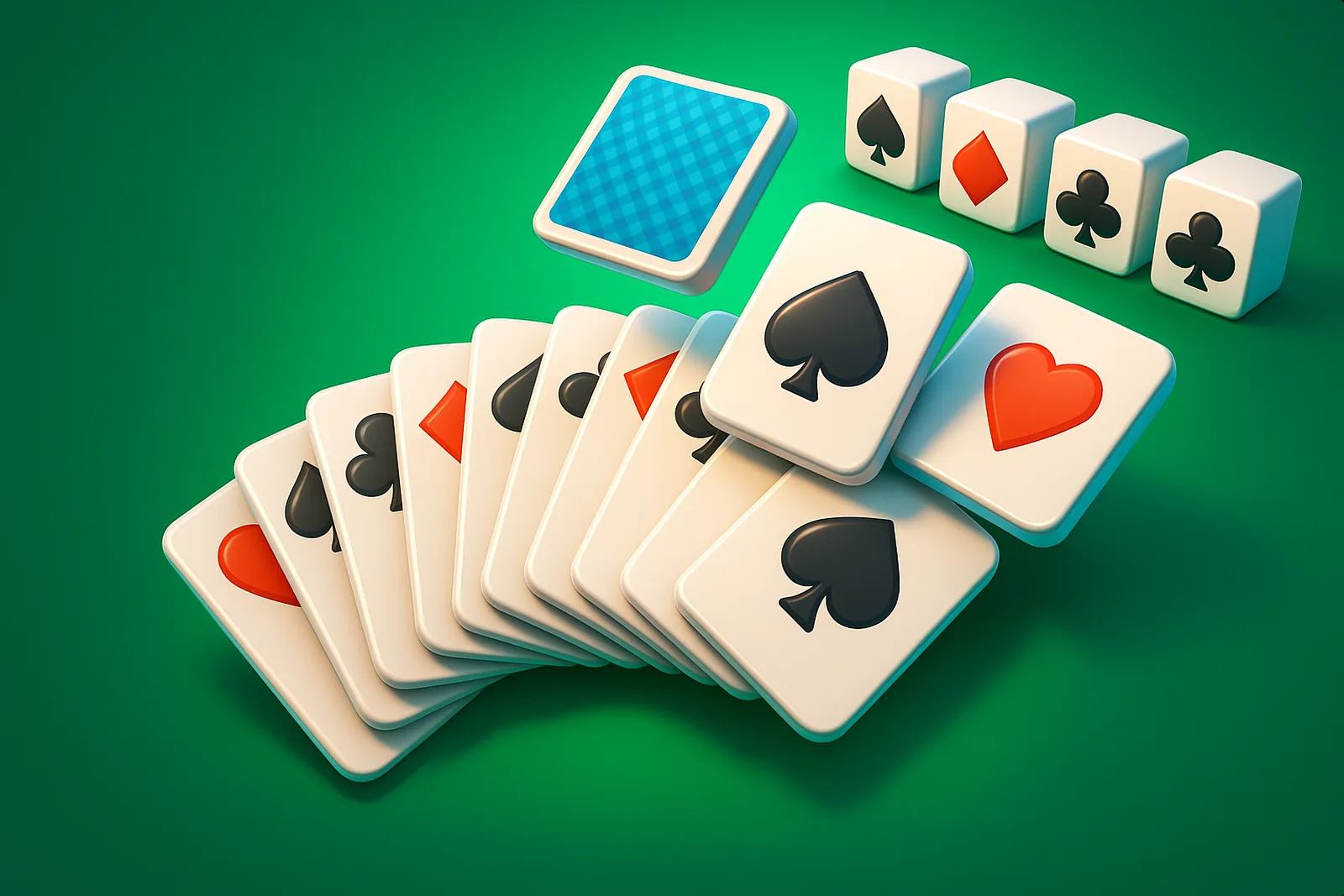
Online shuffling is fair when the game creates an unpredictable random order for the whole deck before play, then deals from that order without changing it to help or punish you. The usual tools are an RNG, a shuffle algorithm, and sometimes a seed.
Klondike Solitaire (Turn 1) is a one-player card game using a standard 52-card deck, where the aim is to build 4 foundations from Ace to King by suit. Before you make a move, the shuffle has already decided the tableau, the stock, and every later card you will draw.
That is why how online card shuffling works matters. A fair deal does not promise an easy one. It does not even promise a winnable one. It promises that the order was produced without favouring a result, a player, or a later correction after the board became awkward.
So how does an online shuffle stay fair?
A fair online card shuffle has to do one plain job: make each possible deck order possible without steering the result. With a standard deck, there are 52! possible orders. That number is far beyond anything a player can inspect by playing a few hands, so fairness depends on method, not on whether yesterday felt lucky.
The common sound method is a Fisher-Yates style shuffle. It starts with a complete deck, picks a random card for the last position, swaps it there, then repeats with the remaining positions until the deck is ordered. If each pick is equally likely within its current range, the final deck is unbiased.
The random picks come from an RNG, short for random number generator. In RNG card games, the RNG does not shuffle cards by itself. It produces numbers. The shuffle algorithm turns those numbers into card positions. A weak step in either part can bias the deal. For example, taking random numbers and forcing them into a smaller range badly can make some positions slightly more likely than others.
Fair online deals also need discipline after the shuffle. The game should not redraw the stock because you are losing, tuck an Ace into reach because a session is going badly, or hide a King because you won twice. Once the deck order is made, the deal and later draws should follow it. Bad luck is allowed. Secret correction is not.
What does the game actually use to deal the cards?
The observable fact is simple: the game needs one complete deck order before the first card appears. Unless the code, seed, or audit trail is public, a player cannot prove the exact internal source of random bits from the table alone. What matters is whether the deal behaves like one fixed shuffled 52-card deck.
- The deck: Klondike uses 52 cards: 4 suits, 13 ranks in each suit, and no jokers.
- The RNG: This supplies random numbers. A stronger source is harder to predict from earlier outputs, which matters more when future cards must stay hidden.
- The shuffle: This maps those numbers to card positions. Fisher-Yates is the standard answer because it can give every permutation the same chance when fed unbiased random choices.
- The deal routine: This takes the shuffled order and places cards into the tableau, stock, waste, or other areas required by the game rules.
- The game state: Undo and hints should refer to the same deal. They should not create a new deck order unless the player starts a new game.
A seed may sit at the start of this chain. The seed sets the initial state of a pseudo-random generator, which then produces the numbers used by the shuffle. The useful question is not whether a seed exists. It is whether the seed was chosen fairly and whether the resulting deck was accepted before anyone knew whether it looked kind.
Can a seeded shuffle still be fair?
- Yes, if the seed is chosen without cherry-picking. A seeded shuffle is deterministic: the same seed and same algorithm produce the same deck. That is useful for replays, daily deals, and bug reports. It is fair when the seed is selected by a fair process, not chosen because it creates a desired result.
- Yes, if the seed is not useful to the player too early. If a visible seed lets someone calculate the whole deck before making decisions, the deal may still be unbiased, but the game is no longer testing hidden-card play in the normal way.
- Yes, if the shuffle maps seeds to decks without avoidable bias. A poor mapping can make some card orders more common. A sound shuffle uses random choices in the correct range at each step.
- No, if seeds are filtered after the outcome is known. Removing hard deals, unwinnable-looking deals, or deals where the first stock card is inconvenient changes the promise. The player is no longer seeing fair online deals; they are seeing curated deals.
- No, if the seed changes mid-game. A hint can be calculated from the current state, and undo can return to an earlier state. Neither should alter the hidden order of the stock.
Where does Klondike Solitaire (Turn 1) sit in all this?
Klondike Solitaire (Turn 1) is a one-player solitaire game with a 52-card deck, a one-card stock draw, 7 tableau piles, and 4 foundations. The shuffle matters before the first card lands, because it determines every face-down tableau card and every later stock card.
The setup is exact. The tableau has 7 piles. The first pile gets 1 card, the second gets 2, and so on up to 7, making 28 tableau cards. The top card of each tableau pile is face up. The other 24 cards form the stock. The foundations begin empty.
A normal turn is small. You move face-up tableau cards in descending rank and alternating colours. You may move a King to an empty tableau space. You draw 1 card from the stock to the waste, and the top waste card may be played if it fits. Aces start foundations, which then build upward by suit from Ace to King. Turning over a newly exposed face-down tableau card is often the whole point of a move.
The win condition is concrete: all 52 cards must finish on the 4 foundations, 13 cards per foundation. Klondike Solitaire (Turn 1) on Veena Games has unlimited redeals, undo, and hints, but those tools do not change what a fair shuffle means. The score that matters in the base game is the position itself: won when the foundations are complete, not won because a hidden score target was reached.
What should a player look for in an honest browser card game?
- Clear rules before clever features. The page should make the deck, layout, legal moves, and win condition understandable. If you cannot tell what ends the game, you cannot judge the deal.
- A fixed deal once play begins. Hints, undo, redeals, and restarts are fine. Quietly changing unrevealed cards after bad moves is not fine.
- Sensible language about randomness. Claims about how online card shuffling works should mention an RNG, a shuffle method, or a seed only in ways that match the game. Vague promises of luck tell you less.
- No confusing pressure around outcomes. Free browser solitaire has no reason to push urgency, stakes, or opponent claims. If a game is one player with 52 cards, it should behave like that.
- Honesty about scoring. If points, time, streaks, or move counts are shown, the page should make clear whether they decide the result or merely record performance. For Klondike, the rules win is still all cards on the foundations.
- Acceptance of losing deals. A fair solitaire game may give you a miserable board. Removing every rough deal can make a game gentler, but it is no longer the same fairness claim.
Frequently asked questions
No. A fair shuffle can give you five awkward deals in a row, just as a real deck can. Random does not mean kind, balanced, or due for a correction. What matters is that the deck order is chosen before play and is not adjusted because you are winning, losing, using hints, or taking back moves.
52 cards can be arranged in 52! different orders, which is about 8 followed by 67 more digits. That scale is why a good shuffle does not need to remember every previous deal to avoid repeats. It only needs to choose one ordering fairly from a vast set of possible deck orders.
The misconception is that one named function decides fairness by itself. The correction is that fairness comes from the whole method: how the random numbers are produced, how they are turned into card positions, and whether the result is biased. Math.random is not suitable for security work, but casual browser solitaire is mainly judged by unbiased dealing and honest rules.
A real Klondike hand might show no playable aces, two black kings buried, and the only red queen hidden under five facedown cards. That feels hostile, but it is still a normal consequence of shuffling 52 cards once and dealing them into the tableau and stock. Fair shuffles produce ugly starts as well as generous ones.
It depends on what undo changes: the cards or only your moves. If undo returns the position to an earlier state in the same deal, it is a learning tool, not a new shuffle. If a game quietly changes the stock after undo, that would be a different matter. Veena Games treats undo as part of play, not as a way to redraw the deck.
Compared with Klondike Solitaire (Turn 1), Klondike Solitaire (Turn 3) is not less fair because of the shuffle. It is harder because you see the stock in threes, which changes access to cards and timing. The same honest deck order can feel much tighter under Turn 3 rules than under a one-card draw.
The short rule is: a game does not need to show the seed to be fair. The exception is when it offers shareable deals, daily challenges, or competitive verification, where a visible seed can help players reproduce the same deck. For ordinary free solitaire, clear rules and consistent dealing matter more than exposing a technical value most players will never use.
Most people do wrong by expecting randomness to look evenly mixed over short runs. They notice three bad deals and forget the ten ordinary ones before them. Real randomness clusters. You can get repeated buried aces, repeated easy foundations, or repeated dead stocks without anyone steering the game. A smooth-looking pattern is often less random than a jagged one.
A seed is a starting value for a random number generator. Give the same seeded generator the same rules, and it can recreate the same sequence of numbers, which means the same deck order. That is useful for testing, replaying, and sharing deals. A seed is not a cheat by itself; it is a way to make randomness repeatable.
Play several deals, restart some, use undo, and watch whether the deck behaves consistently. Check that the rules are stated plainly, that the game does not demand an account or download for basic play, and that redeals are clearly treated as new deals. On Veena Games, Klondike Solitaire (Turn 1) is free in the browser with unlimited redeals, undo, and hints.
Nobody knows precisely, because the answer depends on rules, hidden information, and what counts as perfect play. The best available public figure for standard draw-one Klondike is roughly four wins in five under strong play or full-information analysis. Your personal rate will be lower if you miss buried moves, waste tableau spaces, or use the stock in the wrong order.
In 1938, Ronald Fisher and Frank Yates described a practical way to randomise a list. Richard Durstenfeld later gave the efficient computer version in 1964. Programmers often call it the Fisher-Yates shuffle. Its core idea is simple: walk through the deck, swapping each card with a randomly chosen remaining position, so every final order can be reached evenly.
A biased shuffle costs trust. Even in a free game, players want their losses to come from the deal and their decisions, not from a crooked shortcut in the code. Bias can make some card orders too common and others too rare. That changes difficulty, breaks comparison between players, and makes a familiar game feel wrong even when the rules look correct.
Final thoughts
For most free browser card games, public evidence is thin. Players rarely get source code, seed logs, or independent audits. That does not make a game dishonest; it means you judge it by clear rules, consistent behaviour, and whether the claims stay modest. A page that explains the game plainly is already doing more than one that hides behind lucky-sounding words.
It also helps to separate fairness from comfort. Klondike Solitaire (Turn 1) can feel kinder than Klondike Solitaire (Turn 3) because drawing 1 card gives you more direct access to the stock. That is a rule difference, not proof of a softer shuffle. The same shuffled deck can produce a board that opens quickly, a board that needs patience, or a board that goes nowhere useful.
If you know the deck was meant to be fixed, you stop blaming every blocked card on the machine. You start asking better questions: Which face-down card can I uncover? Which foundation move is safe? Is undo teaching me something, or merely delaying the reset button?
-
 Card Games
Blackjack vs Video Poker: The Two Lowest House Edges
Video poker wins only with the right full-pay machine and perfect play; for most real seats, fair 3:2 blackjack is the cleaner low-edge choice.
18 August 2026
Card Games
Blackjack vs Video Poker: The Two Lowest House Edges
Video poker wins only with the right full-pay machine and perfect play; for most real seats, fair 3:2 blackjack is the cleaner low-edge choice.
18 August 2026
-
 Card Games
 You Can Finish in Five Minutes
A practical guide to quick card games, matching fast solitaire and blackjack choices to the kind of break you actually have.
18 August 2026
Card Games
Card Games You Can Finish in Five Minutes
A practical guide to quick card games, matching fast solitaire and blackjack choices to the kind of break you actually have.
18 August 2026
-
 Card Games
Games That Need No Luck at All
A practical guide to skill based card games, from FreeCell and Baker's Game to Eight Off, Yukon Solitaire, and Forty Thieves.
18 August 2026
Card Games
Games That Need No Luck at All
A practical guide to skill based card games, from FreeCell and Baker's Game to Eight Off, Yukon Solitaire, and Forty Thieves.
18 August 2026