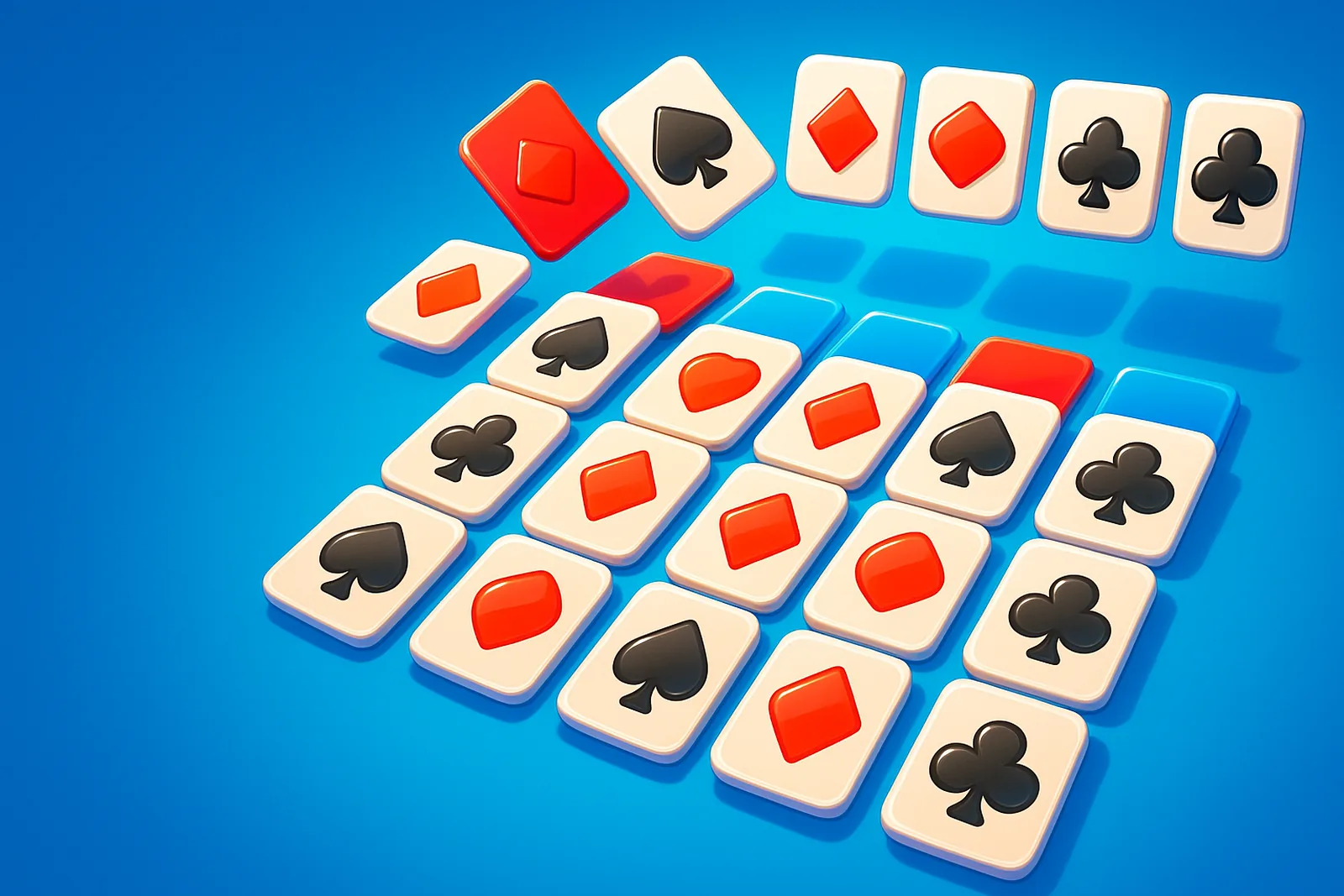
Learn Klondike first if you want quick wins. Learn FreeCell first if you want the fairest path to getting good. Learn Spider after those, preferably Spider Solitaire (1 Suit), because its lessons take longer and its mistakes can stay hidden for half a game.
The choice is not a personality test. These games ask different things of you. Klondike Solitaire (Turn 1) teaches when to reveal a hidden card, when to use the stock, and when a tempting move is actually a trap. FreeCell teaches planning because all 52 cards are visible from the deal, so excuses run out quickly. Spider Solitaire teaches patience because you are managing 10 columns, long runs, and a board that can clog before it looks dangerous.
If you want one clear order, use this: Klondike Solitaire (Turn 1), then FreeCell, then Spider Solitaire (1 Suit). Move to Spider Solitaire (2 Suits) only when 1 Suit feels controlled. Leave Spider Solitaire (4 Suits) for days when you want a full puzzle, not a quick card break.
Which should you learn first if you want the quickest wins?
Start with Klondike Solitaire (Turn 1) if your goal is to win soon and understand the shape of solitaire quickly. It has 7 tableau columns, a stock, a waste pile, and 4 foundations. The rhythm is easy to grasp: reveal face-down cards, build down in alternating colours, and send aces upward when you can.
That does not make Klondike the fairest game. Hidden cards and stock order matter. Some losses come from choices you made, and some come from a deal that never gave you enough access. The skill is judgement under partial information. You learn to ask whether moving a card opens a face-down card, frees a column, or merely looks tidy.
The Klondike vs FreeCell decision changes once you care less about getting a first win and more about knowing why you won. FreeCell is clearer, but not necessarily easier on day one. Every card is visible, and the 4 open cells give you temporary parking spaces. That sounds generous until you fill them too early and realise the board has locked.
Spider is the slowest first lesson. Spider Solitaire (1 Suit) is learnable, but the board is wider, the game uses 2 decks, and building complete king-to-ace runs takes time. If you want quick wins, Spider should be third, not first.
What changes the moment every card is visible?
Visibility changes the contract between you and the game. In Klondike, you are managing risk because buried cards can overturn a good plan. In FreeCell, the position is on the table from move one. You may still miss the best line, but the game is not hiding the evidence.
| Klondike Solitaire (Turn 1) | FreeCell |
|---|---|
| Information: some tableau cards start face down, so early moves are partly about uncovering what you cannot yet judge. | Information: all 52 cards are visible, so the puzzle is planning, sequencing, and keeping enough space to move. |
| First aim: reveal hidden cards quickly, especially in longer columns, because each new card may open the game. | First aim: identify trapped low cards and awkward kings before you spend the 4 open cells. |
| Main danger: a move can look right because it reveals a card, then leave you with no useful follow-up. | Main danger: filling every free cell turns a solvable-looking position into a traffic jam. |
| Luck factor: stock order and hidden cards affect how much control you have over a deal. | Luck factor: almost every deal is winnable, so mistakes are easier to trace back to a choice. |
| Best learner habit: ask what a move reveals before asking whether it can be made. | Best learner habit: keep empty columns and free cells available until they do real work. |
This is why FreeCell feels sterner after a few games. Klondike sometimes forgives a loose plan. FreeCell makes the loose plan visible.
Why does Spider teach patience while Klondike teaches judgement?
Klondike teaches judgement because you rarely know the full position. You choose between revealing a card now, waiting for a better stock pass, or moving a sequence that might block a useful colour later. A good Klondike player is comfortable with incomplete evidence.
Spider teaches patience because progress is longer and less dramatic. Standard Spider uses 2 decks and 10 tableau columns. You are not alternating colours. You are building descending sequences, and the clean reward comes when a full king-to-ace run is completed and removed. Until then, many good moves look boring.
- Klondike decision: reveal a face-down card even if the revealed card may not help.
- Spider decision: keep a same-suit run intact instead of making a flashy mixed-suit move.
- Klondike mistake: empty a column before you have a useful king to place there.
- Spider mistake: deal a new row from the stock while messy columns still need space.
The FreeCell vs Spider choice is mainly about tempo. FreeCell gives you a visible tactical puzzle with 4 spare cells. Spider asks you to tolerate a board that improves slowly. Spider Solitaire (1 Suit) is the patient version you should learn first; Spider Solitaire (4 Suits) is a much harsher teacher.
Which one fits a short break, a long session, or a fresh learner?
- For a short break, play Klondike Solitaire (Turn 1). It starts quickly, the rules are familiar, and a useful move is usually visible within seconds. It is also the easiest game to stop without feeling you have abandoned a large puzzle. Klondike Solitaire (Turn 3) is better once you know the rhythm, but Turn 1 is the quicker teacher.
- For a long session, play Spider Solitaire (1 Suit), then Spider Solitaire (2 Suits). Spider rewards attention over time. You are shaping 10 columns, protecting empty spaces, and trying not to bury useful cards under mixed runs. A good Spider game can feel slow for 20 moves, then open suddenly.
- For a fresh learner, play Klondike first, then FreeCell. Klondike gives the basic solitaire grammar: tableau, foundations, stock, waste, and the value of revealing cards. FreeCell then removes the fog. Once all cards are visible, you learn to plan instead of hoping the next card solves the position.
- For daily improvement, make FreeCell the main game. It is short enough for a break and deep enough to repay care. Losses feel useful because the cause is usually visible: a cell filled too early, an empty column wasted, or a low card left trapped.
Which game should become your default after you try all three?
Make FreeCell your default after you have tried Klondike and Spider. Klondike is still the best first lesson, and Spider is better when you want a longer, slower puzzle. FreeCell is the best solitaire game for regular play because it gives you the cleanest link between decision and result.
That link matters. In Klondike, a hidden card can rescue or wreck a plan. In Spider, the consequences of a poor structure may not become obvious until much later. In FreeCell, the punishment is usually close to the mistake. You filled the last open cell. You moved a king into the only empty column without checking what needed that column next. You buried a low card under a sequence that cannot move. The board tells on you.
FreeCell also scales well. Early on, you can focus on simple habits: keep at least one free cell open, create empty columns, and move cards to the foundations when doing so cannot trap anything important. Later, the same game becomes more exact. You start counting how many cards a stack can move with the cells and columns available. You plan backwards from blocked aces and twos. You stop making moves just because they are legal.
If variety matters, rotate. Klondike Solitaire (Turn 1) is still the quick comfort game. Spider Solitaire (1 Suit) is still the patient one. But the default should be FreeCell because it keeps giving you a fair argument with the same 52 cards.
Frequently asked questions
Yes. FreeCell puts every card face up from the deal, so failure usually comes from a weak plan rather than a hidden card. The four free cells give you room to test ideas, but they also punish waste. If you like seeing the whole problem before you commit, FreeCell is the cleanest place to begin.
1 empty free cell is often enough to save a position; 2 or more gives you real freedom. Empty tableau columns matter even more because they let you move longer runs. The habit to learn is simple: spend free cells to make progress, then clear them again before starting the next manoeuvre.
The common misconception is that Klondike is just luck; the correction is that luck decides what is possible, while judgement decides how often you reach it. Hidden cards make some losses unavoidable. Still, choices such as when to move to the foundation, when to expose a face-down card, and when to leave a card in place change a lot.
You uncover a red 7, with a black 6 available and a face-down card under another black 6. Moving the red 7 to the first black 8 you see may look tidy, but playing the other black 6 first could uncover a new card. In Klondike, exposing face-down cards usually beats making the tableau look neat.
It depends on patience: Spider rewards players who can build partial plans without needing quick closure. A game can look stuck for ages before one completed suit changes everything. If that sounds satisfying, Spider is a strong fit. If you want a clear tactical puzzle with less waiting, FreeCell will probably feel better.
Compared with FreeCell, Spider gives you less certainty and more traffic. In FreeCell, all cards are visible and the four free cells act as tools. In Spider, new rows arrive from the stock, mixed suits get in the way, and a promising column can become awkward after one deal. Spider Solitaire (1 Suit) softens that sharply.
The short rule is to move safe low cards to the foundation when they cannot help you in the tableau. The exception is Klondike, where a card on the foundation may still be needed to build or uncover something. FreeCell makes safety easier to judge because every card is visible from the start.
Most people treat legal moves as good moves. They are not the same. A move that fills your last empty space, buries a useful card, or blocks a long run can make the next six moves worse. Before moving, ask what the move reveals, what space it spends, and whether it creates a new option.
A free cell is a single holding space for one card in FreeCell. An empty column is a cleared tableau space that can hold a sequence, depending on the rules and what other spaces are open. Free cells solve small blockages. Empty columns solve bigger movement problems. Good FreeCell play protects both, but values empty columns more.
Play FreeCell if you want one clean puzzle with no hidden information. Play Klondike Solitaire (Turn 1) if you want a lighter, quicker feeling game where some deals collapse fast. Leave Spider for a longer break unless you choose Spider Solitaire (1 Suit), which is friendlier than the multi-suit versions.
Nobody knows precisely how many possible FreeCell deals are winnable; the full space is enormous. The best-known practical figure comes from the classic Microsoft set of 32,000 numbered deals, where only deal 11982 is known to be unwinnable. That is why FreeCell feels fair: almost every ordinary deal can be beaten with accurate play.
FreeCell in its modern computer form was created by Paul Alfille in 1978 on the PLATO system. It later reached a huge audience through Microsoft Windows, where numbered deals made it easy for players to compare results. That computer history suits the game: visible cards, repeatable deals, and precise planning all work naturally on a screen.
The cost of getting it wrong is usually frustration, not lost skill. Start with Spider Solitaire (4 Suits) too early and you may think solitaire is slow and punishing. Start with Klondike Solitaire (Turn 3) and you may blame yourself for hidden-card losses. If that happens, switch to FreeCell for a clearer test of planning.
Final thoughts
If a friend asked what to play tonight, I would not hand them the hardest version and call it character-building. I would say: take the win first. Play Klondike Solitaire (Turn 1) until the tableau stops looking like a mess of red and black cards. Learn what an empty column is worth. Learn why revealing a face-down card usually beats tidying a visible one.
Then move to FreeCell before Klondike’s luck starts teaching the wrong lesson. FreeCell is blunt in a useful way. It shows every card and still lets you get stuck, which is a fine kind of embarrassment. You can look back 3 moves and see the moment you spent your last spare cell for no good reason.
Keep Spider for the evenings when you actually want to sit with a problem. Spider Solitaire (1 Suit) is enough at first. There is no prize for rushing into Spider Solitaire (4 Suits) and turning a good game into paperwork.
The best habit is to change games for a reason. Quick lift: Klondike. Careful practice: FreeCell. Long puzzle: Spider. If one of them starts feeling automatic, that is the moment to make it slightly harder.
-
 Card Games
Blackjack vs Video Poker: The Two Lowest House Edges
Video poker wins only with the right full-pay machine and perfect play; for most real seats, fair 3:2 blackjack is the cleaner low-edge choice.
18 August 2026
Card Games
Blackjack vs Video Poker: The Two Lowest House Edges
Video poker wins only with the right full-pay machine and perfect play; for most real seats, fair 3:2 blackjack is the cleaner low-edge choice.
18 August 2026
-
 Card Games
 You Can Finish in Five Minutes
A practical guide to quick card games, matching fast solitaire and blackjack choices to the kind of break you actually have.
18 August 2026
Card Games
Card Games You Can Finish in Five Minutes
A practical guide to quick card games, matching fast solitaire and blackjack choices to the kind of break you actually have.
18 August 2026
-
Card Games
Games That Need No Luck at All
A practical guide to skill based card games, from FreeCell and Baker's Game to Eight Off, Yukon Solitaire, and Forty Thieves.
18 August 2026