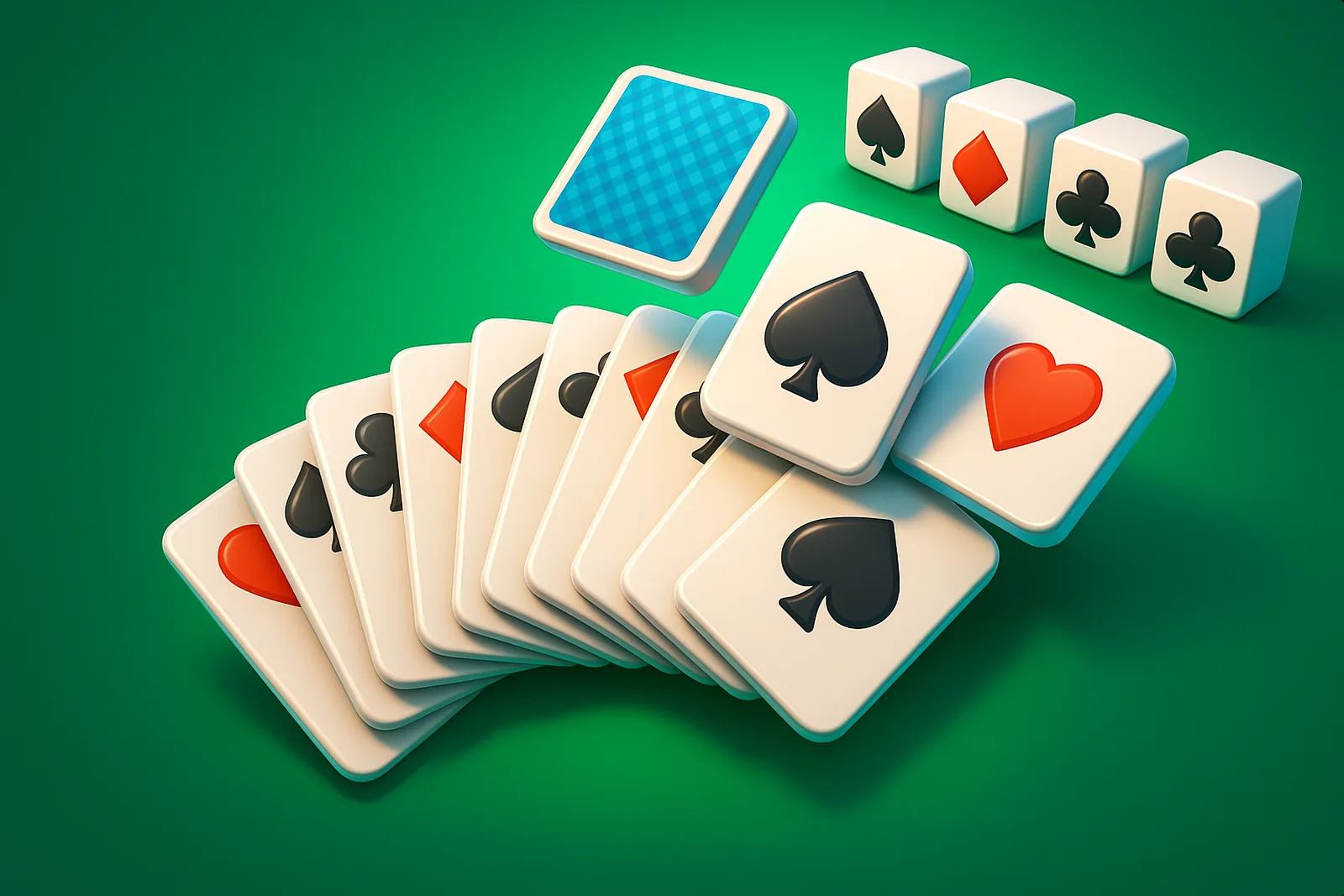
In Klondike Solitaire, the tableau is the seven-column playing area, the foundations are the four suit piles you build from Ace to King, and the stock is the face-down pile you draw from when the board needs a new card.
Klondike is a one-player card game played with a standard 52-card deck. You start with seven tableau columns, some cards face down and some face up. The unused cards become the stock. Beside it sits the waste, where drawn cards appear. The foundations begin empty, waiting for Aces.
A turn is not a single compulsory action. You look for legal moves, build tableau cards down in alternating colours, move Aces and then higher suited cards to the foundations, flip newly uncovered face-down cards, and draw from the stock when you need fresh options. The game is won when all 52 cards reach the foundations. There is no need to memorise a thick solitaire glossary before playing, but these solitaire terms stop the board looking like a mess of piles.
What do tableau, foundation and stock mean in Solitaire?
The tableau is the main working area. In Klondike, it has seven columns. You build cards there in descending rank and alternating colour: a black 9 may take a red 8, a red Queen may take a black Jack. Face-down tableau cards are hidden information. When you clear the card above one, you turn it face up.
The foundation is where finished work goes. There are four foundations, one for each suit. Each starts with an Ace and rises in order: Ace, 2, 3, and so on up to King. A foundation card must match the suit already in that pile. The 6 of Hearts goes only on the 5 of Hearts, never on the 5 of Diamonds.
The stock is the face-down reserve pile. In Klondike Solitaire (Turn 1), you draw one card at a time from the stock to the waste. The waste is not the stock; it is the face-up pile of drawn cards, and only its top card is normally available for play.
Those three words cover the first practical split: tableau, foundation, stock. The tableau is where you arrange. The foundations are where you finish. The stock is where new chances come from. Basic Klondike does not require points. The result, in rules terms, is binary: all 52 cards in the foundations is a win; anything short of that is unfinished.
How does a Klondike setup actually look on the table?
Klondike starts with one standard deck of 52 cards and one player. Deal seven tableau columns from left to right. The first column gets 1 card, the second gets 2, and so on until the seventh column gets 7. In each column, only the top card is face up at the start.
| Area | Starting size | Face-up cards at the start | What it is for |
|---|---|---|---|
| Tableau column 1 | 1 card | 1 | Smallest working column |
| Tableau columns 2 to 6 | 2 to 6 cards | 1 per column | Main hidden-card puzzle |
| Tableau column 7 | 7 cards | 1 | Deepest hidden-card column |
| Foundations | 0 cards | 0 | Build suits from Ace to King |
| Stock | 24 cards | 0 | Draw new cards into the waste |
The numbers matter. The tableau uses 28 cards in total, because 1 + 2 + 3 + 4 + 5 + 6 + 7 equals 28. That leaves 24 cards for the stock. The foundations are empty spaces rather than dealt piles.
If you are naming the whole layout as part of a solitaire glossary, include the waste as well. It begins empty. Once you draw from the stock, the drawn card lands there face up. In Turn 1 Klondike, that means one new visible card per draw, not three.
What happens on your turn, in the order you really play it?
- Scan the foundations first, but do not play on autopilot. If an Ace is available, it can start its suit foundation. If a 2 of the same suit is available after that, it can go on the Ace. Foundation moves are permanent in intent, though many digital games let you undo mistakes.
- Look across the tableau. You may place a face-up card, or a valid face-up sequence, onto a card of the next higher rank and opposite colour. A red 7 can go on a black 8. A black 7 can go on a red 8. Suits do not matter in the tableau; colour and rank do.
- Use empty tableau spaces carefully. In Klondike, only a King, or a sequence headed by a King, may be moved into an empty tableau column. Empty spaces are powerful because they let you shift long runs and expose buried cards.
- Turn over exposed face-down cards. When you move the last face-up card away from a tableau column and reveal a face-down card underneath, turn that card face up. This is one of the main ways the game opens.
- Draw from the stock when the board has no useful move. In Turn 1, draw one card to the waste. If the top waste card can move to the tableau or a foundation, you may play it. Cards below it in the waste are blocked until they return to the top through later draws or redeals.
- Redeal when the stock runs out. With unlimited redeals, the waste can be turned back into the stock and used again. This does not shuffle the cards under traditional Klondike handling; it preserves their cycle.
- Keep checking the same three places. Tableau moves reveal hidden cards. Foundation moves clear clutter. Stock draws add new options. A good turn is often two or three small legal moves chained together, not one dramatic play.
How do you know a game is won or stuck?
A Klondike game is won when every card in the 52-card deck has moved to the four foundations. Each foundation then holds a complete suit from Ace through King. Nothing else is required. You do not need to empty the tableau separately, because emptying it is already a consequence of moving all cards to the foundations.
Basic Klondike scoring is best understood as win or not won. Some rule sets and computer versions add points for moves, time, or foundation progress, but those are extra systems. The card-game rule itself is about completion: all four suits built up correctly.
A game is stuck when no legal move can improve the position and the stock cycle offers no playable card. With unlimited redeals, the rules do not force a loss the moment the stock has been seen once. You can keep cycling. In practice, if every available tableau move has been checked, every waste card has appeared, no hidden tableau card can be exposed, and no foundation can advance, the hand is dead.
Some stuck positions are obvious. Others look alive because you can still draw and redeal, but the same blocked cards keep returning in the same order.
Why learn these terms before you play another hand?
Knowing the solitaire terms changes what you see. A beginner sees seven messy piles and a draw pile. A player who knows the tableau, foundation and stock sees three jobs: reveal hidden cards, build suits, and manage the reserve.
That matters because Klondike punishes vague moves. If you move a card only because it can move, you may bury a useful space or block a lower card of the same suit. If you understand that the foundations are the finish line, you also understand why sending every card up too early can sometimes reduce tableau flexibility. The rules allow it. The position may not thank you.
The terms also make help readable. A hint saying “move the 6 to the tableau” or “play the Ace to the foundation” is useful only if the words mean something. The same vocabulary carries into Klondike Solitaire (Turn 3), Yukon Solitaire, FreeCell and many other patience games, though the rules around moving stacks and using reserve cards change.
Klondike is worth playing because it gives you enough luck to stay uncertain and enough structure to blame your decisions. That is a rare mix. Short hands can still leave one card trapped for a reason you can name.
Frequently asked questions
No. The stock is the face-down pack you draw from; the waste is where drawn cards go when they are not played at once. In Klondike Solitaire (Turn 1), one card leaves the stock at a time. You can play the top waste card to the tableau or foundation if the normal rules allow it.
7 tableau piles are dealt in Klondike: the first has 1 card, the second has 2, and so on up to 7. Only the top card of each pile starts face up. That shape matters because most of your early progress comes from uncovering the face-down cards, not from rushing every possible card to the foundation.
The common misconception is that the foundation is a spare shelf for cards you might want later; the correction is that it is the scoring area where suits are built from ace to king. A card on a foundation is usually out of the tableau fight. Move it there because it advances the win, not because the table looks neater.
Picture a hand where a black queen sits face up on one tableau pile and a red jack is buried under two face-down cards in another. If you can move a red jack onto that queen, you expose the next hidden card. That is why tableau moves are often about access, not just making a tidy descending run.
It depends on what the move opens. If playing an ace to the foundation reveals a face-down tableau card, do it. If moving a low card to the foundation removes the only card that could carry a useful alternating-colour sequence, wait. Foundations win the game, but the tableau usually creates the chances to reach them.
Klondike Solitaire (Turn 3) makes the stock more restrictive because you see cards in groups of three, so the order of the waste matters more. In Klondike Solitaire (Turn 1), each draw is visible immediately, which makes the stock easier to read. The core terms are the same; the pressure on them changes.
Only a king may fill an empty tableau space; the apparent exception is that a whole descending sequence may move there if its top card is a king. A red king can carry a black queen, red jack and so on. A queen by herself cannot start an empty space in Klondike.
Most people block themselves by making every legal move as soon as it appears. A legal move can still be a poor move if it buries a useful card or fills an empty space with the wrong king. Before moving a tableau card, ask what card becomes available and what space disappears.
A build is a legal ordered run of cards. In the tableau, Klondike builds down by rank and alternates colour, such as black 9, red 8, black 7. In the foundation, it builds up by suit, such as ace, 2, 3 of hearts. Same word, different direction.
Check the face-up tableau cards first, then look for moves that uncover face-down cards. Play obvious aces and twos when they do not harm the tableau. Use the stock when the table has no productive move. If a move only rearranges visible cards without revealing anything, pause before taking it.
Final thoughts
If a first hand feels chaotic, slow down at the exact moment you want to rush. Ask three questions. What card can I uncover in the tableau? What foundation card is genuinely ready? What stock card am I waiting to see again?
That habit is more useful than memorising tricks. Klondike has luck in it. Some deals will not give you enough access, and no amount of tidy play turns every blocked position into a win. The evidence for exact winnability in everyday casual Klondike is thin anyway, because small rule differences matter: one-card draw, three-card draw, redeals, undo, and scoring all change the feel of the game.
Still, the names are not decoration. They are handles. Once you know that the tableau is your workshop, the foundations are the destination and the stock is the reserve, each click has a purpose. You will still make poor moves. Good. Now they are visible poor moves, not a general fog. The next hand becomes cleaner because you can remember the mistake in plain words: I filled the space before freeing the King; I buried the red 7; I sent the 5 up too soon.
-
 Card Games
Blackjack vs Video Poker: The Two Lowest House Edges
Video poker wins only with the right full-pay machine and perfect play; for most real seats, fair 3:2 blackjack is the cleaner low-edge choice.
18 August 2026
Card Games
Blackjack vs Video Poker: The Two Lowest House Edges
Video poker wins only with the right full-pay machine and perfect play; for most real seats, fair 3:2 blackjack is the cleaner low-edge choice.
18 August 2026
-
 Card Games
 You Can Finish in Five Minutes
A practical guide to quick card games, matching fast solitaire and blackjack choices to the kind of break you actually have.
18 August 2026
Card Games
Card Games You Can Finish in Five Minutes
A practical guide to quick card games, matching fast solitaire and blackjack choices to the kind of break you actually have.
18 August 2026
-
 Card Games
Games That Need No Luck at All
A practical guide to skill based card games, from FreeCell and Baker's Game to Eight Off, Yukon Solitaire, and Forty Thieves.
18 August 2026
Card Games
Games That Need No Luck at All
A practical guide to skill based card games, from FreeCell and Baker's Game to Eight Off, Yukon Solitaire, and Forty Thieves.
18 August 2026