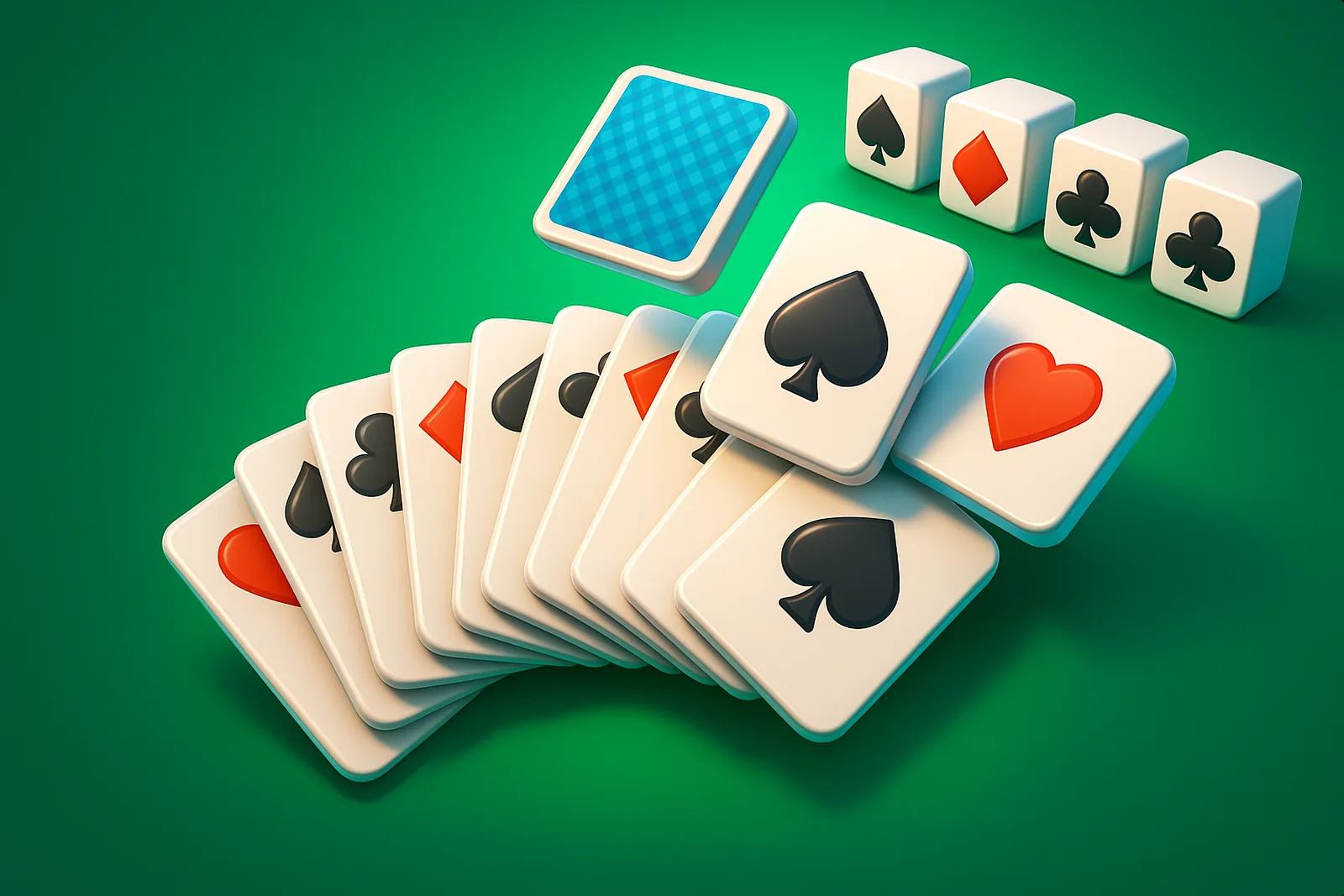
Solitaire did not begin as one neat invention. It grew from European card play in the late 1700s, first under names linked to patience, then spread through printed rule books, parlours, soldiers’ quarters and, much later, home computers.
The history of solitaire is awkward because people played it before people carefully recorded it. The rules moved by habit as much as by print. Families changed redeal rules. Publishers renamed games. The same layout could have different names on different sides of the Atlantic. Some origin stories are useful; some are charming rubbish.
The best-recorded modern form is Klondike: 7 tableau piles, 4 foundations, a stock, a waste pile, and alternating colours built downward in the tableau. One-card draw is the gentler household version. Three-card draw is the stricter one. Both belong to a much older patience card game history, but neither can honestly be called the original solitaire.
Where did solitaire come from, and why did people start playing it alone?
The solitaire origin is best placed in Europe in the late 18th century, though the exact first game is not pinned down. Playing cards had been in Europe since the late 1300s, but games for one player appear much later in the written record. By the 1780s, German-language sources were describing patience-style card games, and French and English rule books followed in the 19th century.
The reason people started playing alone is probably less romantic than the usual stories suggest. A pack of cards is cheap, portable and complete. You do not need a table of four. You do not need stakes. You do not even need another person awake in the house.
Solitaire also suited the social habits of the period. Parlour games mattered. So did quiet accomplishments. A one-player card layout let someone pass time, practise attention, and enjoy a small contest without gambling openly. It could be played by a traveller, a servant on a break, an officer between duties, or a person at home after the rest of the room had lost interest.
There is a famous tale that Napoleon played solitaire during exile. Treat that as the usual story, unverified. Napoleon did play cards, and patience games were known in Europe around that era, but the neat image of the emperor brooding over a layout is folklore unless tied to a specific source. The broader fact is safer: by the 19th century, one-player card games had become visible enough to be collected, named and taught in books.
Why do historians call it a patience card game?
Historians use “patience” because that was the common European name for many one-player card games before “solitaire” became the dominant word in American English. The term describes the manner of play more than a single rule set. You lay cards out, wait for openings, and accept that the deck will not always give you what you need.
That does not mean all patience games are slow or gentle. Some are almost mechanical. Some are harsh. Forty Thieves, for example, gives the player a very different problem from Klondike. FreeCell later showed how much skill could matter when the whole position is visible. The family name covers a method: one player arranging a standard deck, or sometimes 2 decks, by fixed rules toward a target pattern.
The patience card game history is also a history of print. Once publishers began collecting these games, names stuck more firmly. Before that, a household rule could live for years without a formal title.
- Patience is the older British and European word for the family.
- Solitaire became the normal American word for card patience.
- A solitaire can mean one specific layout, not the whole family.
- Patiences in older books usually means a collection of separate games.
That is why a Klondike history cannot stand in for the whole patience card game history.
What do we actually know about the name 'solitaire'?
- The word is French in origin. “Solitaire” means solitary or alone. That part is straightforward, and it fits a one-player game neatly.
- It did not first belong only to card games. The word was also used for other solitary pastimes, including the board puzzle now often called peg solitaire. That older overlap can confuse the record.
- British English kept “patience”. In Britain, people traditionally played patience. In the United States, people more often played solitaire. Both names can describe the same card layout.
- Card-game books helped fix the vocabulary. During the 19th century, printed collections grouped one-player card games under patience or solitaire, depending on audience and publisher. The titles did not always agree.
- The Napoleon link is not proof of the name. The usual story, unverified, says Napoleon played solitaire in exile. Even if he played patience games, that would not prove where the name came from or which rules he used.
- Modern usage narrowed the word. On computers and phones, “solitaire” often means Klondike unless another version is named. Historically, that is a shortcut. Useful, but not precise.
How did the game people play now become the familiar Klondike form?
The familiar form is Klondike: 7 tableau piles dealt from left to right, with only the top card of each pile face up, and 4 foundations built upward by suit from aces to kings. Tableau cards build downward in alternating colours. Empty spaces take kings, under the usual rules. That structure is what most people now picture when they hear “solitaire”.
Klondike was not the only candidate. Patience books carried many layouts, and different countries favoured different names. Some games use all cards face up. Some use 2 decks. Some, like Pyramid Solitaire or Golf Solitaire, ask the player to remove cards rather than build foundations. Klondike won attention because it balances luck, hidden information and small decisions in a way that is easy to teach from memory.
The name “Klondike” is usually linked to the Klondike Gold Rush of 1896 to 1899 in north-western Canada. That connection makes sense: the game’s name appears to echo the period’s hunger for gold, risk and waiting. Still, the strongest version of that tale is often repeated more confidently than the evidence deserves. The gold-rush link is plausible; the exact moment of naming is harder to prove.
Computer software changed Klondike’s reach in the 20th century. Rule books had already spread Klondike, but computers made one version feel official. Microsoft included Solitaire with Windows 3.0 in 1990, using Klondike as the default form people met at work and at home. The program also taught mouse use by accident: dragging, clicking and releasing cards became ordinary gestures. A pastime once passed through parlours and books became a standard screen habit.
Why did the one-card draw version beat other household rules?
One-card draw did not beat every other rule everywhere, but it became the friendliest default for casual play. It reduces the punishment for a missed move and makes the waste pile easier to read. Three-card draw remains a proper Klondike rule, just a sharper one.
| Rule choice | What it changes | Why a player cares |
|---|---|---|
| Draw 1 from the stock | Every stock card becomes available in order | More positions can be rescued, so a short session feels fairer |
| Draw 3 from the stock | Only every third exposed card is immediately playable | Planning matters more, and blocked cards stay blocked longer |
| Unlimited redeals | The stock can be recycled without a hard cap | The player can explore the position rather than lose to a single pass |
| Limited redeals | The number of stock passes is fixed | Each waste-pile decision carries more weight |
| Undo allowed | Moves can be tested and reversed | The game becomes a puzzle as well as a gamble with hidden cards |
The one-card version also suits screens. A player can understand the next action instantly: turn a card, move it if possible, keep going. Three-card draw asks the player to remember the waste order and think about future passes. That is satisfying for many players, but it is a worse first lesson.
Frequently asked questions
Mostly. In British English, patience is the older everyday word for one-player card games; in American English, solitaire became the usual word. The two overlap heavily, though solitaire can also mean a board game with pegs. If someone says patience in a card context, they almost always mean a solo card game.
52 cards are used in classic Klondike Solitaire: one standard deck, no jokers. The tableau starts with seven columns, the foundations build by suit from ace to king, and the remaining cards form the stock. Klondike Solitaire (Turn 1) draws one card at a time from that stock, which makes it easier to inspect and plan than three-card draw.
The common misconception is that solitaire began as a computer time-waster. The correction is older and more interesting: people were playing patience-style card games long before home computers. Computers changed the scale. They removed shuffling, scoring arguments, missing cards, and setup time, so a game that already suited quiet spare minutes became much easier to start.
You uncover a black 6 under a face-down card, with a red 7 open in another column and a red 5 waiting in the waste. One move opens a hidden card; another merely tidies the board. That choice is the puzzle. Luck gives you the deal, but skill decides which unknowns you expose first and which options you keep alive.
It depends on the draw rule and how much hidden information remains. A one-card draw gives you more access to the stock, so choices in the tableau matter more often. Hidden cards still decide plenty of games. Good play improves your chances by revealing cards, preserving empty columns, and avoiding dead ends, but no skill can make every Klondike deal winnable.
Compared with FreeCell, Klondike hides more information and gives luck a larger role. FreeCell begins with every card visible, so the game feels like an open logic problem. Klondike begins with buried cards, so each reveal changes the position. That uncertainty is why a short Klondike Solitaire (Turn 1) deal can feel dramatic after only a few moves.
Build foundations when the move cannot damage your tableau. The exception is when a low card still helps you move cards between columns, especially early in the deal. Sending a red 5 up too soon may block a black 4 that needs to shift later. Foundation moves are safe when they clear space or cannot remove a useful landing card.
Most people move the obvious card instead of the card that reveals information. Clearing a face-up 9 may look tidy, but turning over a hidden card is usually worth more. Another common mistake is filling an empty column too quickly. Empty columns are powerful because only kings can start them, so spending one on a weak king can trap better sequences later.
A tableau is the working area of the game: the columns where you build descending, alternating-colour runs in Klondike. It is separate from the stock, waste, and foundations. In classic Klondike there are seven tableau columns. Most of your real decisions happen there, because tableau moves reveal hidden cards and create the space needed to move kings and long sequences.
Look for moves that uncover face-down cards before you cycle through the stock. Play aces and twos when they are clearly useful, but do not empty a column unless you have a king ready or a strong reason to wait. In Klondike Solitaire (Turn 1), use undo to compare close choices; it teaches faster than guessing and replaying the whole deal.
Nobody knows precisely, because house rules, draw rules, redeals, and the amount of information allowed all change the answer. The best available computer figure for standard Klondike under complete-information analysis is around 8 deals in 10 being solvable. Actual human win rates are lower, because players do not know the buried cards and can make irreversible mistakes.
Microsoft included Solitaire with Windows 3.0 in 1990. That did not invent the game, but it put Klondike in front of millions of office and home computer users. It also taught mouse control by stealth: drag cards, double-click, release. For many players, the Windows version fixed what “solitaire” looked like more firmly than any printed rulebook.
The cost of getting it wrong is space. In Klondike, empty columns are scarce, and only kings can occupy them. If you use one for a king with no useful run beneath it, you may block a better king later and lose the chance to move a whole sequence. Waiting is often stronger than filling the gap immediately.
Final thoughts
The nicest thing about solitaire is that it has never quite belonged to experts. Books named it, software standardised it, and historians can trace parts of it, but most of its life happened at ordinary tables. Someone learned a layout from an aunt. Someone changed the redeal rule because the old one felt mean. Someone called every version “patience” and never cared what a publisher called it.
That looseness is not a flaw in the history. It is the reason the game survived. A rigid game needs a rule book nearby. Solitaire only needs a pack, a flat surface and the memory of what comes next. The rest can be argued over after the hand is lost.
If you play Klondike now, especially with one-card draw, you are playing a softened modern heir to a broad family of patience games. It is easier to finish than many older or stricter forms. It is also still recognisably the same private bargain: you accept the deal you are given, look for order in it, and decide whether the next face-down card is worth chasing.
-
Card Games
What Do Tableau, Foundation and Stock Actually Mean?
A plain-English solitaire glossary for Klondike, covering tableau, foundation, stock, setup, turn order, winning and getting stuck.
19 August 2026
-
 Card Games
Blackjack vs Video Poker: The Two Lowest House Edges
Video poker wins only with the right full-pay machine and perfect play; for most real seats, fair 3:2 blackjack is the cleaner low-edge choice.
18 August 2026
Card Games
Blackjack vs Video Poker: The Two Lowest House Edges
Video poker wins only with the right full-pay machine and perfect play; for most real seats, fair 3:2 blackjack is the cleaner low-edge choice.
18 August 2026
-
 Card Games
 You Can Finish in Five Minutes
A practical guide to quick card games, matching fast solitaire and blackjack choices to the kind of break you actually have.
18 August 2026
Card Games
Card Games You Can Finish in Five Minutes
A practical guide to quick card games, matching fast solitaire and blackjack choices to the kind of break you actually have.
18 August 2026