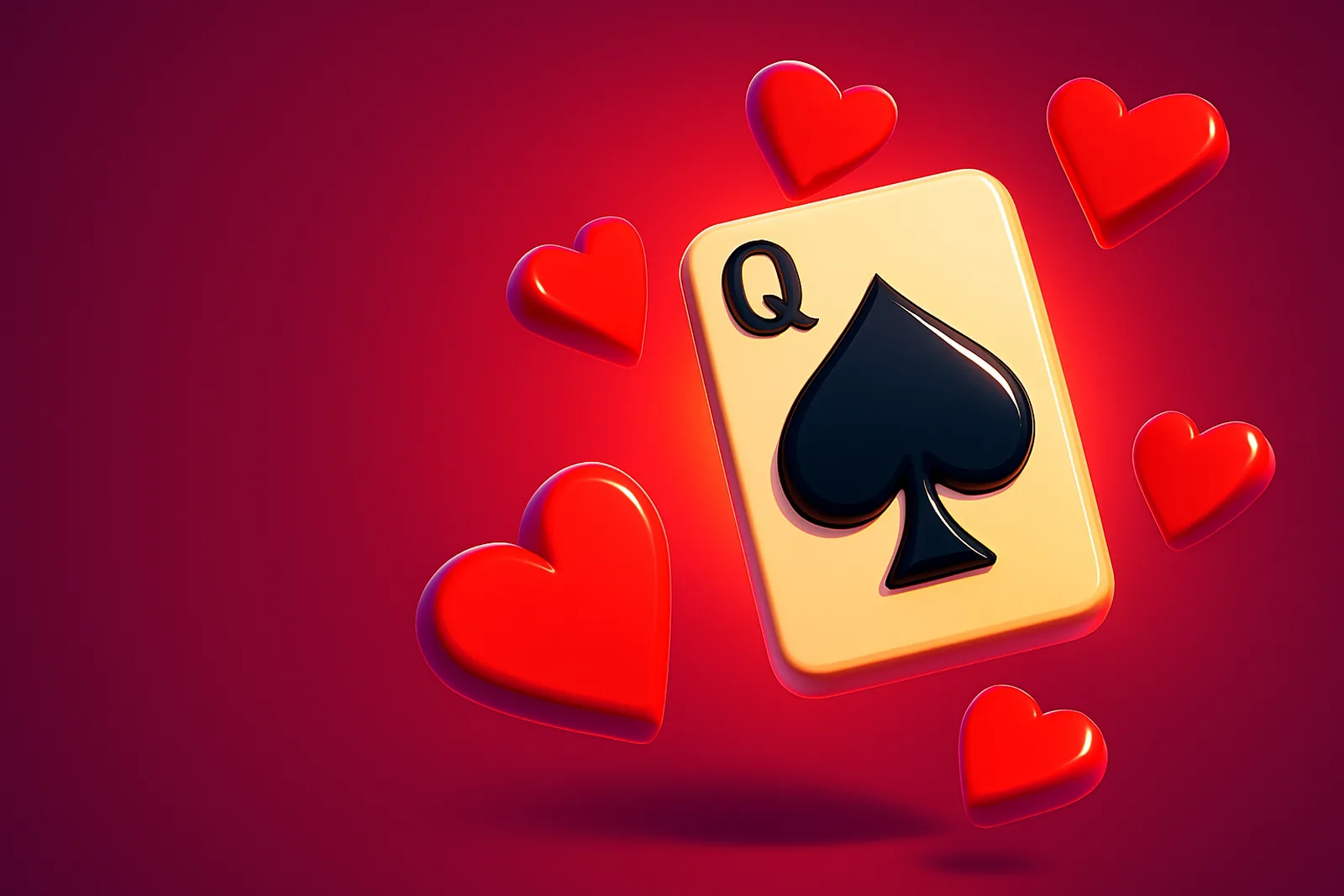
The queen of spades is feared because modern Hearts gives it 13 penalty points, the same weight as all the hearts put together. That single black card can turn a careful hand into a losing one, unless you dump it safely or use it while shooting the moon.
That was not always the game. Early Hearts was mainly about avoiding hearts. The queen of spades arrived through later variants usually called Black Lady, with Black Maria used in Britain and elsewhere for closely related forms. The records are clear enough on the broad movement, but thin on the exact first table that made the queen dangerous.
The useful story is not a grand origin myth. It is a practical change to a trick-taking game. Players already understood that low score was good, tricks could be traps, and suits mattered. Then someone made one spade worth 13 penalty points. One card could now swing the hand.
Why is the queen of spades the card everybody fears in Hearts?
The queen of spades matters because Hearts is a low-score game and she carries a heavy penalty. In the common modern form, each heart is worth one penalty point. The queen of spades is worth 13. Take her in a trick and you have collected the same damage as taking every heart in the deck.
That changes how the whole hand feels. A low spade can be safe early, then suddenly dangerous once higher spades have been drawn. Holding the ace or king of spades can feel like holding a lit match, because if the queen has not appeared, you may be forced to win her. A player short in spades may wait to throw her onto somebody else’s trick. Everyone watches that suit.
The card also matters because of the moon shot. If one player takes all the penalty cards, they shoot the moon, so the queen of spades can be either poison or cargo. In one hand you are desperate to avoid her. In another you may need her, because a moon attempt fails if someone else captures even one penalty card.
The queen of spades matters before she is played. It names the card that gives the game its bite. Hearts without the queen is still a clever avoidance game. Hearts with her becomes a game of timing, memory and nerve.
Where did the black lady in Hearts come from?
The black lady in Hearts is the queen of spades, and the name is plain enough: she is a queen from a black suit. The history behind her entry into the game is less tidy. No printed source I would trust identifies the first player, club or town that decided she should be worth 13 penalty points.
The older game is easier to place. Hearts appears in American card-game writing in the late nineteenth century. The Standard Hoyle of 1887 said the game had been played in the United States for about five years and reported, cautiously, that it was thought to be of German origin. In that early shape, the point of the game was to avoid taking hearts.
Black Lady is the later variant that made the queen of spades a major penalty card. That change was neat because it did not require new equipment or a new structure. The same deck, the same tricks, the same aim of avoiding points. One card simply became terrifying.
The evidence is thin on exactly when table talk hardened into the name Black Lady Hearts. It is safer to say that Black Lady describes the queen-of-spades version of Hearts, rather than pretending we know the person who coined it. Folklore gives card games colour. Rule books give them dates.
How did Hearts turn into the version people play now?
Hearts changed by addition rather than replacement. The old avoidance idea stayed: follow suit when you can, take tricks when you must, and keep penalty cards out of your pile. The penalties became more dramatic as the queen of spades was added, passing became common, and shooting the moon gave greedy courage a reason to exist.
- Early recorded Hearts: by 1887 it was known in the United States as a trick-taking avoidance game. The central burden was hearts. The usual aim was still simple: finish with fewer penalty points than the others.
- Black Lady: the queen of spades became the black lady, normally worth 13 penalty points. This made spade management as important as heart avoidance, because a clean-looking trick could suddenly carry the worst card in the game.
- Passing: many modern tables pass cards before play. A familiar four-hand cycle is left, right, across, then no pass. Passing gives players a way to shed danger, load an opponent, or prepare a moon shot.
- Shooting the moon: the game stopped being only about ducking points. A player who takes every penalty card can turn disaster into an attack on the whole table, depending on the house scoring rule.
The old game asked you to duck damage; the later game also asks you to place it. Modern Hearts is still recognisably the old game, but the queen, passing and moon shot make it less passive. You are not only avoiding bad cards. You are shaping who gets stuck with them.
Why do people call it Black Maria, and is that the same game?
- Black Maria is a related name, not a single fixed rulebook. In many card-game references it means a Hearts-family game in which the queen of spades is the feared card. The black maria card game can therefore look very close to Black Lady Hearts.
- The name probably came from outside cards. Black Maria was a nickname for a dark police van or prison van. The usual story, unverified, links the expression to Maria Lee, a large and formidable lodging-house keeper in nineteenth-century Boston who helped police deal with unruly prisoners. Treat that as folklore, not proof.
- British usage matters. Black Maria is especially associated with British card play, while Black Lady is a common label for the queen-of-spades form of Hearts. Players have not used the names with laboratory precision.
- Rules can differ. Some Black Maria tables add extra penalty cards or alter the deal for the number of players. Others are effectively the modern queen-of-spades Hearts most people recognise.
- The safe answer is this: Black Maria and Black Lady are close relatives. If someone invites you to Black Maria, ask the penalties before the first deal. The queen will almost certainly be bad news.
What changed from old Hearts tables to the browser game on Veena Games?
The largest change is not the aim of the hand. The danger is still hearts plus the queen of spades. What changed is the table around the game: how quickly you can sit down, how rules are applied, and how much arithmetic sits between hands.
| Decision point | Old card table | Browser game on Veena Games |
|---|---|---|
| Finding players | You needed a physical deck and enough people ready to play a four-handed trick-taking game. | You play as one seat against three opponents, so the table is already filled. |
| Rule agreement | Players had to settle house rules before the deal: passing, moon scoring, and any Black Maria extras. | The game presents one consistent Hearts rule set centred on hearts, the queen of spades, and shooting the moon. |
| Handling the deal | Someone shuffled, dealt, gathered tricks, and checked whose turn it was after every trick. | The browser handles the deal and flow of play, leaving the decisions on which card to part with. |
| Scoring pressure | Players counted penalty cards by hand, which made mistakes possible after messy or talkative hands. | The score follows the result of the hand, so attention stays on avoiding the queen and reading the suits. |
| Variant drift | Black Lady, Black Maria and local Hearts rules could blur from table to table. | The experience is the modern Hearts shape: duck hearts, dodge the queen, or take the lot. |
Frequently asked questions
Usually. The queen adds 13 penalty points, while each heart adds 1. In a normal defensive hand, taking her is the single biggest mistake you can make. She stops being worst only when someone is trying to shoot the moon, because then the queen is part of the full 26-point sweep rather than a disaster by itself.
13 points is the value of the queen of spades. That is half the penalty available in one hand, because the 13 hearts are worth 1 point each and the queen is worth 13. This is why players track her so closely. One wrong trick can do as much damage as collecting every heart in the pack.
The common misconception is that passing the queen makes the problem disappear. The correction is harsher: it only moves the problem to another seat. If you pass her left, that player may still be able to force her back onto you with spades. Passing helps most when you also remove the cards that would trap you later.
Say your spades are queen, seven, and two. That is a dangerous holding because the ace and king can pull your low spades away, leaving the queen exposed. If you can pass her, do it. If you cannot, watch the first spade tricks carefully and look for a safe discard before spades are led a third time.
It depends on your spade length, your high cards, and the score. Keeping the queen can work if you have several low spades and can wait until another player is void. It is reckless if you hold queen-small-small, or if the ace and king are still live and you have no escape suits.
Compared with Hearts (No Passing), ordinary Hearts gives you one chance to send the queen away before play starts. In Hearts (No Passing), you must manage the hand you are dealt. That makes short spade holdings more awkward and long spade holdings more valuable. The queen is still worth 13 either way, but the route out is narrower.
The short rule is: follow suit if you can. Hearts being broken usually controls when hearts may be led, not whether the queen of spades can appear as a discard. The exception is the opening trick if the table uses a no-points-first-trick rule. Then the queen may be held back by rule, not by choice.
Most people do wrong by treating every high card as an equal threat. The ace of clubs and the king of diamonds can be annoying, but the queen of spades changes the hand. If you spend your safe exits too soon, you may have no harmless card left when spades are led and the queen is waiting.
The black lady is a nickname for the queen of spades. It refers to the card itself, not to a special power beyond the usual 13 penalty points. You will also see older names such as Black Maria connected with games that make the queen of spades the central danger.
Count spades from the first trick. Notice whether the ace and king have gone. Keep at least one low spade if you need protection, and try to create a void in another suit so you can discard safely. Do not win a trick in spades unless you know the queen has already been played or cannot be dropped on you.
Nobody knows precisely which table first did it. The best available figure is around 1909 for printed references to Black Lady, the Hearts form that made the queen of spades a 13-point penalty. The idea may have circulated before it reached rule books, as card-game changes often did.
Historical fact: early Hearts rules centred on hearts as the penalty suit. The queen of spades came later through Black Lady and related forms. That change made the game sharper because one card could suddenly outweigh a whole run of small mistakes. It also made spade-counting as important as avoiding hearts.
Getting it wrong costs 13 points at once, and it can cost more if the same trick also contains hearts. The real damage is often positional. Once you take the queen, you may be forced to lead next, lose control of the suit order, and help another player finish a moon attempt.
Final thoughts
The queen of spades works as game design because she is not complicated. A new player understands her in one hand. Take this card and your score hurts. After that, the game keeps revealing extra layers: who is void in spades, who still holds the king, who is pretending to be weak, who is quietly collecting every penalty card on purpose.
That is also why the history feels right even where the evidence thins out. Card games change at tables, not in committees. Someone tries a harsher penalty. Someone gives it a nickname. A local habit crosses a city, then an ocean, then a rule book. By the time anybody writes it down, the players already think it has always been that way.
If you want to play better Hearts, do not treat the queen as a random accident. Count spades when you can. Notice who passed what kind of cards. Ask why a player led a suit, not only whether the move helped them this second. The black lady is frightening because she is visible before she arrives. Most bad tricks announce themselves early. The skill is hearing them.
-
 Hearts
Omnibus Hearts vs Standard: The Ten of Diamonds Problem
Omnibus Hearts suits players who want a chase card; standard Hearts suits players who prefer clean avoidance and sterner punishment.
19 August 2026
Hearts
Omnibus Hearts vs Standard: The Ten of Diamonds Problem
Omnibus Hearts suits players who want a chase card; standard Hearts suits players who prefer clean avoidance and sterner punishment.
19 August 2026
-
 Hearts
Short Hearts: The Quick-Round Variant
Short Hearts is ordinary four-player Hearts played to 50 points, so the same decisions arrive in fewer hands.
19 August 2026
Hearts
Short Hearts: The Quick-Round Variant
Short Hearts is ordinary four-player Hearts played to 50 points, so the same decisions arrive in fewer hands.
19 August 2026
-
 Hearts
Spot Hearts: When Every Heart Has Its Own Price
Spot Hearts removes the queen of spades penalty, so every hand is a fight over the thirteen hearts and the lowest score wins.
19 August 2026
Hearts
Spot Hearts: When Every Heart Has Its Own Price
Spot Hearts removes the queen of spades penalty, so every hand is a fight over the thirteen hearts and the lowest score wins.
19 August 2026