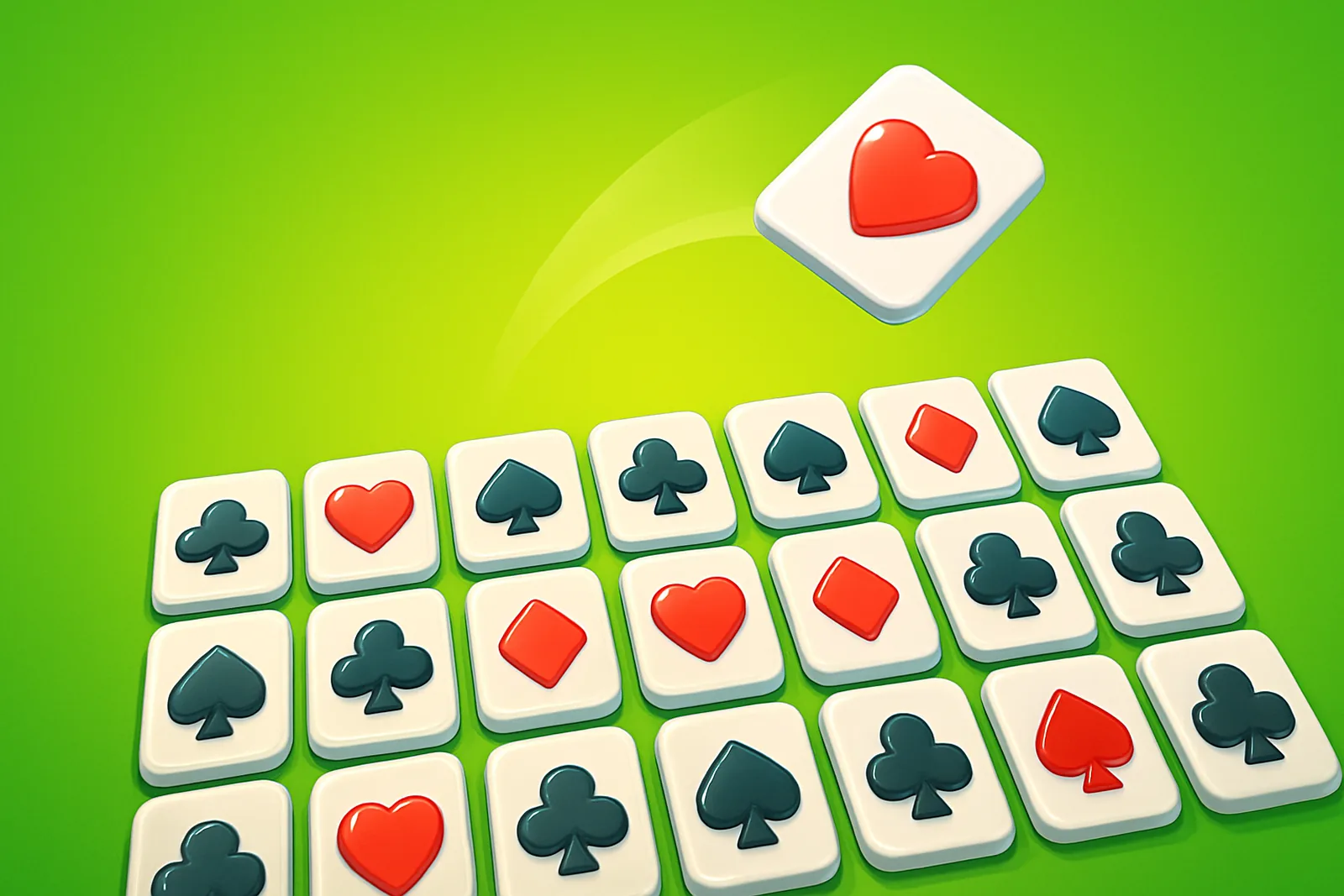
Golf Solitaire is a 1-player card game where you clear 35 tableau cards by moving available cards onto a waste pile if they are exactly one rank higher or lower. Suits do not matter. Low scores win.
The game is easier to start than Klondike Solitaire (Turn 1), but it punishes casual clicking. You see all the tableau cards, so the puzzle is not about hidden information. It is about order. Playing the obvious card now can block the card you need two moves later, and spending the stock too quickly leaves you with no rescue when the chain breaks.
Start with the sequence you meet at the table: know the waste card, check the exposed tableau cards, choose a legal rank, and spend the stock only when the run has stopped. If you came looking for golf solitaire rules rather than a history lesson, the key idea is this: build a run from the waste pile, use the stock only when the run stops, and aim to leave as few tableau cards as possible.
What are the actual golf solitaire rules?
Golf Solitaire is played by 1 player with a standard 52-card deck. The aim is to remove every card from the tableau. You do that by playing available tableau cards onto the waste pile when the rank is exactly one step higher or one step lower than the current waste card.
Ranks matter. Suits and colours do not. If the waste card is a 7, you may play any available 6 or any available 8. If the waste card is a queen, you may play a jack or a king. In the usual Golf Solitaire rules used here, ranks do not wrap round: an ace is next to a 2, and a king is next to a queen, but an ace and a king are not neighbours.
Only available tableau cards can be played. In the dealt layout, cards overlap in columns, so a card is available only when no other tableau card is covering it. You cannot move cards between tableau columns. You cannot place a tableau card into an empty space. Every useful move goes to the waste pile.
The stock is your reserve. When you cannot, or choose not to, play from the tableau, you turn the next stock card onto the waste pile. That new waste card gives you a fresh rank to build from. The skill is not learning a long rulebook. It is deciding which legal move keeps the next legal move alive.
How is the layout set up before the first move?
Start with a shuffled 52-card deck. Deal 7 tableau columns, with 5 cards in each column. That makes 35 tableau cards. The cards are face up, usually overlapped so that each column has a front card and 4 cards behind it. The front card in each column is available at the start.
The remaining 17 cards form the stock. Before play begins, turn the top stock card face up to start the waste pile. That leaves 16 cards in the stock for later. The waste card is the card you build on; it sets the first legal ranks you may play from the tableau.
Nothing is hidden in the tableau. You can see the whole problem from the first move, although not every card can be used yet. A buried 9 might be visible, but it is still unavailable until the cards in front of it have been removed. That is why the opening position matters. Two playable cards may both be legal, yet only one opens a column you need.
The layout also explains the name. Like golf, the game rewards a low score rather than a high one. A perfect deal ends with no tableau cards left. A rough deal ends with several cards stranded because the stock ran out before the right ranks appeared.
What do you do on each turn?
- Look at the waste card. Its rank decides your legal moves. From a 10, you may play an available 9 or jack. From a 3, you may play an available 2 or 4.
- Check the available tableau cards. At the start, that normally means the front card of each of the 7 columns. Later, new cards become available as you clear the cards covering them.
- Play one legal tableau card to the waste pile. Put it on top of the waste. It becomes the new waste card, so the next legal ranks change at once. A 6 played on a 7 now invites a 5 or 7.
- Keep the run going if you can. One turn may clear several cards in a row without using the stock. The order matters because each played card changes the next target.
- Turn a stock card when the run stops. If no available tableau card is one rank away, turn the next stock card onto the waste. You may also choose to use the stock instead of taking a legal move, but doing so spends a limited card.
- Never move cards between tableau columns. Golf Solitaire is not Klondike Solitaire (Turn 3). There are no builds in the tableau, no suit piles, and no empty-column tactics.
What ends a game, and how is scoring counted?
A game ends in one of two ways. The good ending is simple: you clear all 35 tableau cards. That is a win, and your score is 0 because no tableau cards remain. The other ending arrives when the stock is empty and no available tableau card can be played onto the waste pile.
Scoring is counted by the number of tableau cards left at the end. Each remaining tableau card is 1 point. Low scores are better, which is the golf part of Golf Solitaire. Stock cards left over do not add points in this scoring method; the score is about how much of the board you failed to clear.
| Situation | What it means for the game | Score effect |
|---|---|---|
| All tableau cards cleared | The game is won immediately | 0 points |
| Stock still has cards | You may turn another stock card if needed | No score yet |
| Stock empty, legal tableau move exists | Play may continue from the current waste card | No score yet |
| Stock empty, no legal tableau move | The game is over | 1 point per tableau card left |
This scoring is blunt, which is useful. You do not need a calculator or a bonus chart. If 6 tableau cards remain, the score is 6. If 1 card remains, the score is 1, and it will probably annoy you more than a loss with 12 left.
Why do people keep playing after they know the rules?
The rules take a few minutes. The judgement takes longer. Golf Solitaire keeps its pull because every turn asks a small, exact question: should you take the safe card now, or leave it as a bridge to a better run later?
There is enough luck to keep the game brisk. The stock may hand you the rank you need, or it may strand a whole side of the tableau. But the open layout means you can see many of your mistakes before they happen. If two legal cards are available, one may expose a dead end while the other opens three more ranks. That is not a grand strategy speech. It is one click.
Compared with Pyramid Solitaire, Golf Solitaire has less arithmetic and more rhythm. Compared with TriPeaks Solitaire, the board is plainer and the punishment for wasting the stock can feel sharper. Compared with FreeCell, it is far shorter and more vulnerable to the shuffle. Those differences are why it suits a spare 5 minutes without feeling like a coin toss.
The best rounds have a pleasing snap to them: queen, jack, 10, 9, 8, then a stock card that lands exactly where your next column needs it. The bad rounds are quick enough to forgive.
Frequently asked questions
No. Suits are ignored because Golf Solitaire is about rank, not suit or colour. If the waste card is a 7, any 6 or 8 that is currently playable can go on it. Hearts, clubs, spades and diamonds make no difference. This is why one good rank chain can clear several tableau cards quickly.
2 moves is the minimum worth checking before you click. Look at the card you can play now, then ask what it leaves you next. If playing a 9 onto an 8 exposes no follow-up, but playing a 7 lets you continue to 6 and 5, the second line is usually stronger. Long chains save stock cards.
The common misconception is that the longest visible run is always best; the correction is that the best run is the one that leaves useful ranks behind. A flashy chain can burn through all your 6s and 7s, then leave a block of queens untouched. Prefer a line that clears awkward ranks or opens more choices, even if it is shorter.
Waste 8, exposed tableau cards 7, 9, 6, 10, 4, jack, king: taking 7 may be better than taking 9 if it lets you continue 6 next. Taking 9 may be better if it leads to 10 and jack. The good move is not the first legal move. It is the one that turns one card into several.
It depends on the ranks showing: a cleared column is only valuable if the move that clears it does not strand the rest of the board. If the last card in a column is a queen and you have kings and jacks waiting, clear it. If clearing it spends your only connector between low and high cards, keep the connector alive.
Compared with TriPeaks Solitaire, Golf Solitaire feels more direct because the job is usually one clear chain from the waste through the tableau. TriPeaks Solitaire has a different rhythm, with overlapping peaks and new cards becoming available as you clear lower ones. Neither is always easier. Golf Solitaire punishes wasted stock cards very quickly.
Play adjacent ranks; the exception is wraparound, which only applies if the version you are playing allows it. Many Golf Solitaire games treat ace and king as not connected, so ace only meets 2 and king only meets queen. Do not plan a rescue line through king to ace unless the game has already shown that move is legal.
Most people draw from the stock as soon as they dislike the visible moves. That is expensive. A stock card is a fresh chance, but it also discards the old waste card and may break a possible chain. Before drawing, check both directions from the current waste card and look for a move that creates another move.
The waste pile is the active pile you build on during the hand. The top waste card decides what ranks you may play from the tableau: one rank higher or one rank lower, subject to the game’s ace and king rule. Every tableau card you play becomes the new waste card, so the target changes after every move.
Pause before each stock draw and count the playable ranks from the waste card. Prefer moves that produce another move. Save flexible middle ranks, such as 6, 7, 8 and 9, when they connect two parts of the board. Do not chase one lonely card if it cuts off three others. Play a few fast hands, then slow down one hand deliberately.
Nobody knows precisely what counts as a good score across all Golf Solitaire sites, because scoring systems vary. The best available figure is 0 cards left in the tableau: a complete clear. If your score is based on remaining tableau cards, every card left is one step worse. Judge progress by how often you finish close to empty.
Golf Solitaire took its name from golf’s scoring idea: lower is better. The usual aim is not to collect points, but to finish with as little left behind as possible. That gives the game its odd name and its pressure. You can make plenty of legal moves and still score badly if those moves leave the board cluttered.
The cost of getting it wrong is usually a dead end, not one bad move. Drawing too early changes the waste card and may throw away the exact rank that connected half the tableau. Once the stock is gone, there is no reserve plan. Treat each draw as a limited resource, because it is the only way to change a stuck waste card.
Final thoughts
For a first few games, resist the urge to play every legal card as soon as it appears. Golf Solitaire looks like a speed game because the moves are so simple, but the good decisions are often about waiting. A playable 5 might be the only way back to a 6 later. Spend it now and the column behind it may never open.
I would start by watching columns rather than ranks. If one column has only 2 cards left and another has 5, clearing the short one can still matter because it removes a blocker and reduces the final score. But a longer column may hide the card that lets the whole board move. The visible tableau gives you enough information to make a real choice, not perfect knowledge of the stock.
Do not treat every loss as a mistake. Some deals are mean. The useful question after a bad round is narrower: did you burn the stock when a tableau move was available, or did you take a move that killed the next two? If yes, you found something to improve. If no, shuffle again. The game is at its best when you care about 1 card, then let it go.
-
 Pyramid
 Solitaire Rules: Pairs That Make Thirteen
Pyramid Solitaire is a one-player card game where you clear a 28-card pyramid by removing kings and pairs that make thirteen.
14 August 2026
Pyramid
Pyramid Solitaire Rules: Pairs That Make Thirteen
Pyramid Solitaire is a one-player card game where you clear a 28-card pyramid by removing kings and pairs that make thirteen.
14 August 2026
-
 Pyramid
TriPeaks Rules: One Up or One Down
A plain guide to TriPeaks rules: the 28-card layout, legal one-up-or-one-down moves, stock draws, wins, losses, and streak scoring.
14 August 2026
Pyramid
TriPeaks Rules: One Up or One Down
A plain guide to TriPeaks rules: the 28-card layout, legal one-up-or-one-down moves, stock draws, wins, losses, and streak scoring.
14 August 2026
-
Pyramid
Golf Solitaire: Why the Last Card Decides Everything
Practical Golf Solitaire heuristics for repeat players who want clearer first moves, fewer dead piles, and better endgame judgement.
12 August 2026