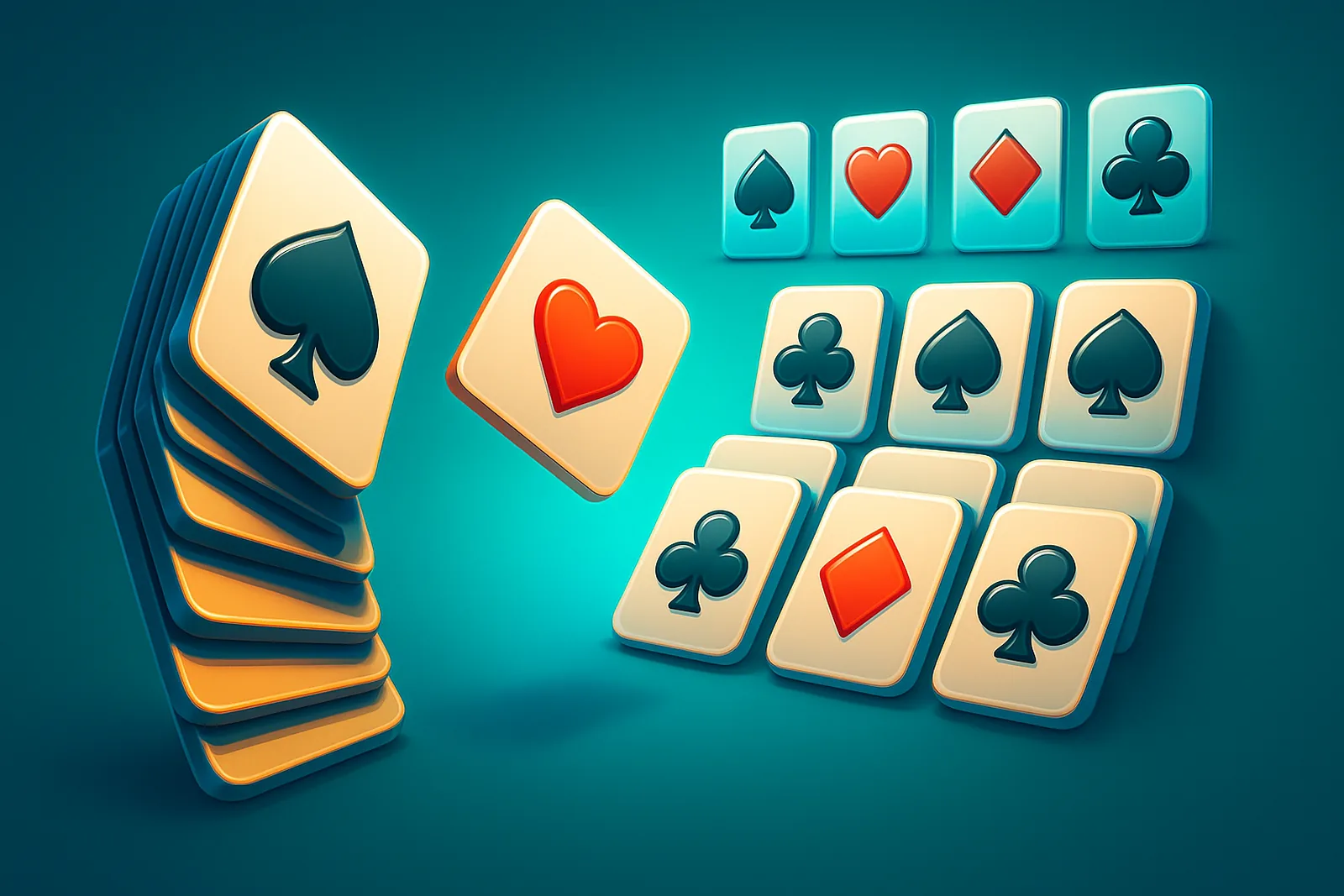
Canfield is harder than Klondike. Play Canfield when you want a tight, unforgiving puzzle; play Klondike when you want a fairer solitaire with more visible choices and a better chance to recover from a poor opening.
The confusion starts with names. Canfield is also known as Demon Patience, so demon patience vs klondike is usually the same argument as canfield vs klondike. They look related because both use foundations, tableau building, a stock, and alternating colours in the tableau. They do not feel the same after the first few moves.
Canfield Solitaire difficulty comes from pressure. A reserve pile sits there from the start, demanding attention and blocking information. The foundations do not begin with Aces; they begin on a random rank and wrap around. Klondike gives you a larger tableau and a more familiar rhythm: expose cards, free Aces, build foundations, open columns for Kings. Canfield asks you to survive before it lets you feel clever.
Which one is harder, and which should you play?
Canfield is the harder game. If you have ten spare minutes and want to feel in control, play Klondike. If you want a game that may punish a reasonable move five turns later, play Canfield.
The two games share enough furniture to mislead people. Each has a tableau, foundations, a stock, and a waste pile. Each builds tableau sequences in alternating colours, and each rewards you for clearing buried cards. The difference is where the pressure sits. Klondike gives you a spread of tableau columns and asks you to uncover hidden cards. Canfield gives you a reserve that must be drained, and it does not care whether the rest of the layout is ready.
That reserve changes the mood of every decision. A move that would be ordinary in Klondike can be dangerous in Canfield because it may block the rank or colour needed to release the top reserve card. Improving the tableau is only half of it; the queue still has to be managed.
Choose Klondike if you want a readable puzzle after work, a familiar flow, or a game where small improvements feel visible. Choose Canfield if you enjoy scarcity, awkward timing, and the feeling that the deal is leaning over your shoulder. For most players, Klondike is the better default. Canfield is the better test.
The honest evidence on exact win rates is thin because rule sets and software choices change the result. The direction is not thin. Canfield Solitaire difficulty is higher because the structure gives you fewer gentle ways out.
What actually makes Canfield so punishing?
Canfield punishes you because it starts with debt. The reserve is not a bonus pile. It is an obligation, and it usually contains cards you cannot inspect beyond the top card. Every time you clear a tableau space, the reserve wants to fill it. That sounds helpful until the card it supplies is the wrong rank, the wrong colour, or a card you needed to keep buried for later.
The foundations also begin on a random rank rather than on Aces. If the base rank is a 7, for example, each suit must build upward from 7 and wrap through King to Ace, then onwards. This makes early foundation play less automatic. In Klondike, an Ace is an obvious starting signal. In Canfield, a card may be foundation-ready only within a cycle you are still trying to organise.
The tableau is small, so temporary storage is scarce. You can easily reach a position where the next useful card is visible, but no legal move frees it. A pretty sequence can still be useless if it traps the one space needed to empty the reserve.
The old name Demon Patience fits. It is not difficult because the rules are obscure; it is difficult because they are cramped. Demon patience vs klondike is really a question of pressure against room. Canfield supplies pressure from move one.
How does Klondike give you more room to work?
Klondike gives you room in two ways: more tableau structure and clearer long-term landmarks. You start with seven tableau columns, and the job is easy to understand even when the deal is awkward. Turn hidden cards face up. Release Aces. Build foundations. Open spaces for Kings. None of that guarantees success, but it gives each decision a visible target.
The tableau in Klondike is wider than Canfield’s, so you can often move a sequence to expose a hidden card without immediately being forced to accept a bad replacement. Empty columns matter, but they do not always refill against your will. That extra column space lets you repair mistakes, especially in easier rule sets.
Klondike also has a more familiar foundation rhythm. Aces start foundations, then 2s, 3s, and so on by suit. You may still have to wait for the right card to appear, but the target is obvious. You rarely need to think about wrapping a suit through King and back to Ace.
Turn rules change the feel. Turn-one Klondike is gentler because every stock card becomes available in order. Turn-three Klondike is stricter because two useful cards can sit behind the visible one. Even then, Klondike usually feels more negotiable than Canfield because its main problem is hidden information, not a reserve pile applying constant pressure.
Canfield vs Klondike at a glance
| Decision point | Canfield | Klondike |
|---|---|---|
| Best first pick | Choose it when you want a severe puzzle with little spare space and fast consequences for weak timing. | Choose it when you want a familiar solitaire where steady uncovering often creates fresh options. |
| Main source of difficulty | The reserve controls tempo. You must clear it, but each released card can also clog the tableau. | Face-down tableau cards hide information. The challenge is exposing them without blocking future builds. |
| Foundation rhythm | Foundations start from a random rank and wrap, so early foundation moves are less automatic. | Foundations start with Aces, giving a clear ladder from low cards to Kings. |
| Recovery after a poor move | Recovery is limited because the small tableau and reserve can trap useful cards quickly. | Recovery is more plausible because a wider tableau can offer another column, sequence, or reveal. |
| Better mood match | Play for tension, discipline, and a short lesson in scarcity. | Play for rhythm, recognition, and a fairer sense of progress. |
Which game suits the mood, the time, and the odds?
For a normal break, choose Klondike. It teaches itself as you play, and it gives back enough visible progress to make a losing deal feel worth the time. If you want the classic solitaire feeling without too much friction, Klondike is the right answer.
For a sharper session, choose Canfield. It is better when you are alert, patient, and happy to lose quickly rather than drift through a soft game. Canfield is not the variant to play while half-watching something else. It asks for exact moves.
- Play Canfield when you want a compact puzzle, a harsher deal, and decisions that matter early.
- Play Klondike when you want a smoother game with more chances to uncover, reorganise, and recover.
- Pick Canfield over Klondike if you enjoy FreeCell-like discipline but still want the uncertainty of a stock.
- Pick Klondike over Canfield if you are teaching someone solitaire or returning after a long gap.
The odds are not clean enough to quote as one universal number. Different rule sets, stock passes, draw rules, and software handling all affect the result. What matters for play is the direction of difficulty. In canfield vs klondike, Canfield is the higher-friction game because its reserve and random foundation base shrink your safe choices.
If you are unsure, start with Klondike for one game, then move to Canfield while your head is still warm. The contrast is immediate: Klondike asks what you can uncover; Canfield asks what you can afford.
Frequently asked questions
Yes. Canfield Solitaire is worth trying because it teaches a different kind of patience: managing one forced reserve card instead of spreading decisions across seven tableau piles. If you enjoy Klondike Solitaire (Turn 1), expect fewer cosy moves and more deals where the right play is to wait, not tidy.
13 cards sit in the reserve at the start of classic Canfield Solitaire, and only the top one is playable. That is the pressure point. Those buried cards may be exactly what you need, but you cannot browse them, rearrange them, or choose a better one. You have to clear the reserve in order.
People often assume every solitaire game builds foundations from aces; Canfield Solitaire does not. Its first foundation card sets the base rank for all four suits. If the base is a 6, each foundation must begin with a 6, then climb through 7, 8, 9 and so on, wrapping after kings.
Your reserve top card is the 9 of hearts, the foundation base is 6, and no black 10 is open in the tableau. That 9 cannot move to a foundation until the 6, 7 and 8 of hearts have landed. It cannot move to the tableau either. Every card underneath it is now waiting.
It depends on stock access: if the stock order keeps feeding cards you cannot use, planning has very little room to breathe. When the waste gives you choices, skill matters. The better player protects tableau spaces, times foundation moves, and avoids burying the one card that could release the reserve.
FreeCell shows every card from the start and gives you storage cells, so failure usually feels traceable. Canfield Solitaire hides much of the deal and lets the reserve dictate tempo. You can still play well, but you are often solving around missing information rather than calculating a fully visible position.
Fill empty tableau spaces from the reserve. The exception is when the reserve is exhausted; then a space can be filled from the waste under the usual rules. Early on, an empty space is not a luxury slot. It is usually another way to expose the next reserve card.
Most people rush cards to the foundations because it feels like progress. In Canfield Solitaire, that can remove useful packing cards from the tableau. A black 8 on the foundation may look tidy, but it might have been the only landing place for a red 7 that would uncover the reserve.
The base card is the rank that starts every foundation. If the first foundation card is a queen, the other foundations must also start with queens when their suits appear. Building then continues upward in suit, wrapping from king to ace. It changes the whole rhythm of the game.
Look at the base rank first, then the reserve top card, then any empty tableau spaces. Ask which move releases a reserve card or creates a safe landing spot. Do not move a card just because it can move. In Canfield Solitaire, legal moves are common; useful moves are scarce.
Nobody knows precisely, because rulesets, redeals, interfaces and player choices change the answer. The old practical yardstick is about one win in thirty under traditional play. Computer analysis for a tightly specified version can produce very different figures, so treat any single percentage without rules attached as thin evidence.
Canfield takes its name from Richard A. Canfield, an American gambling-house owner associated with the game in the late nineteenth century. The casino link is why it is often described as classic casino patience. In Britain, the same family of game has also been known as Demon.
The cost is a jammed reserve. Klondike Solitaire (Turn 3) often rewards opening face-down tableau cards and cycling the stock with patience. Canfield Solitaire punishes the same tidy habits if they block the reserve or waste a rare space. You may make ten neat moves and still lose the only route forward.
Final thoughts
If a friend asked which one to play tonight, I would not give a balanced lecture. I would ask what kind of annoyance they wanted. Klondike annoys you by hiding the card you need. Canfield annoys you by showing you a problem and giving you nowhere tidy to put it.
That is why Canfield has a loyal audience. It feels mean in a clean way. You can see the shape of the trap, and sometimes you can wriggle out with one well-timed tableau move or one foundation card saved for later. Losing does not always feel mysterious. It feels earned by the deal, the rules, or a move you now wish you had delayed.
Klondike remains the better everyday game because it is generous with moments. A facedown card turns, an Ace appears, a King finally has a column, and the board breathes. Canfield gives fewer of those little releases, but the ones it gives land harder.
Keep both names straight at the table: Demon Patience is Canfield, and Klondike is the familiar wider game. Open Klondike when you want comfort. Open Canfield when you want the game to bare its teeth; it will not apologise for the bite.
-
 Canfield
Forty Thieves Strategy: Winning a Game Built to Beat You
A practical Forty Thieves strategy guide built around ordered choices, stock discipline, column priorities, and common traps that cost winnable deals.
15 August 2026
Canfield
Forty Thieves Strategy: Winning a Game Built to Beat You
A practical Forty Thieves strategy guide built around ordered choices, stock discipline, column priorities, and common traps that cost winnable deals.
15 August 2026
-
Canfield
Forty Thieves: The Two-Deck Game That Takes No Prisoners
Forty Thieves Solitaire uses two decks, ten columns and one pass through the stock, making every blocked card matter from the first deal.
14 August 2026
-
Canfield
How to Play Canfield, the Casino Solitaire
A clear guide to Canfield Solitaire rules, from the 13-card reserve and random foundation rank to legal moves, scoring, and why demon patience bites.
14 August 2026